

Scientifically, the migration of humans refers to the remarkable journey our ancestors made long ago to fill the earth. These migrations define our human story today. Early human migrations marked humankind’s steps as they ventured from their origins and spread across the globe.
The story of human origins is filled with the movement of populations from one region to another over thousands of years. These migrations shaped societies and cultures across continents.
Beginning possibly as early as 70,000 years ago, driven by environmental changes and the pursuit of new horizons, this epic journey saw our ancestors navigate challenges and pursue opportunities.
But how and when did Homo sapiens spread and become a global population?
Coupled with scientific insights and enriched by biblical narratives, this exploration will offer a comprehensive view of when, where, and how these migrations occurred.
What Is Human Migration?
Human migration is the movement of people from one location to another. This process has led to the development of communities, cultures, and civilizations throughout history. Migration includes not only physical relocation but also the exchange of ideas, technologies, and beliefs that occur as populations settle in new regions.
Scientists use three main ways to study the timeline and paths the earliest humans took when they migrated around the world. A brief look at these can give us a clearer picture of how researchers piece together the history of humans and how we came to exist across the globe.
First, researchers date the oldest human remains found in various regions. By plotting the findings on a world map, they can trace back to where humans first originated and the routes they possibly followed.
Second, archaeological artifacts from Homo sapiens (modern humans) are mapped according to their dates and locations. This mapping reveals not only where our ancestors lived but also their cultural and technological advancements.
Third, molecular anthropology examines similarities and differences in DNA sequences so scientists can map relationships among human groups. This method gives important insight into human migrations because it doesn’t require that physical evidence must be left behind.

Theories on the Migration of Humans
When we consider modern theories of human migration, the Out of Africa theory is the primary scientific explanation for humanity’s migration. This model, often referred to as the replacement model, suggests that humanity began roughly 150,000 to 200,000 years ago in Africa.
Then, around 50,000 to 70,000 years ago, humans first migrated from East Africa, reaching the Middle East, Europe, Asia, and eventually North and South America. This grand movement wasn’t just a journey of distance but also of replacement. As early humans ventured into new territories, they gradually replaced existing Neanderthal populations.
In full, this theory suggests a dynamic and transformative period in the history of humans, where our species spread and adapted to the different environments around the earth.
The Out of Africa theory lets us see how interconnected our past is and sets the stage for exploring the finer details of the story of our early ancestors.
How Does the Bible Support This Theory?
While the Out of Africa theory is primarily rooted in evolutionary science, it also aligns with several details in the Bible and in the human origins model we hold at Reasons to Believe.
This model suggests that humanity emerged recently from a single location—consistent with the biblical account of the Garden of Eden. The RTB model places the Garden of Eden at the bottom of the Persian Gulf today and may have extended into East Africa. This location fits well with the scientific understanding of early human migration.
In Genesis 10, after the flood, the Bible describes the spread of humanity from a central point. This idea mirrors the migration patterns hypothesized by scientists of movement from Africa to the Middle East and beyond. This surface-level connection between the Out of Africa model and biblical texts invites us to further consider how ancient Scriptures and modern science can complement each other.
Other Relevant Theories
For a wider view on the topic, let’s consider other migration theories, even if some have fallen out of favor. Considering other views helps to solidify our positioning and broaden our thinking.
One such theory is multiregionalism. This model suggests that modern humans evolved simultaneously in different regions of the world from earlier hominin populations. However, as our understanding of human genetics, the fossil record, and archaeology has deepened, anthropologists have largely set aside multiregionalism.
Another theory to consider is the assimilation model. This hypothesis suggests that as Homo sapiens moved out of Africa, they interbred with other hominin populations, such as Neanderthals and Denisovans, rather than entirely replacing them, modern humans and these ancient groups merged into a single population. It is clear that full assimilation didn’t happen. While it is true that modern humans interbred with Neanderthals and Denisovans, they remained distinct with only trace amounts of genetic material present in modern human DNA. (Genetic traces of these ancient groups found in modern human DNA).
Overall, growing evidence strongly supports a more singular origin that aligns with both the Out of Africa theory and the Bible.
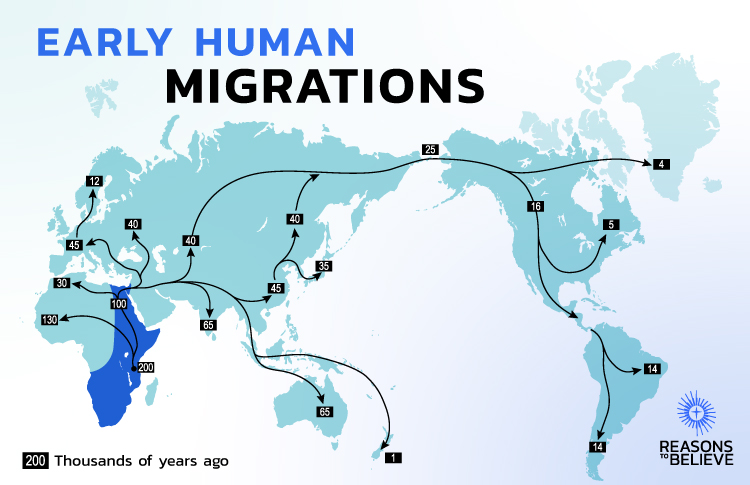
Early Human Migration
Where Did Humans Begin?
The question of human origins has intrigued scientists and historians alike for centuries and has driven considerable research and investigation. Current scientific agreement holds that humans emerged near East Africa, in an area referred to as the cradle of humanity.
The East African Origin
East Africa is widely recognized and supported as the birthplace of humankind due to the wealth of fossil discoveries there that trace human existence back thousands of years. Key sites in countries like Ethiopia, Kenya, and Tanzania have provided some of the oldest known humanlike fossils, supporting the scientific theory that modern humans (Homo sapiens) began in this region between 150,000 to 200,000 years ago.
Insights from Who Was Adam?
For those interested in diving deeper into the origins of humanity, the book Who Was Adam? offers a comprehensive examination of the scientific and theological perspectives on human beginnings as well as the genetic and fossil evidence that contributes to the belief in humanity’s East African roots.
Genetic Evidence
Advancements in genetics have further reinforced the East African origin theory. Studies of mitochondrial DNA and Y-chromosome data trace the lineage of all modern humans back to a common ancestor in Africa, often referred to as “Mitochondrial Eve” and “Y-chromosomal Adam”—a throwback to the Bible.
These genetic markers are used as pivotal evidence for piecing together the human family tree and tracing our dispersal across the globe.
The Global Journey
From African origins, humans migrated out of this cradle and eventually populated every corner of the world. This exodus is believed to have occurred in multiple waves, with early humans developing distinct cultures along the way.
Who Was the First Human Being?
The first human beings appeared in Africa, as supported by extensive genetic and archaeological evidence, but science has yet to determine the origin site of the very first human.
While the Bible doesn’t mention a specific location for humanity’s beginnings, it emphasizes that the first humans were Adam and Eve. They and all humans have been created in the image of God. Everyone who has ever lived descended from Adam and Eve.
When Did Early Humans Migrate to New Places?
The great human migrations are believed to have begun around 50,000 to 70,000 years ago when early humans began to move out of East Africa and embark on an adventure that would span continents and millennia.
Evidence for the first leg of this migration saw our ancestors travel through the Middle East. From there, they went into Europe and Asia, gradually spreading across these vast landscapes.
The final stages of this epic journey saw humans crossing into the Americas, a monumental feat that marked the culmination of a long and expansive migration process starting from East Africa.
Why Did Early Humans Migrate?
Scientists think the early migrations were not primarily about survival (forced migration) but about voluntary migration. Researchers believe humans embarked on a journey of discovery, change, and expansion that led to the occupation of new lands.
The Scientific Perspective: Environmental Changes
From a scientific perspective, human migrations out of Africa were predominantly driven by cultural challenges, such as disease and significant environmental changes. Africa, at the time, was thought to be marked by severe drought conditions that pushed early humans to seek more fertile land.
This period coincided with the “greening” of the Middle East, where ample resources awaited those bold enough to venture out. This shift provided both an escape from worsening conditions and an opportunity for a better life in new territories.
Geographical conditions were also highly favorable for human migration. Earth was in an ice age, and water levels were lower, which made it possible for humans to travel between regions that today are disconnected by water.
Due to lower sea levels, it was possible to walk across the Persian Gulf, which is where some scholars believe the biblical Garden of Eden was located. The Rub’al Khali, now a desert, was once a humid and cool passageway with rivers and streams that allowed migration from Africa to the Middle East.
The Biblical Perspective: Divine Providence
From a biblical perspective, migration flows are seen as an act of divine providence. According to Scripture, human movement was either “commanded”—in the form of a decree—or “forced” directly by God’s hand.
Initially, at the point of creation and again after the flood, humans were instructed to “multiply and fill the earth.” How can they fill the earth unless they migrate?
Yet, in one account, they resisted, choosing instead to settle and build the Tower of Babel. It was here that God intervened by confounding human language and compelling people to scatter across the globe:
So the LORD scattered them from there over all the earth” (Genesis 11:8).
This biblical account aligns with the rapid migrations suggested by scientific evidence. The idea that accessible routes with abundant resources were part of God’s providence offers a profound understanding of how these great migrations were undertaken. Humans moved not just by necessity but also by divine design.
A Combination of Forces
The migration of the human species was influenced by multiple environmental and spiritual pressures. The challenges our ancestors faced were lessened by how accessible routes and resources were, which suggests a remarkable synergy between natural and supernatural forces.

Scientific Evidence for Early Human Migration
It’s fascinating to consider how scientific evidence can complement and support the biblical perspective of both human creation and migration.
The RTB Model: A Biblical Perspective
The Reasons to Believe (RTB) model provides a framework that aligns with biblical narratives and is supported by scientific data. This model suggests that after God’s intervention at the Tower of Babel, humans began to scatter across the globe.
This scattering was not just spiritual—it also entailed a physical journey. God’s scattering required them to move. RTB’s model holds that migration started in the Middle East, occurred rapidly, and spread outward from this region.
Rapid Migration and Coastal Superhighways
One of the striking aspects of the migration was its rapidity, which is backed by evidence. The coastal routes, often referred to as “coastal superhighways” provided the passageways for these migrations.
Coastal highways played a significant role in speeding up migrations. These routes were stable environments that removed the need for complex clothing or new tools. Coastal highways also provided reliable food sources from the sea and fresh water from rivers leading into the coasts.
The journey to distant lands, such as Australia, points to how quickly early humans could adapt and move across vast distances.
For example, anthropologists estimate that the migration to Australia could have been completed in less than 1,000 years if groups moved at an average pace of just over 10 miles per year. In the grand scheme, this amount of time and distance per year is not excessive and could be easily accomplished.
Archaeological and Fossil Evidence
Archaeological and fossil discoveries reveal important insights into the migration patterns of early humans. Fossilized remains and artifacts found in regions like East Africa, the Middle East, and Asia trace the journey of Homo sapiens as they spread across the globe. Key sites such as Jebel Faya in the United Arab Emirates and the Levant (today’s Israel, Lebanon, Jordan, and Syria) have evidence of human presence dating back over 100,000 years—supporting the idea of early migrations through these regions.
The coastal superhighways are believed to have played a significant role in human dispersal. While much of the evidence along these routes has been lost to rising sea levels, inland archaeological sites provide a glimpse into the lives of early humans who followed rivers away from the coasts. Tools, skeletal remains, and other artifacts found along river systems like the Tigris-Euphrates and the Indus River further show how early humans adapted to the different environments during their migrations.
Genetic Evidence: Mitochondrial and Y-Chromosomal DNA
Science further supports RTB’s model through genetic evidence. Both mitochondrial DNA and Y-chromosomal DNA research support the idea of human migration starting from a common point. These genetic markers trace the lineage and movement of human populations and highlight a pattern that aligns with the RTB model.
Genetic data not only reinforces the idea of a rapid spread but also illustrates the interconnectedness of human populations—that we are all one people—as they migrated and settled across different continents.
Great Human Migrations: Europe
Genetic markers in European populations show that their origins can be linked back to East African (Ethiopian) groups, especially those close to the Middle East.
Mitochondrial DNA studies show the genetic traits of people living outside Africa have subparts of African mitochondrial DNA sequences, called haplotypes. Two important haplotypes, known as M and N, have been key to understanding these migrations. M haplotypes are usually found in Asia, while N haplotypes are mainly seen in western Asia and Europe.
The Route Through Central Asia
The journey from the Middle East to Europe wasn’t a straight path. Instead, it took a winding route through central Asia. Y-chromosomal data helps create a more detailed map. Two dominant Y-chromosome haplotypes in Europe, M173 and M17, seem to come from the M45 type—common in central Asian populations—and traces back to the M89 type found in the Middle East.
Studies place the origin of M173 about 30,000 years ago, and it serves as a significant milestone in the migration timeline.
The third prominent Y-chromosomal haplotype in Europe is known as M172 and it emerged about 10,000 years ago. It also came from M89 and likely represents human migrations due to the rise of agriculture as it changed the culture and economy of Europe.
Great Human Migrations: Asia
Genetic markers from Asian populations reveal a deep connection to East African origins. This African link is foundational, as all genetic markers found among Asian groups trace back to these early populations.
Mitochondrial DNA variants, haplotypes C, D, E, and G, are strong among groups with historical ties to South and East Asia, and even the Americas. They all descend from the M haplotype variant rooted in East African populations. Studies estimate that the M haplotype originated between 25,000 and 80,000 years ago.
Y-chromosome data matches these findings closely. Prominent Y-chromosome haplotypes in East Asia, notably C and D, can be traced back to M168, which also originated in East Africa and provides more evidence for migration from a common ancestor.
Studies estimate that M168 appeared between 31,000 and 79,000 years ago, with other estimates ranging from 56,000 to 81,000 and 36,000 to 109,000 years ago.
The Journey Through Asia
Early human migration routes into Asia appeared to have followed along the southern coast (including what is now India, Pakistan, and Sri Lanka) before turning northward. This path provided temperate climates, abundant resources, and steady expansion into new lands. Some groups are thought to have continued the coastal migration into Indonesia and Australia.
Great Human Migrations: Australia
The Y-chromosomal DNA from indigenous Australian populations reveals a significant genetic connection to African ancestors. This genetic link is shared among various Asian and Oceanic groups, connecting the paths taken by our ancestors.
One unique Y-chromosomal variant, known as haplotype M130, is particularly telling. It occurs with remarkable frequency among aboriginal Australians—over 60 percent—and is also found in populations from New Guinea, Malaysia, and India, although at lower frequencies.
This haplotype doesn’t appear in any other global populations and can also be traced back to the M168 haplotype from East Africa.
Crossing the Waters to Sahul
During the last ice age, the landmass known as Sahul—made up of modern-day Australia, New Guinea, and Tasmania—was separated from Asia by a strait over 50 miles wide, even with the lower sea levels.
To reach Sahul, early humans had to have the knowledge and skill to build and navigate seaworthy vessels. This requirement for sea travel suggests they had advanced cognitive abilities and technological understanding.
Anthropologists propose that the first Australians embarked on numerous voyages and hopped from island to island to complete their journey.
The First Human Migration to America
Scientists generally agree that the initial settlers of the Americas came from Asia and likely crossed the Bering Strait on a land bridge that once connected the two continents. This crossing was a significant milestone in human migration, yet the exact timing and route of these migrations remain the subject of ongoing debate.
The fossil record provides some clues. The oldest human remains in the Americas date between 13,500 and 9,500 years ago. However, these findings do not necessarily point to a single mass migration event. Instead, many scholars believe settling the Americas involved multiple migratory waves, possibly from both northeast and southern Asia.
The Clovis Culture and Beyond
The Clovis culture, a people group identified by unique stone tools, is often considered the earliest well-documented human presence in North America. This culture suggests a rapid spread of humans across the continent. Around 12,000 years ago, other groups like the Folsom culture began to emerge and show a diverse and complex pattern of settlement.
Some researchers think the Clovis people were among the first to reach North America, while others believe there were people before them. Limited and incomplete evidence from early humans in the Americas drives this debate and makes it difficult to clearly understand the early migration patterns.
Genetic Insights into Native American Origins
Native American groups have lower genetic diversity than other populations, which suggests they went through a genetic bottleneck from a small founding group. Five key mitochondrial DNA haplotypes (A, B, C, D, and X) help us trace their ancestry. Most of these haplotypes link back to Siberia and East Asia, but the rare haplotype X, interestingly, points to European roots.
Y-chromosomal DNA studies also add to the understanding and show that haplotypes unique to Native Americans trace back to Siberian ancestors. This genetic evidence supports the theory that multiple waves of migration into the Americas occurred around 12,000 to 15,000 years ago.
Debating Migration Routes
The routes taken by the first American migrants remain debated. Traditionally, it was believed that people traveled through an ice-free corridor between the massive ice sheets covering Canada and Alaska. However, this theory is challenged by the idea that migrants could have followed the Pacific coastline as this route might explain the rapid settlement of South America.
Human Migration Patterns
The Homo sapiens migration story is a blend of genetic discoveries and archaeological findings that show how early humans ventured into new territories, adapted environmentally, and interacted with other hominid species.
Timeline of Human Migration
The following timeline captures the key milestones of human migration and highlights the significant genetic and archaeological evidence that supports the Out of Africa model.

What Does the Bible Say About Human Migration?
As we conclude our exploration of humanity’s historical migration, let’s also consider some spiritual and moral points that may be relevant to us today. The Bible offers several insights we can apply to human migration that emphasize unity, law and borders, and our shared heritage.
Unity and Shared Heritage
Scripture emphasizes that we are all connected—a truth science supports through genetic ancestry. As the saying goes, “We are all Africans under our skin.” This commonality reminds us of our shared lineage and the fundamental unity of humankind. We are all the descendants of immigrants that bear the image of God.
Compassion and Hospitality
The Bible stresses that fellow human beings should treat strangers and migrants with compassion and kindness. Exodus 22:21 says, “Do not mistreat or oppress a foreigner, for you were foreigners in Egypt.” This passage calls us to remember our own pasts and to treat others with the grace and empathy we would wish for ourselves.
Ephesians 2:11–22 expands on this theme by inviting all people to become part of God’s family. It reminds us that, spiritually speaking, we were all once strangers and aliens until Jesus Christ welcomed us as citizens in his kingdom.
Borders and Laws
While the Bible emphasizes unity and hospitality, it also acknowledges the importance of borders and laws for national protection.
The challenge is to balance security with compassion. The Bible encourages us to seek wisdom and justice and strive for solutions that honor both our shared humanity and the unique identities of nations.

Embracing Our Shared Journey
Reflecting on what the Bible says about human migration, we’re encouraged to embrace our shared journey with humility, love, and wisdom. As descendants of those who crossed great distances in search of safety, opportunity, or community, we inherit a legacy based on movement and change.
It’s a reminder that in the grand weave of human history, we are united by the common threads of migration, faith, and hope.
If we acknowledge this shared heritage, we can better appreciate the richness of the human experience and strive to build connections that reflect the values of compassion, unity, and order that the Bible so profoundly advocates.