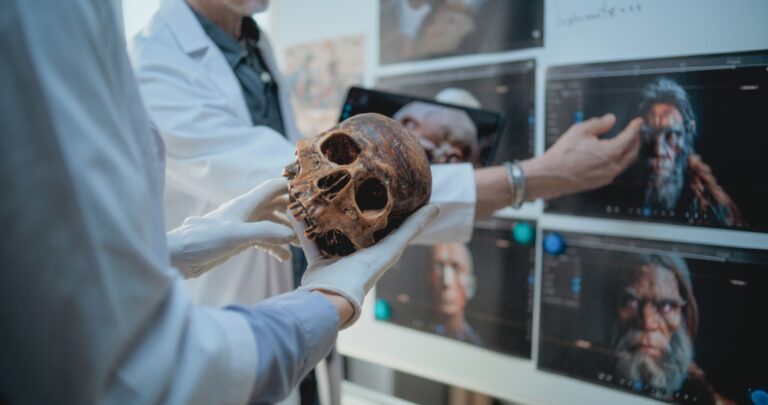

Neanderthals and early humans—how different were they, really?
Imagine walking the earth 50,000 years ago. You may have encountered creatures who looked somewhat like us, but weren’t quite human.
They hunted, gathered, and perhaps even cared for each other in ways similar to our ancestors. Yet, despite those similarities, the differences between Neanderthals and humans were significant.
The distinctions raise intriguing questions about our origins:
- Were Neanderthals human?
- What does it mean to be human?
- Where do Neanderthals fit in the Bible’s story of creation?
Let’s examine what separates us from Neanderthals, why it matters, and how our old-earth creationist perspective differs from evolutionary theories.
What Are Neanderthals?
Neanderthals were a distinct species, created by God, that belonged to a group of creatures called hominins. They lived from about 300,000 to 40,000 years ago in the Middle East, Europe, and Asia before going extinct.
Even though Neanderthals were biologically similar to modern humans (Homo sapiens), they were different from humans in significant ways .
In fact, most biologists who believe in evolution would say Neanderthals are an evolutionary dead end, meaning they did not contribute to human evolution. Even for these scientists, Neanderthal DNA would be distinct from that of the human species.
At Reasons to Believe, our biologists hold that God as creator used similar designs for both humans and Neanderthals, but with key differences that set them apart.
Neanderthals were intelligent, capable of using tools, and they likely formed strong emotional bonds with others. However, they lacked something crucial that makes humans unique: the image of God.
This means that while Neanderthals could think, feel, and even behave in ways that seem humanlike, their cognitive abilities were inferior to those of modern humans.
Unlike you, they didn’t possess the same spiritual and intellectual gifts that come from bearing the image of the creator of the universe.
But you do.
You have the unique capacity for a relationship with God—something Neanderthals were not created to experience.
It’s a great reminder that you are fearfully and wonderfully made—not the product of an unguided evolutionary process.
Similarities Between Neanderthals and Humans
How closely do we resemble our ancient neighbors, the Neanderthals? While Neanderthals and humans share intriguing similarities, these parallels tell a story of design, not descent.
From their unique physical structures to their intriguing behaviors, these similar traits highlight the creativity of a common designer rather than suggesting a shared evolutionary path.
Let’s delve into the remarkable traits we share with Neanderthals and explore what they reveal about our unique origins.
Physical and Functional Similarities
Like us, Neanderthals walked upright on two legs. (They were “obligate bipeds” if you want to sound smart—that’s the fancy way of saying they always walked on two legs, just like we do.)
Brain Size
The average Neanderthal brain size was slightly larger than that of modern humans, but brain size alone doesn’t determine cognitive capacity. (See “Brain and Skull Differences” below.)
Genetic Similarities
Neanderthals shared 99.7% of their genetic material with humans. (To keep this in perspective, humans also share about 60% of our genes with bananas. Shared DNA doesn’t necessarily mean direct ancestry.) Neanderthals had 23 pairs of chromosomes, including evidence of a fused chromosome 2.
Behavior
Some researchers claim Neanderthals were very similar to us in terms of their behavior. But some anthropologists and those of us at Reasons to Believe dispute and reject these behavioral claims based on counterevidence, which we’ll explore in the next section.
As you consider these similarities, you might wonder how creatures so similar to us could be fundamentally different.
Glad you asked. . .
Differences Between Neanderthals and Humans
Physical and Functional Differences
Despite overall similarities, Neanderthals and humans have significant morphological differences (meaning their bodies and physical features were very different from ours).
Neanderthals displayed a unique combination of features not found in other hominins, including:
- an extraordinarily long face
- a pronounced midface projection
- a poorly developed chin
- a highly developed brow ridge
- large, round eye sockets
- an extremely long nose
- larger, cavernous sinuses
- larger front teeth
- a retromolar gap
- a rounded bump at the back of the head (occipital bun)
- a flat-front brain that bulged in the back and sides
- a flatter skull bone
- an elongated opening at the base of the skull (foramen magnum)
- a higher voice box (larynx)
- thicker bones
- shorter limbs with a barrel chest
If you were to encounter a Neanderthal, you’d immediately notice these distinctive features. Their appearance would be both familiar and alien to your eyes.
Some scientists once thought that the differences between Neanderthals and modern humans weren’t significant. That is, they believed that Neanderthals’ unique traits came from their environment and way of life, not their genetics.
For example, Neanderthals lived in cold climates and their stocky bodies helped them stay warm. This would be comparable to how people like the Inuits, who live in cold regions today, have similar body shapes.
However, later discoveries like a Neanderthal infant skeleton found in Israel have shown that these differences were present from birth, meaning they were genetic, not just environmental.
Developmental Differences
Studies of Neanderthal dental and skull anatomy across different age groups—infants, children, and young adults—reveal that they underwent a more rapid craniofacial development along a different trajectory than modern humans.
In comparison, humans have the longest developmental period of any known species. We develop slower due to the complexity of our brains and social behaviors (good things are worth the wait).
Behavioral Differences from the Archaeological Record
While some researchers claim that Neanderthals and early modern humans shared behavioral similarities, it’s important to know that these claims are disputed. Archaeologists and RTB scientists reject the assumptions that Neanderthals had developed language, created art, used jewelry, mastered fire, performed ritual burials, cared for their sick/injured, or used medicinal plants.
| Claim | Counterevidence |
|---|---|
| Neanderthals possessed language due to a hyoid bone | The existence of a hyoid bone doesn’t necessarily mean Neanderthals had complex language abilities like humans; other structural features may have limited speech ability. |
| Neanderthals created art like cave paintings and abstract carvings | There’s no evidence that Neanderthals made art. Their markings on cave walls (“artworks“) do not reflect symbolic or creative thought. |
| Neanderthals used jewelry made from shells or bones | The evidence that Neanderthals used jewelry is suspect. |
| Neanderthals mastered fire for cooking and warmth | While they used fire, there’s limited evidence they truly “mastered” it in the same way humans did, and their technology was less advanced. |
| Neanderthals buried their dead ritually | The burial practices may not reflect ritual or symbolic understanding of death but could be practical, such as for hygiene or protection from scavengers. |
| Neanderthals cared for their sick and injured | Care may not indicate compassion or moral understanding, but rather a survival-driven need to maintain group members. |
| Neanderthals used plants with medicinal value | The use of plants might not show a true understanding of medicine as humans know it, but probably reflects trial and error or instinctual use of certain foods. |
It’s hard to tell how Neanderthals thought and behaved. Still, when you look at the archaeological record, there are substantial differences between Neanderthals and modern humans.

Neanderthal vs. Modern Human Technology
Neanderthals were on Earth much longer than humans have been to date, yet their “technology” remained static. They managed to make stone flakes, scrapers, and points, but that’s all.
Human technology, on the other hand, started primitively but quickly became more complex and diverse. Archaeological records show that Homo sapiens spread weaponry, jewelry, and art around the world at a rapid-fire rate.
Just picture two parallel timelines: one for Neanderthals, static and unchanging, and another for humans, exploding with innovation and creativity. While a Neanderthal might spend its entire life using the same stone tools their ancestors did, a human of the same era could be crafting intricate jewelry or painting vivid scenes on cave walls.
So, while Neanderthals had amazing abilities, they couldn’t learn or innovate like we can.
As cognitive neurobiologist Johan J. Bolhuis and his colleagues stated well:
Our species was born in a technologically archaic context, and significantly, the tempo of change only began picking up after the point at which symbolic objects appeared. Evidently, a new potential for symbolic thought was born with our anatomically distinctive species, but it was only expressed after a necessary cultural stimulus had exerted itself. This stimulus was most plausibly the appearance of language. . . . Then, within a remarkably short space of time, art was invented, cities were born, and people had reached the moon.
Brain and Skull Differences
The shape of the human skull is unusual and distinct from all hominins. Our skulls are rounder, with large areas in the brain (the parietal lobe) for things like touch, spatial awareness, hand-eye coordination, and balance.
Neanderthal skulls are more stretched out from front to back (anterior-posterior) and don’t have as much brain capacity as humans do.
In terms of our brains, the main difference between human and Neanderthal brains is the size and shape of the cerebellum. This is the part of the brain that helps with movement, thinking, language, memory, and social abilities.
In humans, the cerebellum is larger and sticks out more toward the center of the brain. In Neanderthals, the right side of the cerebellum was much smaller than the left, a condition called volumetric laterality, which doesn’t appear in human brains.
Because of these differences, researchers believe humans were more advanced in thinking and social skills than Neanderthals.
The smaller size of the cerebellum and parietal lobe in Neanderthals likely limited their visual thinking, memory, ability to process language, and ability to understand themselves in relation to the world around them.
Facial Structure Differences
Humans have smaller, flatter faces, while Neanderthals had larger, protruding facial features. These differences in skull and face shape also affect the size and shape of different brain areas in each species.
Genetic Differences
Even though human DNA and Neanderthal DNA are highly similar, there are some important differences, including the way some human and Neanderthal genes are used (called gene expression):
- Some genes that play a role in cognitive development differ in human and Neanderthals that play a role in cognitive development
- Genes that play a role in cognitive development are also expressed (used differently) in humans and Neanderthals
- Specific genes that control the development of the voice box (larynx) differ between humans and Neanderthals. These differences suggest that Neanderthals likely couldn’t speak as humans can.
- Humans have distinct genes that play a role in skull shape, and the design of the rib cage differs in humans and Neanderthals
In other words, your genes tell a story of human exceptionalism. The differences between your DNA and that of Neanderthals reflect the distinct cognitive capacities God designed for each species.

FAQ: Modern Human Origins
Are Neanderthals the Same Species As Us? Are Neanderthals Human?
No, Neanderthals were not the same species as humans, nor were they evolutionarily related to us. They were a distinct species created by God.
Due to similar designs, Neanderthals shared biological similarities with humans but remained biologically distinct. Though intelligent and capable of emotion, they lacked the image of God, making them cognitively inferior to humans.
Did We Evolve from Neanderthals?
No, humans are a distinct species created by God, starting with Adam and Eve. Humans did not evolve from any other creature.
When Did Neanderthals First Appear?
Neanderthals lived from about 300,000 years ago to their extinction around 40,000 years ago.
Where Did Neanderthals Live?
Neanderthals inhabited regions across the Middle East, Europe, and Asia.
How Long Did Neanderthals Live?
As a species, Neanderthals existed for approximately 260,000 years, from about 300,000 years ago until their extinction around 40,000 years ago.
What Did Neanderthals Look Like?
While Neanderthals shared overall anatomical similarities with us, they had noticeable differences in skull and facial anatomy. They possessed a more robust build with a “hyper-polar” body design adapted for cold climates. Key distinguishing features included a pronounced brow ridge, a large nose, and a more compact body with shorter limbs.
What Is the Biblical View of Neanderthals vs. Humans?
There’s no singular biblical view on Neanderthals because the Bible doesn’t mention them directly. Just like there are different perspectives on the age of the earth, there are different Christian perspectives on Neanderthals.
Different Christian Perspectives on Neanderthals
- As old-earth creationists, we regard Neanderthals as creatures lacking the image of God and a distinct species from modern humans—similar to how we view the great apes.
- Young-earth creationists often regard Neanderthals as fully human descendants of Adam and Eve, and they attribute differences to factors like disease.
- Some Christians view Neanderthals as image bearers, though a distinct species from modern humans.
Bridging Science and Faith in Neanderthal Research
These fascinating discoveries about Neanderthals offer more than just scientific insight. They invite us to deepen our appreciation for the complexity and breadth of God’s creation while reflecting on the special place we hold within it.
Scripture and science agree, you—as a human—are exceptional and uniquely set apart for a divine purpose.