

The evolution of tools tells a fascinating story that stretches back millions of years, revealing something deeper about human nature and our unique place in creation.
When examining the archaeological record, it reveals that tools used by the first humans weren’t just practical innovations. They were expressions of something deeper, something that sets us apart from every other creature on Earth.
While the phrase “evolution of tools” often gets used to support evolutionary theory, we’d like to offer you a different perspective. The story of prehistoric tools actually points to evidence of God’s special creation of humanity, revealing our spiritual nature as beings made in his image.
The journey from simple stone tools to modern technology isn’t just about increasing complexity. It’s about the emergence of symbolic thinking, creative expression, and spiritual awareness that appeared suddenly and dramatically with true humans.
This perspective aligns perfectly with the biblical account of Adam and Eve, showing how science and Scripture work together to tell the same remarkable story.
We All Use Tools
The use of all tools shows the ability to plan ahead and solve problems. This remarkable trait appears in both animals and humans, though in very different ways. God created both animals and humans with this ability, but humans were given a far greater capacity to create, innovate, and express purpose through tools.


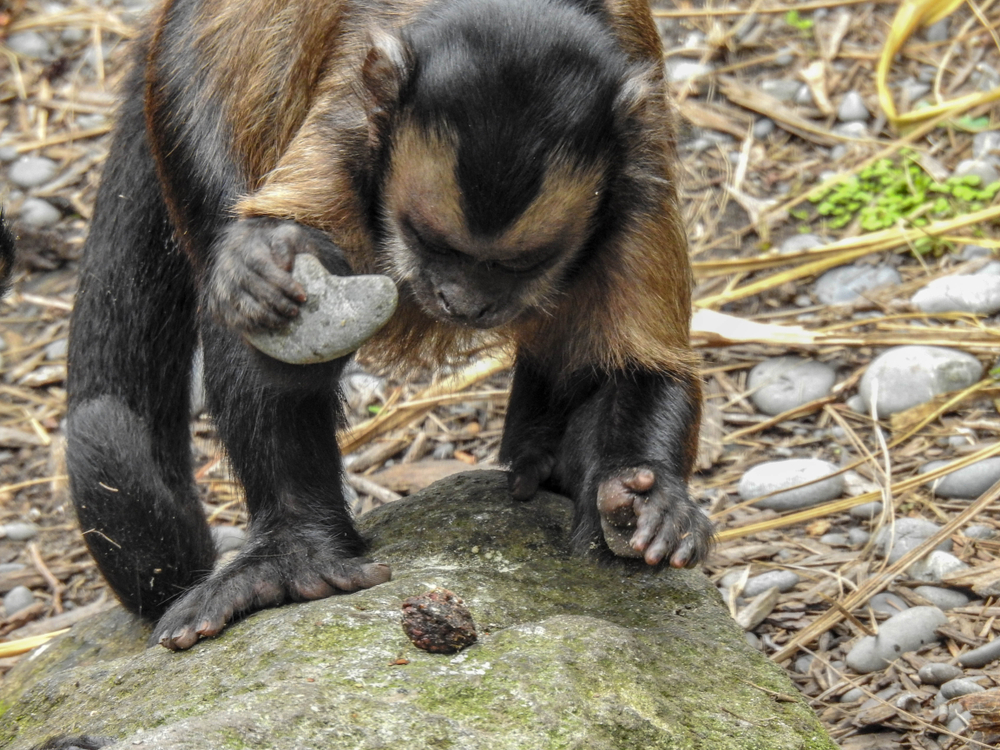
Animals create and use tools at a basic level.
The use of tools is actually widespread in the animal kingdom:
- Sea otters use flat rocks to crack open clams and shellfish, turning over on their backs in the water to use their bellies as anvils.
- Dolphins use sea sponges to protect their snouts during foraging, carefully selecting the right size and shape for their needs.
- Crows craft hooks from twigs to fish out insects, showing remarkable problem-solving abilities.
- Octopuses carry coconut shells as armor, demonstrating forward planning.
- Herons use various items as bait to catch fish, showing they understand cause and effect.
- Elephants use branches to swat flies away, modifying natural materials for their needs.
- Capuchin monkeys select specific stones to crack open nuts, choosing the right tool for the job.
This use of tools among animals drives home an important point. Tool use isn’t a defining feature of God’s image. In fact, the tool used by chimpanzees is comparable to the tool use of some hominins like Homo habilis and Homo erectus.
Humans create and use tools at a complex level. We’ve developed spears, hammers, crossbows, tractors, telescopes, computers, and countless other innovations. But what truly sets human tools apart isn’t just their complexity.
While some animals show cleverness, only humans show advancement. We refine and innovate tools generation after generation. The same stagnation we observe in animal tool use also appears in the hominin record. Neanderthals were on Earth longer than modern humans have been, but their technology remained essentially unchanged.
Our technology has exploded from primitive to sophisticated in a remarkably short time. There must be something to explain this difference. We believe it’s the image of God reflected in our symbolic capacity.
When Did Humans Start Using Tools?
Before we answer this question, we need to define our terms carefully. In scientific circles, the word “human” can mean different things depending on what you believe about our origins.
In this article, the word “human” is used with precision. We don’t use it to describe every primate creature with upright posture or a large brain. Instead, “human” is reserved for the descendants of Adam and Eve. These are beings who aren’t just biologically advanced but also spiritual image-bearers of God.
Some scientists refer to extinct hominins like Homo habilis or Neanderthals as “early humans,” but we see those beings as merely animal primates. They were biologically impressive animals, but not truly human in a theological or spiritual sense.
Humans are us, the descendants of the first two humans, Adam and Eve. We’re spiritual beings uniquely created in the image of God and distinct from all other creatures. Though biologically classified as Homo sapiens, humans aren’t the result of evolutionary processes, and we’re much more than our biology.
We’re a distinct creation, specially made with inherent dignity, value, and purpose. Some refer to us as “modern humans” to suggest we evolved from earlier species, but humans didn’t evolve from animals. We were created with spiritual capacity and moral responsibility from the beginning. Our unique identity shows up clearly in the archaeological record.
Hominins are a group of extinct primate species like australopithecines, Homo habilis, Homo erectus, Neanderthals, and others that appear in the fossil record. They share some physical similarities with humans, but hominins are nonhuman creatures.
They were biologically advanced animals created by God but were not spiritual beings made in his image. While they may have used crude tools or displayed limited intelligence, they’re not considered part of the human lineage in a theological or spiritual sense.
Neanderthals represent a specific type of hominin, created by God with impressive cognitive and physical capabilities, but still not fully human. Neanderthals were intelligent creatures capable of tool use, limited culture, and maybe even some crude symbolic behaviors. But they ultimately lacked the image of God.
They were still alive when Adam and Eve were created but went extinct shortly afterward. Neanderthals weren’t our ancestors, though some interbreeding with humans may have occurred on a biological level.
Now we can answer the question properly. From the time of their creation around 130,000 years ago, humans (Homo sapiens) have used tools. But unlike the simple tools of earlier hominins, human tools show creativity and symbolic purpose.
The archaeological record shows an explosion of innovation when the first true humans appear. Sophisticated hunting weapons, finely crafted blades, sewing needles, musical instruments, and even tools used to create art all appear suddenly. This sudden cultural advancement reflects far more than survival. It reveals a spiritual capacity for beauty, planning, and symbolic thought.
Human tool innovation appears abruptly and fully formed, consistent with the view that humans were specially created with intelligence, purpose, and the image of God. Before the appearance of humans, hominins created only crude tools. Even though they lived on Earth four times longer than humans have so far, their tool use remained unchanged and stagnant, showing no signs of advancement or innovation over time.
The hominin tool timeline tells this story clearly. Hominins began using tools perhaps as early as 3.4 million years ago. No stone tools have been discovered with australopithecines, but animal bones show signs of butchery. The australopithecines most likely used tools made from sticks, similar to what chimpanzees use today.
The habilines, such as Homo habilis, are traditionally considered the first makers of stone tools. These tools appear in the archaeological record about 2.6 million years ago and are known as Oldowan technology. (In archeology, “technology” simply means how tools were made and used—not to be confused with modern machines or electronics.)
These were flakes produced from a rock (called the core stone) that was hit with another rock (called the hammerstone). There’s some evidence that Homo habilis also used bones to make tools, in addition to stones.
Oldowan technology remained unchanged for nearly 800,000 years before it was replaced by a new technology associated with Homo erectus, called Acheulean technology. Acheulean tool making appeared around 1.76 million years ago and lasted until about 300,000 years ago when the erectines disappeared from the fossil record.
The tools of this era tend to be more symmetric and standardized. These hominins produced a range of different tool types including hand axes (teardrop-shaped tools), cleavers (large tools with broad, straight cutting edges), picks (used for digging or processing tough materials), and flakes (produced as byproducts that were deliberately used as smaller tools).
Mousterian technology is associated with Neanderthals. It appeared around 300,000 years ago until about 28,000 years ago. Mousterian technology was more sophisticated than Acheulean technology. Mousterian tools were prepared using a distinct method called the Levallois technique, which could be used to prepare a variety of tools from chipped flakes.

Crude Tools: What They Are and Why They Matter
Understanding crude or simple tools helps us see the dramatic difference between hominin and human capabilities. Crude tools represent basic functionality without refinement or symbolic meaning.
- Flakes and cores were small, sharp stone flakes chipped off a larger rock (core) and used for cutting meat or plants. These weren’t shaped or refined, just the result of a few strikes with another rock.
- Choppers were rounded stones with one sharpened edge, used for smashing bones, cracking nuts, or chopping vegetation.
- Hand Axes were teardrop-shaped rocks with minimal symmetry, used for cutting or scraping. While slightly more advanced than flakes, early versions still lacked fine craftsmanship.
- Hammerstones were basic stones used to strike other materials, usually to create flakes or crack open bones. No handles or shaping were involved.
- Digging sticks used by some hominins were simple wooden sticks used for foraging roots or insects. They weren’t carved or crafted, just selected and used.
What makes these tools “crude”?
What makes these tools “crude” is the lack of complex planning or standardization. They show minimal shaping, just a few strikes to get a rough edge. There are no handles or composite materials, no symbolic decoration or specialized functions.
We can tell the difference between genuine early human tools and Neanderthal tools in several ways. As previously mentioned, Neanderthals produced a distinct set of tools called Mousterian technology. Neanderthal tools were larger and more robust, formed using the Levallois technique.
Modern humans produced tools using a technique that involved chipping away smaller flakes with much greater precision. Modern human tools showed much greater variety than Neanderthal tools and were much more standardized.
One big difference relates to technological advancement. The tools made by Neanderthals were static. They didn’t change over the entire duration that Neanderthals were on Earth. The tools made by modern humans showed technological advancements, from primitive tools of the Upper Paleolithic to the sophisticated high-tech tools we use today. We also see clear, undisputed evidence of symbolism associated with modern human artifacts.
How Did Humans Drive the Evolution of Tools?
After Adam and Eve were created 130,000 years ago, we begin to see a sudden “explosion” of human culture. Art, language, music, and religious expression all appear together. Each of these points to a unique human ability to think symbolically, express deep meaning, and reflect spiritual awareness. No other creature possesses this ability, only humans.
This ability to use symbolism as creative and spiritual beings also sparked an unprecedented leap in tool innovation. It transformed the way humans designed and used tools.
What are some examples of symbolic behavior?
- Cave art provides powerful examples of symbolic behavior. Prehistoric tools were essential for creating these masterpieces. Stone scrapers prepared surfaces, hollow bones served as tubes for blowing pigment, and mineral-based tools created paints. Prehistoric tools made the artistic expression possible, but the art itself reveals symbolic thinking that goes far beyond survival needs.
- Burial practices show another dimension of symbolic tool use. Early human tools found in graves were often finely crafted and placed with personal ornaments or red ochre. These items were positioned with care, not just for utility, but to signify honor or belief in an afterlife. This behavior isn’t seen in animals. These tools demonstrate both symbolic intent and a leap in design complexity.
- Jewelry required specialized tools used by early humans for shaping, drilling, and threading. Shell beads and engraved pendants show a shift from basic tool use to refined craftsmanship with symbolic meaning tied to identity or status. The precision required reveals advanced planning and abstract thinking.
- Musical instruments provide perhaps the clearest evidence of symbolic capacity. Ancient flutes made from bird bones and ivory were carved with precision tools, showing a high degree of planning, creativity, and abstract thinking. The tools used by early humans to make instruments were as carefully designed as the instruments themselves. This provides further evidence of symbolic and spiritual expression.
The presence of symbolism in the archaeological record aligns perfectly with the sudden appearance of humans. This symbolic capacity isn’t found in earlier hominins or animals. Evolutionary biologists still can’t explain the origin of language, which represents the pinnacle of our symbolic capacity.
Human tool innovation didn’t just evolve—it erupted alongside spiritual and symbolic awareness, revealing a mind uniquely made in the image of God.
What Makes Human Tools Unique?
Several key characteristics distinguish human tools from those made by animals or hominins, revealing our special nature as image-bearers of God.
- Humans build on what came before. Unlike animals, humans don’t just make tools, we improve them over time. We’ve gone from sharp rocks to robots and rockets by learning from past generations. This cumulative improvement shows up nowhere else in the natural world.
- Humans plan ahead in remarkable ways. Human tools aren’t just made in the moment. We design them with specific purposes in mind, whether for farming, building, making music, or solving problems we anticipate in the future. This forward-thinking capacity reflects our ability to mentally travel through time.
- Humans use tools in the stone age and beyond for more than survival. Animals use tools mostly to get food. Humans do that too, often in much more complex ways, but we also use tools for art, worship, communication, and exploring the world. These uses show deeper meaning and imagination that transcends basic survival needs.
- Humans teach each other in sophisticated ways. Toolmaking isn’t instinctual or just copied through observation. It’s actively taught. Parents and teachers pass down knowledge so others can learn and improve upon it. This means our knowledge grows as a community, creating an ever-expanding base of technological capability.
- Some tools have deep meaning beyond their practical function. We use tools to express who we are or what we believe. Musical instruments and religious objects aren’t just helpful, they’re meaningful. A handmade cross, a paintbrush, or even a flag can carry deep symbolic value. These tools connect us to beauty, purpose, and something bigger than ourselves.
- This transformation started suddenly, according to the archaeological record. The leap in toolmaking didn’t happen slowly or gradually. When humans showed up, advanced tools appeared rapidly alongside art, music, and religious expression. It all points to something more than intelligence. It reveals our spiritual nature and the image of God.
This pattern continues today. While animal tool use remains essentially unchanged, human technology continues advancing at an accelerating pace. From prehistoric tools to smartphones and space shuttles, we see continuous innovation driven by our unique capacity for symbolic thought, creativity, and spiritual awareness.
The use of tools by early humans established patterns we still follow today. We create tools not just for survival, but for beauty, meaning, and connection with the divine. This reflects our fundamental nature as beings created in God’s image, designed for relationship with our Creator and dominion over the natural world.
Conclusion
The story of the evolution of tools reveals something remarkable about human nature. While Neanderthals may have made markings on cave walls and buried their dead, intentional activity doesn’t automatically carry meaning.
A dog may intentionally bury a bone, but it’s not creating a memorial or making a symbolic statement. It’s simply acting on instinct. The act is deliberate, but it doesn’t carry deeper meaning.
Human tools tell a different story entirely. They’re not just more advanced than animal tools, they’re meaningful. They show we’re more than clever animals. We’re creative, intentional, and spiritual beings designed to reflect the image of our Creator.
The archaeological record supports this view beautifully. Stone tools made by hominins remained essentially unchanged for hundreds of thousands of years. But when humans appeared, tool technology exploded with innovation, artistry, and symbolic meaning. This wasn’t gradual evolution, it was a sudden emergence of capabilities that reflect our spiritual nature.
From prehistoric tools to modern technology, we see consistent patterns of innovation, meaning, and spiritual expression that set humans apart from all other creatures. This supports the biblical account of special creation rather than gradual evolution from animal ancestors.