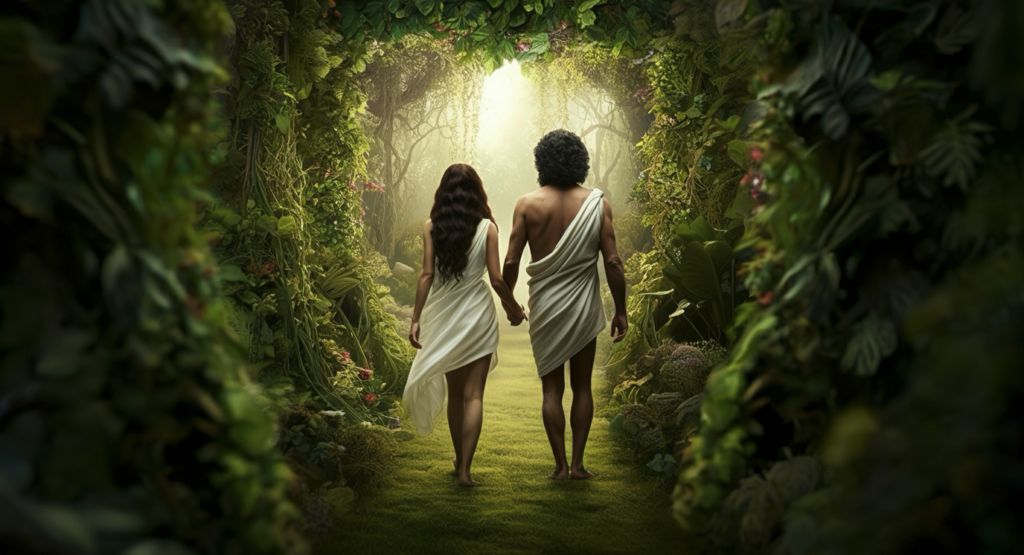

The Adam and Eve story in the Bible is about the first human beings—the first man, whom God called Adam, and the first woman, Eve. God created both Adam and Eve in his own image. The biblical account of Adam and Eve is not merely a story, they really existed. But how do we know this to be true?
According to the Genesis account (Genesis 2:20–21), God created Adam first and then Eve: “But for Adam no suitable helper was found. So the LORD God caused the man to fall into a deep sleep; and while he was sleeping, he took one of the man’s ribs and then closed up the place with flesh.” The fact that God created Eve from material taken from Adam’s side emphasizes the intimate connection and “one flesh” relationship God designed for them.
As we look into the story of Adam and Eve and the origins and purpose of humanity, we find ourselves at an intriguing intersection of faith and science. What can the Adam and Eve story teach us today? How does it align with modern understanding and scientific facts? What insights can we take away from this ancient account that defines mankind’s origin?
Join us as we explore the Adam and Eve story through the lens of biblical reflection and scientific discovery.
Who Were Adam and Eve?
Adam and Eve were the first human beings and the original ancestors of the human race—created by God in his own image (Genesis 1:27). They were the first man, Adam, and first woman, Eve.
This distinction of being made in God’s image bestows a one-of-a-kind role in creation, setting the stage for humanity’s journey through the ages of history.
According to Genesis, they were not only the first human beings but the exclusive and definitive ancestors from whom all humanity are descendants. “Adam named his wife Eve, because she would become the mother of all the living” (Genesis 3:20).
The Adam and Eve story is a testament to the complexity of human nature (as God’s image bearers) and the divine intention behind our existence. At the same time, it offers fertile ground for both theological reflection and scientific inquiry.

How Did God Create Adam and Eve?
In Genesis 2, we’re given a vivid account of how God created the first humans. “Then the Lord God formed a man from the dust of the ground and breathed into his nostrils the breath of life, and the man became a living being” (Genesis 2:7).
Adam was shaped from the dust of the earth by the hand of God. The Hebrew word, yatzar, describes God’s creative work, which forms the image of a potter shaping or molding the ground or soil (afar) into the first human. From a human perspective, it was a humble beginning, and yet one that was transformed when God breathed life into him. In the Hebrew, the word used to describe God imparting his breath to Adam (vayyippach) connotes intimacy. This divine breath set him apart from all other creatures.
This act of divine respiration signified more than just the animation of a body. It was the infusion of a spirit—making Adam, and all humankind, singularly unique in creation. We were created with distinction and purpose.
Eve was then created. The Hebrew word that describes her creation (banah) indicates that she was Adam rebuilt. She was made from Adam’s side emphasizing the intimate connection and equality of God’s design between man and woman.
Adam and Eve in the Garden of Eden
The Bible explains that God placed Adam in the Garden of Eden to care for it, marking the start of his journey. “The Lord God took the man and put him in the Garden of Eden to work it and take care of it” (Genesis 2:15). Adam was created, at least in part, for the purpose of caring for God’s creation.
Adam was tasked with naming the animals and yet, as busy as that assignment was, God recognized Adam’s need for companionship. God then created Eve, bone of his bones and flesh of his flesh (Genesis 2:23). Together, they were to cultivate the garden and establish authority and dominion over the earth while living in harmony with all that had been entrusted to them.
In Eden, there existed two trees that God had created. God permitted Adam and Eve to partake of everything except the fruit of these two trees: the tree of life and the tree of the knowledge of good and evil.
It’s here that a pivotal event occurred that altered the course of human history forever.

The Fall: What Did Adam and Eve Do?
Adam and Eve rebelled against God’s command and ate the fruit from the forbidden tree: the tree of the knowledge of good and evil.
“When the woman saw that the fruit of the tree was good for food and pleasing to the eye, and also desirable for gaining wisdom, she took some and ate it. She also gave some to her husband, who was with her, and he ate it” (Genesis 3:6).
Their disobedience, sparked by the serpent, often identified as Satan, was driven by a desire to be like God. Through subtle persuasion, the serpent sowed seeds of doubt and ambition within Eve, painting a picture of enlightenment and power that lay beyond the forbidden fruit.
This act introduced sin and human death into mankind’s experience, forever changing the relationship between God and the humans he created. Because of Eve and Adam’s sin, all of humanity is born into a sinful state. This condition is known as original sin.
Who Ate the Apple: Adam or Eve?
In the story of Adam and Eve, there’s a common misconception that adds an extra twist to the narrative: the infamous apple as the forbidden fruit.
But was it really an apple?
People often represent the forbidden fruit as an apple, but the Bible doesn’t say what the fruit was—only that it was the fruit of the tree of the knowledge of good and evil. This little detail tends to get lost in translation (quite literally), as the image of a tempting apple has become ingrained in our cultural mind.
The biblical story says that Eve ate of the forbidden fruit and shared it with Adam. “When the woman saw that the fruit of the tree was good for food and pleasing to the eye, and also desirable for gaining wisdom, she took some and ate it. She also gave some to her husband, who was with her, and he ate it” (Genesis 3:6). What’s noteworthy here is that Adam was not deceived or persuaded by Eve. Instead, Adam made a conscious choice.
Despite being given a direct command from God not to eat from the tree, Adam accepted the fruit from Eve. He ate from the forbidden fruit and disobeyed God. Adam’s sin was the same as Eve’s.
So, who ate the “apple”? They both did. And though their sin incurred God’s righteous judgment, a second Adam would come to Earth to redeem sinners from their sinful state and to be reconciled with their Creator forever. We’ll explore that part of the story later.
Scientific Facts About the Story of Adam and Eve
The Adam and Eve story and the Genesis creation account sit at the crossroads of faith and science. Skeptics of the Christian faith say that the story lacks credibility, but Christian scholars offer a fascinating parallel between the biblical and scientific accounts of human origins.
According to the Bible, Adam and Eve were made directly by God. This depiction leaves little room for combining God’s creative process with evolutionary views that believe humans evolved from ancestral apelike beings over millions of years.
Mainstream science affirms a gradual evolutionary process where humans share a common ancestry with great apes, tracing back over six million years. This model is supported by three primary lines of evidence. But each can be refuted or reframed when looked at from a biblical perspective:
- The first line of evidence is the observation that humans continue to evolve today. Supporters argue that microevolutionary changes—minor adaptations and variations within species—imply that evolutionary leaps, or macroevolution, happened historically. However, from a biblical perspective, these small changes reflect adaptability within God’s dynamic creation rather than proof of an evolutionary chain.
- The second line of evidence lies in the physical and genetic similarities between humans and great apes. While the theory of evolution holds that these similarities are evidence of common descent, a biblical view suggests they reflect a common design where God used similar blueprints across different forms of life.
- The third line of evidence comes from the hominin (humanlike) fossil record. While often cited as tangible proof of human evolution, the fossils can also be viewed through a creation model. A biblical perspective suggests hominin diversity may represent God’s deliberate introduction of various life-forms at different times.

When Did Adam and Eve Live?
The question of when Adam and Eve lived remains a topic of interest and debate, particularly because the Bible doesn’t provide a specific timeline on when creation occurred. However, science gives us several tools to estimate their time period by exploring genetics and archaeology through an old-earth creationist perspective.
One of those tools comes from genetics, where the concepts of mitochondrial Eve and Y-chromosomal Adam serve as anchors in time for dating our earliest ancestors.
According to some population genetics studies, these genetic lineages suggest that mitochondrial Eve and Y-chromosomal Adam lived approximately 130,000 to 140,000 years ago.
Second, the fossil record builds on this idea. Around 130,000 years ago, we see the unique globular human skull, a hallmark of modern humans, emerging. This key developmental feature appears suddenly in fossil evidence.
Third, archaeology reveals the presence of distinctly human behavior, that is, symbolic thought and expression, appearing more than 100,000 years ago. These behaviors mark a sudden and significant leap in cognitive and cultural development that further aligns with the genetic timeline.
The coinciding of these dates is both impressive and thought-provoking as it paints a potential picture of human origins that aligns with both the biblical account of Adam and Eve and scientific evidence.
(For more on this topic, consider supporting Reasons to Believe and purchasing Old-Earth or Evolutionary Creation?)
Where Did Adam and Eve Live?
According to the Bible, Adam was made even before the beauty of Eden took form. Once the garden was established, God placed Adam there to tend and nurture it (Genesis 2:15), and then Eve was created and also lived there.
The Garden of Eden is described as a specific location on Earth, and not the entirety of the planet. This view differs with some interpretations by young-earth creationists who see Eden as covering the whole Earth. The garden’s precise location remains a mystery: its exact boundaries have been lost to time.
Nevertheless, the biblical text and modern science can help us make estimates. The Garden of Eden was most likely located around the modern Persian Gulf. Genesis 2 specifically mentions the Tigris, Euphrates, Pishon, and Gihon rivers.
Only the first two of these four rivers still flow, but, prior to the last ice age, all four waterways flowed into the Persian Gulf. As such, we estimate that the Garden of Eden was located somewhere within this region. It should be noted that the Garden of Eden may well have extended into parts of east Africa. The text describes the Gihon River as winding through the land of Cush, which corresponds to modern day Ethiopia.
What Language Did Adam and Eve Speak?
Some suggest Adam and Eve may have spoken Hebrew, as it is the language of the first five books of the Old Testament.
However, this idea lacks scientific backing. No concrete evidence supports the idea that Hebrew was the first human language. Indeed, humanity’s earliest form of communication remains a mystery.
Interestingly, one of the oldest known people groups, the Khoisan in Africa, use a unique method to communicate through clicking sounds. This ancient form of language offers a glimpse into the many ways humans have communicated across the ages.
In a playful nod to this thought, one might say that Adam and Eve “really clicked.”

What Did Adam and Eve Look Like?
The Bible is silent on the specific appearance of Adam and Eve, thereby leaving room for some interpretation and speculation. While they’re considered real, historical figures in the biblical narrative, Adam and Eve also serve as the theological everyman and everywoman that represent all of humanity.
This concept allows people from different heritages to envision the primordial pair in a way that reflects their own identities.
Science suggests that Adam and Eve:
- were physically and behaviorally modern humans
- likely had heavily pigmented, dark skin
- likely had brown eyes
- likely had broad, flat noses
- likely had black or brown, tightly curled hair
(For a deeper dive into this topic, be sure to check out our dedicated post on Adam and Eve’s appearance where we explore this topic in greater detail.)

Adam and Eve History, Family Tree
While the story of Adam and Eve is often referred to as just that—“a story”—there’s reasonable evidence to affirm the pair as historical figures with a documented family tree. According to the Bible, they were created on the sixth day of creation as the culmination of God’s work. They represented God’s crowning achievement of creatures made in his image. We find further description of this work beautifully captured in Psalm 8:4–6.
The Bible (Genesis 4:1, 25) introduces us to their children—Cain, Abel, and Seth—and Genesis 5:4 reveals that Adam and Eve had many more sons and daughters, suggesting a larger family tree.
There’s even a possibility they may have had children before the Fall. This is speculative and inferred from Eve’s childbirth experiences. After the Fall, God told Eve her childbirth pain would increase, perhaps implying she had a beforehand understanding of childbirth.
Regarding the end of their lives, Adam lived for 930 years, with his long life eventually ending due to the time constraints brought on by the fall. The Bible doesn’t specify how long Eve lived.
In a broad sense, all humanity can trace its roots back to this first couple, making us all descendants of Adam and Eve. For Adam’s family tree, see Genesis 5. For a family tree from Jesus Christ all the way back to Adam, see Matthew 1.
The Second Adam: Jesus Christ

Obviously, the tragedy of the Adam and Eve story is that they rebelled against their Creator and plunged themselves and their posterity into a state of sin. But the story doesn’t end there.
In Christian theology, Jesus is seen as the “second Adam.” This idea comes from the apostle Paul in Romans 5:12–21 and 1 Corinthians 15.
Through Adam, sin and death entered the world and spread to all people. But through Jesus Christ came hope, redemption, and the gift of eternal life. His life, death, and resurrection offer a path to a restored relationship with God by counteracting the fall and providing a new beginning for humans who believe in his promise to save.
1 Corinthians 15 shines the light on Jesus’s resurrection, which not only affirms his divinity but highlights the hope of salvation. Jesus’s conquest over death nullified the consequences of sin introduced by the first Adam.
This theological reality highlights the transformation—from lost to redeemed—available to all persons who call on the name of the second Adam. It’s God’s great promise of salvation. Jesus as the second Adam is not just a theological idea but a beacon of hope, signifying the ultimate triumph of life over death and the enduring assurance of a restored creation.

Conclusion
As we contemplate the legacy of Adam and Eve and the promise embodied by Jesus Christ, we embrace the enduring themes of creation, fall, redemption, and, finally, consummation that continue to resonate across time and cultures. The Adam and Eve story is our story, and it will continue forever.
This exploration of the Adam and Eve story weaves together history, theology, and science. Reflecting on these themes, we’re reminded of the timeless nature of fall and redemption, identity, and connection that define our shared experience.
- For a deeper exploration into this topic, consider supporting Reasons to Believe by purchasing Who Was Adam?