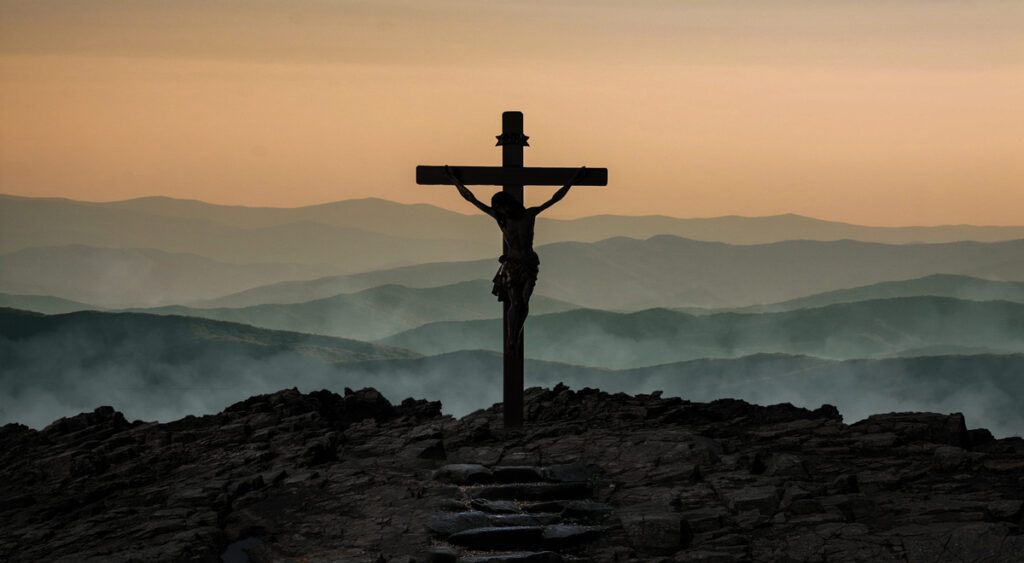

The crucifixion of Jesus Christ is more than a moment in history. It’s the summit of God’s love.
On a hill outside Jerusalem, nails tore flesh. Wood bore weight. Heaven seemed to hold its breath.
For Rome, crucifixion was cruelty perfected. A punishment meant not just to kill but to shame, to strip dignity as well as life.
But for Jesus, the cross was more than Rome’s sentence.
It was the Father’s plan. Long before soldiers lifted the hammer, prophets had painted the picture—hands pierced, muscles exposed, a servant wounded for the sins of the world.
When we consider the crucifixion of Jesus, we’re not simply evaluating history or the medical impact of protracted torture.
We’re standing in the center of God’s story.
So let’s look closely—at both the medical explanation and the meaning beyond it. Because in Christ’s suffering we’re granted eternal life.

Jesus’s Death: The Crucifixion Story
The story of Jesus’s death has been etched into hearts and stained glass alike. Christians throughout the centuries have referred to it as the Passion of Christ. Passion comes from the Latin passio, meaning “suffering,” “enduring.”
And that’s precisely what it was.
The story begins in a garden, with prayers pressed out with drops of blood. It moves through trials—false witnesses, angry mobs, leaders who washed their hands instead of standing for truth. It reaches its breaking point under a Roman whip, flesh torn until he stumbled beneath the weight of the crossbeam. And then, on a hill called Golgotha, the hammer fell. Nails pierced. A cross was lifted.
For six hours, Jesus Christ hung there. Between heaven and earth. Between justice and mercy. Between our sin and God’s forgiveness. The sky darkened. The earth shook.
And finally, in the afternoon Jesus cried: “It is finished.” The Son of God gave up his spirit. Not just an execution. An endurance of love.
Rome reserved crucifixion for the worst of the worst slaves, rebels, and enemies of the state. Never for Roman citizens. It was public theater, a slow-motion death designed to stretch suffering to the breaking point.
A body shredded. Nerves ignited by nails. Multisystem organ failure collapsing under shock and blood loss. This was Rome’s warning: This is what happens if you resist us.
And yet, the death of Jesus turned that on its head. The very tool of torture became the instrument of redemption.
Paul said it best: “The message of the cross is foolishness to those who are perishing, but to us who are being saved it is the power of God” (1 Corinthians 1:18). The cross that mocked became the cross that saves. This very scandal—the thought of God suffering shame—has led some, like Islam, to deny it ever happened.
To them, it’s unthinkable. But for Christians, it’s undeniable.
Even in the medical agony of scourging, shock, and crucifixion, we see more than pain. We see love poured out to the last drop of blood.

The History of the Crucifixion of Jesus
History doesn’t give us every line of the story, but it gives us enough to feel the weight of what happened. The cross is not just written in Scripture, it is etched into prophecy, preserved in stone, and attested in writings from those who followed Him and those who opposed Him.
Historical Accounts & Facts
While no Roman record spells out the crucifixion of Jesus in detail, the practice itself was Rome’s signature punishment in the first century. Crucifixion was designed to terrify as much as it was to kill. Rebels. Slaves. Criminals.
Anyone who dared to disturb the empire’s fragile peace could be nailed to wood as a living warning. And this is exactly how Jesus was treated: condemned as a threat, branded as a troublemaker, and displayed as an enemy of Rome.
Yet the historical trail does not run cold. Ancient voices—some hostile, some indifferent—affirm the event. Roman historians such as Tacitus, Jewish chroniclers like Josephus, and even satirists like Lucian, all make mention of a man crucified under Roman Governor Pontius Pilate. None wrote to defend the faith. All, in their own way, leave behind testimony and undeniable record of the historical Jesus.
Stones, Scrolls, & Bones
In Jerusalem, skeletal remains have been unearthed with heel bones still transfixed by iron nails and fragments of wood clinging to the remains. It’s a haunting echo of crucifixion as the Romans practiced it.
One skeleton, discovered at Giv’at ha-Mivtar in 1968, bore the scars of being nailed through the ankles, confirming the very method described in the Gospels. Another study, published in Archaeological and Anthropological Sciences, detailed similar findings that match John’s description of broken legs to hasten death (John 19:31–33).
And the witness reaches further back still.
The Great Isaiah Scroll, unearthed at Qumran and carbon-dated to centuries before Christ, contains the same words we read today: a Servant “pierced for our transgressions, crushed for our iniquities” (Isaiah 53:5). Psalm 22 speaks of hands and feet pierced, lots cast for clothing, mockers circling in scorn. These weren’t written in hindsight; they were prophecies anticipating history.
Stone, bone, and scroll. All three bear the same testimony: Jesus’s crucifixion was real. And more than real, it was foretold.
Witnesses
The scrolls speak. The stones remember. The bones still bear their scars. But the witness does not end there. Voices rose too—some hostile or indifferent, as previously mentioned, as well as some faithful.
Historians, satirists, and the earliest Christians all, in their own way, left behind testimony of the cross. Together, they remind us: the crucifixion of Jesus was not hidden in shadows. It was seen, recorded, and declared.
Tacitus: The Hostile Historian
The Roman historian had no love for Christians. His words drip with disdain, yet he couldn’t deny the fact that: “Christus suffered the extreme penalty during the reign of Tiberius at the hands of one of our procurators, Pontius Pilatus.” For Rome, crucifixion was the “extreme penalty,” the harshest punishment of all. Tacitus had no motive to invent the story. Yet even through his scorn, truth slipped through his pen.
Josephus: Dispassionate Chronicler
The Jewish historian wrote with brevity, almost a shrug: “Pilate had condemned him to be crucified.” No passion. No defense. Just fact. And perhaps that’s what makes it so powerful. Josephus was not preaching Christ; he was preserving history. And in his record, we hear the echo of nails against wood.
Lucian: The Mocking Voice
The satirist mocked Christians for worshiping a “crucified sophist.” To him, it was laughable. Absurd. Who would honor a man condemned to such shame? And yet his sneer proves the point: even Rome’s ridicule could not erase the devotion of believers. What the world mocked, the church magnified.
The Earliest Christians
But the strongest witness came from trembling lips and steadfast hearts. Within mere years of the cross, Paul was already repeating the creed: “. . . Christ died for our sins according to the Scriptures, that he was buried, that he was raised on the third day . . .” (1 Corinthians 15:3–4).
This claim was no legend appearing centuries later. There were believers singing by candlelight, early Christians declaring what emperors tried to stamp out. Their hymns, like the one preserved in Philippians 2, praised a Savior who “humbled himself by becoming obedient to death,” even death on a cross.
Historical Consensus
Even scholars who question miracles, doubt the resurrection, and keep faith at arm’s length still agree on this much: Jesus lived in first-century Palestine. Jesus was crucified under Pontius Pilate. His death was verified.
Historians like Bart Ehrman and John Dominic Crossan, men who do not speak as defenders of the church, still affirm these facts. The facts can’t be brushed aside. They stand like immovable stones in the landscape of history.
For all the debates about who Jesus was, there is little debate about what happened on that hill outside Jerusalem. The crucifixion of Jesus is one of the best-attested events in the ancient world.
Voices friendly and hostile alike, Christian apologist and non-Christian, all leave us with the same conclusion: Jesus of Nazareth was nailed to a cross, and there he died.
If even history will not deny him, how much more should faith rejoice in him?
Who Was at the Crucifixion of Jesus?
The cross was not hidden. It stood on a hill, lifted high for all to see.
And so they came.
Some came with love, some with hate, some with nothing more than curiosity.
At the foot of the cross stood his mother. Mary, who once cradled him in a manger, now watched him bleed on a tree. Her heart was pierced with sorrow deeper than any sword could cut.
Beside her were other women—faithful, steadfast, unwilling to turn away. They had followed him from Galilee, and now they followed him to the end. Their devotion would carry them beyond the cross, making them the first witnesses to see the empty tomb.
John was there, the beloved disciple. The others had scattered, but John stayed close enough to hear the Messiah’s last words, close enough to receive the charge: “Behold your mother.”
Roman soldiers stood nearby, hardened men performing a demanding task. They cast lots for his clothes, mocked his name, and yet one among them saw what others missed. As the earth shook and the sky grew dark, the centurion whispered what faith still confesses: “Surely this man was the Son of God!” (Mark 15:39).
Religious leaders smirked. They thought they had won. The crowd jeered, some wagging their heads, others shouting insults. And still, passersby stopped to stare, witnesses to love stretched wide on wooden beams.
It was a cross-section of humanity, friends and foes, mothers and mockers, disciples and deserters.
All gathered at one hill, all gazing at one man.
The message was as unmistakable then as it is now: Christ died not for some, but for all.
What Did They Do to Jesus Before He Was Crucified?

Before the nails, there was the whip. Before the cross, there was the scourging.
Jesus endured a torrent of cruelty designed to break more than a body; it was meant to crush the soul.
The Gospels tell us he was beaten again and again. Spit stung his face. Fists struck his jaw. A crown of thorns was twisted into his brow, each spike pressing deep, blood trickling into his eyes. Soldiers draped a robe across his raw shoulders, bowed in mock worship, and sneered, “Hail, King of the Jews.”
They laughed, but heaven didn’t.
Roman scourging was a unique form of punishment. The whip—the flagrum—was no ordinary lash. Its cords were studded with bits of metal and bone so that each blow would not just bruise but lacerate.
Victims were tied to a post, legs exposed, backs bared. Then came the strikes. The heavy tips bruised deep into muscle. The jagged fragments ripped skin, shredding layer upon layer. With every lash, blood poured. With every blow, pain radiated through every nerve.
Historical accounts say that scourging often left bones exposed and muscles dangling like ribbons. Many collapsed under the punishment long before crucifixion ever began.
Why such cruelty?
Rome used it as terror made flesh. Scourging wasn’t about justice; it was about humiliation. It was meant to strip away not only strength but dignity, leaving the victim so disfigured they were scarcely recognizable as human. And this is what Jesus bore—not for his crimes, but for ours.
The prophet Isaiah saw it centuries before: “By his wounds we are healed” (Isaiah 53:5). Each lash was more than a soldier’s cruelty; it was prophecy fulfilled.
Every strike carried our rebellion. Every piece of exposed tissue bore our shame.
Before he carried the wood of the cross, he had the weight of our sin—on a back striped, torn, and bleeding love.
How Long Was Jesus Tortured?
It was not a moment, but a marathon of pain, fifteen to eighteen hours in which the Son of God was handed over, beaten down, and lifted. Hours that would feel like centuries.
And the wounds were not only in his flesh.
The night began with betrayal, sealed with a kiss from a friend.
The disciples who had sworn to stand beside him fled into the darkness. Peter, bold with promises hours earlier, denied him with curses before dawn. Mockery pierced where nails had not yet reached. False witnesses twisted his words. Soldiers spat in his face. Leaders laughed at his claims.
The emotional blows fell as heavy as the physical. Abandoned by friends and rejected by his people. Paraded from court to court like a criminal, stripped not only of his freedom but of his dignity. His pain was more than skin deep; it was the anguish of carrying the world’s sin, of feeling the growing distance sin carves between humanity and God.
By the time the whip struck, his body was already breaking under the weight of grief.
By the time the nails pierced, the heart had already been pierced by sorrow.

Where Was Jesus Crucified?
Jesus was led outside the walls of Jerusalem to a hill called Golgotha, “the place of the skull.” The Romans chose such places with care. They wanted the cross to be visible, unforgettable.
To the empire, it was a stage of terror. To God, it became a stage of love.
For centuries, Christians have asked: Exactly where was Golgotha?
The answer has stirred debate, not doubt.
Archaeologists and historians have traced the steps, and two main possibilities remain.
The Traditional Site: The Church of the Holy Sepulchre
Since the fourth century, the Church of the Holy Sepulchre has been venerated as the place where Jesus was crucified and buried. Helena, the mother of Emperor Constantine, identified it during her pilgrimage, and tradition has never let it go.
Archaeological studies affirm that, in Jesus’s time, this site was indeed outside the city walls, just as the Gospels describe. First-century graves discovered in the area confirm it was beyond the sacred barrier.
More recently, botanists have unearthed grape seeds and olive pits beneath the church—remnants of an ancient garden that once flourished there. John’s Gospel tells us there was a garden near the place of Jesus’s crucifixion (John 19:41). How fitting then that the hill of death was surrounded by life.
Scholars like Dan Bahat, former City Archaeologist of Jerusalem, are convinced of its plausibility:
Six graves from the first century were found in the area of the Church of the Holy Sepulchre. That means . . . this place [was] outside of the city, without any doubt.
The Alternative Site: Gordon’s Calvary and the Garden Tomb
In the nineteenth century, Protestant scholars began looking northward. They saw an escarpment whose shape resembled a skull and pointed to a nearby ancient tomb, still visible today. General Charles “Gordon” became its champion, and many Christians have since cherished the site as a place of devotion. Its simplicity, its garden setting, and its striking resemblance to the Gospel’s descriptions give it a strong symbolic appeal.
Yet, while Gordon’s Calvary holds the imagination, many archaeologists favor the Holy Sepulchre, citing stronger tradition and firmer evidence.
Outside the Gates, Inside God’s Plan
Whether beneath the dome of the Holy Sepulchre or on the rocky face of Gordon’s Calvary, the geography tells the same story: Jesus died outside the gates. Cast out, shamed, treated as unclean. And yet, it was there, outside the city, that salvation was accomplished.
The world hung the cross as a sign of disgrace. Heaven raised it as a banner of love. Despite the debates about stones and pathways, one truth remains steady: sin was punished, grace was poured out, and the gates of God’s holy city were swung open for all who believe.
As Hebrews reminds us: “Jesus also suffered outside the city gate to make the people holy through his own blood. Let us, then, go to him outside the camp, bearing the disgrace he bore. For here we do not have an enduring city, but we are looking for the city that is to come” (Hebrews 13:12–14).

Timeline of Jesus’s Crucifixion
The cross was not a quick execution. It was slow. Deliberate. Drawn out.
Every lash, every step, every hour on the hill was meant to prolong pain and magnify shame. And yet, what men designed for cruelty, God used for redemption.
The story of Christ’s crucifixion unfolds not in minutes, but in hours. From the prayers in the garden to the cry from the cross, each moment carried eternity’s weight.
What follows is not just a record of suffering. It’s the timeline of salvation.
Gethsemane (Late Thursday Night, 11:00 PM – 1:00 AM)
It began in a garden. Not Eden, where sin began, but Gethsemane, where salvation pressed in.
The Passover meal was finished, the hymns sung, and the disciples followed their Teacher into the olive grove of Gethsemane.
The night was late. The city was quiet. Jesus brought his friends deeper into the grove and said to Peter, James, and John: “My soul is overwhelmed with sorrow to the point of death. Stay here and keep watch with me” (Matthew 26:38).
Then he stepped away. A stone’s throw. Close enough for them to see him. Far enough to be alone. He fell to the ground and prayed: “Father, if it is possible, may this cup be taken from me. Yet not as I will, but as you will” (Matthew 26:39).
Luke tells us that Jesus prayed until his sweat became like drops of blood falling to the ground (Luke 22:44). The weight of the world had pressed down on him long before a soldier’s hand ever touched him.
Doctors call it hematidrosis: tiny capillaries bursting under extreme stress, resulting in blood mingling with sweat. Skin raw. Nerves on edge. His body already preparing for pain beyond imagination.
But the pain was not only physical. Jesus suffered another type of anguish.
Jesus was already beginning to bear the weight of sin. The sin that creates the distance, the separation, the curse that fractures humanity’s communion with God.
Physical pain became the echo of spiritual burden. The sweat of blood bore witness to a soul being crushed under the guilt of the world.
The disciples dozed. Their Master wept. Heaven listened.
Then came the torches through the trees. The betrayer with a kiss.The soldiers with chains.
And there stood the Savior who would not resist.
The Chains of Injustice: Arrest & Trials (Early Morning 1 AM–8 AM)
Dragged through Jerusalem’s narrow streets, Jesus was pushed from one chamber to another. First to Annas (John 18:13), the former high priest, who questioned him in the shadows of the night. Then to Caiaphas (Matthew 26:57), where the council gathered in haste.
False witnesses stumbled over their lies, but still they pressed their case. Slaps stung his face. His beard was torn. His name mocked. The council condemned Jesus for blasphemy (Mark 14:61–64), though their own hearts were blind to the very One standing before them.
By dawn, he was taken to Pilate (Luke 23:1). The Roman governor found no guilt in him, yet feared the crowd. Hoping to sidestep the dilemma, Pilate sent him to Herod Antipas (Luke 23:7), who happened to be in Jerusalem at the time. Herod mocked him, dressed him in a royal robe, and sent him back in scorn.
Again, Jesus stood before Pilate. Again, Pilate declared him innocent (John 19:4). And again, the crowd shouted louder: “Crucify him! Crucify him!” (John 19:6).
Justice bent beneath the weight of fear. Truth was trampled in the dust of politics.
The innocent was condemned, fulfilling Isaiah’s prophecy: “By oppression and judgment he was taken away” (Isaiah 53:8).
Meanwhile, his friends hid in the shadows.
Peter huddled by a fire in the courtyard of the high priest’s house (Luke 22:55). The flames flickered, throwing light across his face. A servant girl looked closer: “You were with him.” Peter shook his head. Denial once. Another voice rose: “You’re one of them.” Denial twice. Then a third accusation, sharper still: “Surely this man was with him; he’s a Galilean.” And Peter swore: “I don’t know him!”
At that very moment, the rooster crowed. The sound cut through the night like a blade. And Luke tells us: “The Lord turned and looked straight at Peter” (Luke 22:61).
Think of it.
Jesus, bound and bruised, facing his accusers, turned his eyes toward his friend. Not a glare. Not a scowl. But a look that carried both truth and love.
Truth—because Peter’s denial fulfilled the warning Jesus had given only hours before. Love—because even in failure, Peter was still his.
Peter’s heart collapsed. He remembered the words, felt the shame, and fled into the night. He wept bitterly. The rock crumbled. The bold disciple broke.
The shepherd was struck and the sheep scattered.
Flogging by Romans (Around 8 AM)
Then came the scourging.
Sentenced to death, Pilate handed Jesus over to Roman soldiers to be flogged and crucified (Matthew 27:26). Soldiers stripped him bare and tied him to a post. The flagrum, leather whips weighted with bone and metal, lashed his back again and again.
Flesh split. Muscles tore. Blood poured.
Joseph Bergeron’s research reminds us that such brutality often pushed victims into hypovolemic shock—blood pressure plunging, pulse racing, body trembling on the edge of collapse. Christ entered crucifixion already weaker than most who faced it.
And as if the lashes weren’t enough, Matthew 27:27–31 recounts the mockery.
They twisted thorns into a crown, shoving it down until spikes pierced his brow. Some believe it was a cruel parody of the Roman Corona Graminea, a wreath given to conquerors. Their message was clear: this “king” would wear not gold, but thorns.
A purple robe was draped across his torn shoulders. A reed was pressed into his hand as a scepter, only to be used to strike his head. They bowed in mockery, spat in his face, and sneered, “Hail, King of the Jews!”
Then came the march.
Denied food. Denied water. Forced to carry the crossbeam, the patibulum, through the streets of Jerusalem. Nearly 2.2 miles. The vertical post, the stipes, waited fixed at Golgotha. The wood pressed into his shredded back with every step. Already faint from shock, he stumbled. His body gave way beneath the weight.
The soldiers seized Simon of Cyrene to carry the beam. But not even Simon could shoulder what truly crushed him. The cross was not his burden; it was ours. The guilt of every lie. The shame of every betrayal. The curse of every rebellion. Too heavy for us to carry. So he took it instead.
The Crucifixion (9 AM–3 PM)
At nine o’clock, Jesus was crucified at Golgotha, “the place of the skull” (Mark 15:25).
Crucifixion was public. Brutal. Rome’s billboard of fear.
The nails were not gently placed; they were hammered through the wrists, not the palms, to be strong enough to hold the body’s weight. Each strike likely grazed the median nerve, sending lightning bolts of pain shooting through arms and chest.
Fire in every limb. Agony in every breath.
Archaeology tells us how rare it is to find crucified remains. Most were left for scavengers, their bones scattered across the ground. And yet, those discovered confirm the Gospel’s details: broken legs, as John described (John 19:31–37), and heel bones transfixed with nails—the scars of Rome’s cruelty are buried in the earth.
Still, in all this, Jesus spoke.
Words pulled through gasps of pain.
Words of forgiveness: “Father, forgive them.”
Words of care: His mother entrusted to John.
Words of hope: “Today you will be with me in paradise.”
Even in agony, he was not silent.
Even in torment, he was still a Savior.
When Darkness Fell (12 PM–the sixth hour)
Around noon, the sky grew dark. For three hours, creation languished alongside its Creator. The sun hid. The earth groaned. Heaven seemed still.
The Final Cry, the Finished Work (3 PM–the ninth hour)
Near three o’clock, his cry rang out: “My God, my God, why have you forsaken me?” And with one final, deliberate breath, he declared: “It is finished.” And Jesus died on the cross.
In that moment, he drank the cup he had dreaded in the garden. The cup of wrath. The cup of sin. Not his own, but ours.
He stepped into the loneliness our rebellion creates, the silence our guilt deserves, the distance our sin carves between God and man.
Jesus bore the full weight of our sin, heaven’s Son restoring what sin’s estrangement had broken in humanity.
And yet, his cry was not the end of faith.
He was quoting Psalm 22, a prayer that begins in desolation but ends in trust. What sounded like abandonment was also the belief that even in darkness, the Father’s plan was still unfolding
A soldier pierced his side with a spear. John, who stood close, bore witness: blood and water flowed (John 19:34–35). Modern medicine explains it as fluid from the heart and lungs, evidence of catastrophic trauma.
But to those who look back in faith, the meaning is unmistakable: life was poured out for the sake of the world.
A King Laid in a Borrowed Tomb (Before sunset, around 6 PM)
As evening fell, Sabbath drew near. Joseph of Arimathea, once a secret disciple, found his courage. He went to Pilate and asked for the body.
Nicodemus, the one who had once sought Jesus under the cover of night, now stepped into the light, carrying burial spices.
Together, they wrapped him in linen.
Together, they placed him in a tomb cut from stone.
A great rock rolled across the entrance. Silence pressed against the grave.
The disciples hid in fear.
Mary wept in grief.
Jerusalem hushed.
And heaven held its breath.
From garden to grave, less than a single day had passed.
Yet in those hours—hours of betrayal, hours of agony, hours of love, the salvation of the world was accomplished.
The Son of God was dead.
But the story was not over.
Even in the stillness of that sealed tomb, dawn was already stirring.
Resurrection was only a sunrise away.

What Was The Crucifixion Really Like?
We wear crosses as jewelry. We carve them into pulpits. We raise them above steeples.
So it’s easy to forget what the cross really was. Not a polished charm of gold or a gilded symbol of faith. It was Rome’s cruelest creation. A tool of torture. A billboard of fear.
Medical experts remind us that Jesus’s suffering was not ordinary. Not even typical. It was worse.
Before the nails ever pierced his flesh, the whip had already torn his back to ribbons, skin shredded, muscle exposed.
Crucifixion in Detail: The Science of Suffering
They pressed the thorns deep into his forehead, and scarlet rivers of blood ran down his face. Then came the cross, rough beams, splintered wood. Nails hammered through his wrists and feet. This was how Jesus was crucified.
Every nerve screamed.
Every breath scraped raw against timber.
To inhale, he had to push against the nail in his feet.
To exhale, he sagged into fire shooting through his arms.
He hung there, bleeding, gasping, suspended in agony that words can hardly hold.
That is what Jesus went through during the crucifixion.
And yet, the most significant weight was not wood. Not nails. Not thorns.
Isaiah tells us: “The Lord has laid on him the iniquity of us all” (Isaiah 53:6).
On that hill, he absorbed all the sins of the world—lies, betrayals, greed, lust, pride.
Every wrong. Every wound. Every shadow of evil.
His body bore the pain. His soul bore the curse.
The wood carried his weight, but the sins of the world crushed his soul.
What Did God Do When Jesus Was Crucified?
Then came the cry that split the silence: “My God, my God, why have you forsaken me?” (Mark 15:34).
Few words pierce the heart like those.
Heaven’s Son calling into heaven’s silence.
Did God really turn away from Jesus on the cross? Did the Father abandon the Son?
No. Never.
The Father and the Son are eternally one, bound in the unbreakable love of the Spirit.
Calvary did not undo the Trinity; it revealed it.
So what happened?
Jesus stepped into our place.
He bore the loneliness of guilt.
He carried the silence of separation.
He walked through the darkness sin casts over every human heart.
He who had never sinned felt the God-forsakenness that belongs to us.
And yet, even then, his cry was more than despair. It was the first line of a song. Psalm 22.
The psalm begins in anguish but rises to trust: “He has not despised or scorned the suffering of the afflicted one; he has not hidden his face from him but has listened to his cry for help” (Psalm 22:24).
In his darkest moment, Jesus was still praying Scripture.
He voiced the ache of the present. He clung to the promise of old.
His cry was real anguish—but tethered to unshakable faith.
Even when he felt forsaken, he was not.
The Father was working his plan.
The Son was offering his life.
The Spirit was holding him strong.
And that’s the bridge to us when shadows fall. When silence lingers. When prayers go unanswered, and nights stretch long—we are not alone.
The God who didn’t abandon his Son will never abandon his children. The Trinity that held firm at Calvary will hold us, too.
The Medical Picture of How Jesus Died on the Cross
The cross was designed to inflict a slow and agonizing death. And in Jesus’s case, the cause of his death was not a mystery, but misery.
The most likely cause of his death was massive blood loss.
Doctors call it traumatic hemorrhagic shock—a body so drained that the heart races, the organs weaken, and the system begins to collapse. The loss of blood gives way to what physicians name hypovolemic shock. In simpler words: life slipping away, drop by drop.
In the last century, some have suggested that Jesus died of suffocation, in association with what’s known as the “suspension torture theory.” The idea is that a crucified man, arms stretched wide, could not expand his chest to breathe, and so he slowly asphyxiated.
But the evidence tells another story. Jesus spoke while on the cross. He prayed. He forgave. He promised paradise.
Those words required breath, and he gave them until his final cry. Ancient writers tell us of crucified men who cursed, mocked, and spat. Modern studies using simulations and volunteers confirm this: although breathing is painful, it is still possible.
When we hold them together, history, medicine, Scripture—the picture sharpens.
Jesus died by the blood poured out.
The scourging.The nails.The hours of strain. They drained him until his body had nothing left.
But his will never broke. John tells us, “He gave up his spirit” (John 19:30).
His life was not stolen. It was surrendered.
The cause of death was blood loss.
The reason for death was love.

Why Was Jesus Christ Crucified?
There are two ways to answer this question: one through the eyes of history, the other through the heart of heaven.
The Historical and Cultural Answer
From a human view, Jesus was crucified because he was a threat.
The religious leaders accused him of blasphemy, claiming to be the Messiah, the very Son of God.
For centuries, they had prayed for a Deliverer.
But they expected a warrior.
A Messiah with a sword in his hand.
A conqueror to crush Rome, not a teacher who spoke of turning cheeks.
They longed for a throne, for power. Not for humility.
But Jesus came washing feet.
He came healing lepers. He came eating with sinners, blessing children, touching the untouchable. His manner was merciful. His weapon was love. And to the powerful, that made him dangerous.
If the crowds followed him, the influence of religious leaders would fade. If Rome heard of him, their fragile peace might shatter.
Better, they reasoned, for one man to die than for a nation to fall.
And so, they schemed.
Rome cared little for their arguments about blasphemy.
Rome cared for order. For quiet streets. For Caesar’s peace.
Pilate, the governor, listened. He questioned. Then he spoke the truth: “I find no fault in him.”
But the crowd roared. And Pilate’s courage cracked.
He handed Jesus over to soldiers, trading the voice of truth for the applause of men.
From history’s view, Jesus died because of politics. Because of power. Because of fear.
Jesus was crucified to silence him. To make an example of him.
To preserve the fragile order of men.
The Biblical and Theological Answer
But Scripture pulls back the curtain.
Behind the politics of men was the purpose of God.
Isaiah had written centuries earlier: “It was the Lord’s will to crush him and cause him to suffer” (Isaiah 53:10).
Not because God delights in pain.
But because God delights in saving his children.The cross was no accident. Jesus was crucified to fulfill God’s plan to save humanity.
He hung there to take our place. To carry our sin. To bear our shame.
Every insult, every nail, every lash became the price of our pardon.
The atonement was devastating because the weight of sin is devastating.
Paul puts it simply: “But God demonstrates his own love for us in this: While we were still sinners, Christ died for us” (Romans 5:8).
From Earth’s view, the cross looked like defeat.
From heaven’s view, it was the triumph of love.
The world saw a criminal condemned.
Heaven saw a Lamb sacrificed.
The crowd shouted, “Save yourself!”
Heaven answered, “He’s saving you.”
So why was Jesus crucified?
History says: because men feared him.
Heaven says: because God loved us.

An Invitation That Still Stands
The crucifixion of Jesus isn’t just an event to ponder. It’s an invitation to receive.
Yes, his sacrifice was for the world. Which means it was for us in this very moment.
Two thousand years have passed, yet the cross is still speaking. Like a billboard planted on the hill of history, it cannot be ignored.
Its wood may be gone, but its message hasn’t faded. It speaks of forgiveness over our guilt.
It shouts freedom over our shame. It sings hope over our despair.
Its power has not dimmed. Its promise has not expired.
At Calvary, the blood of Christ drew a line through time: before and after, lost and found, death and life.
And that same line can be drawn through our own story. The question is not only, “Was Jesus crucified?” The question is, “What will we do with his cross?”
Some walked away from the hill unmoved. Some mocked. Some doubted.
But others believed, and their lives were never the same.
The cross is where love and justice meet.
It’s where mercy embraced truth. Where heaven’s light broke through earth’s darkest hour.
And it is still the place where lives are changed.
Today. Tomorrow. Forever.
The invitation has not expired.
The door is still open.
The Savior who stretched his arms wide on that hill is still stretching them wide for us.
If you’re wondering what it means to follow him, we invite you to read our post on how to accept Christ. And if you’d like to go deeper, explore our full library of resources that walk through the hope, the truth, and the beauty affirmed by science, history, and the gospel.