
Since the beginning of recorded history, miracles have ignited wonder, stirred debate, and provoked doubt.
They have been whispered about in candlelit chapels and examined in sterile laboratories. Christians see them as evidence of divine power, proof of a God who steps into the impossible. Skeptics see them as coincidences, statistical outliers waiting for an explanation within the natural laws of the universe.
But whether they’re embraced or dismissed, one thing is sure: Miracles captivate us.
- A last-minute recovery that stuns doctors.
- A storm that shifts course just in time.
- A moment so perfectly timed it feels orchestrated.
Something deep within us pauses and asks if that was just chance? Or was that something more?
We search for answers, wanting to make sense of the unexplainable. Science, by its very nature, is built for that search. It charts the stars, measures the depths of the oceans, and maps the human body’s inner workings.
But what about when something happens that defies human understanding and the natural laws of our physical world? When the rules bend, the impossible happens, and logic and reason have no answer—what then?
Can supernatural intervention be tested in a lab? Can the miraculous be examined under a microscope?
And if not—does that mean miracles aren’t real? Or does it mean that some things are simply beyond the reach of science?
In this blog, we’ll explore the intersection of faith and reason, the seen and the unseen. We’ll examine what science has to say about miracles, where its limits lie, and whether the inability to explain the supernatural makes it any less real.
Because maybe, just maybe, some miracles aren’t meant to be fully understood.
Maybe they’re meant to be believed.

Miracle Defined
Let’s start with the basics. What does the word miracle mean? In everyday language, we toss this word around a lot.
A last-minute game-winning shot? A miracle.
Finding your lost keys just in time? A miracle.
A parking spot in a crowded lot when you’re already late? Definitely a miracle.
But deep down, we know a miracle is more than just good fortune or happy coincidence. A miracle is when the possible bows to the impossible. Miracles happen when the natural world is interrupted. Those moments leave us breathless. The unexpected recovery, the door that opens just when hope seems lost.
We can’t explain them. We can’t predict them.
But something in us knows they aren’t random. They aren’t just luck.
Definition of a Miracle
A miracle is an event that has no explanation from a materialistic, naturalistic perspective.

Religious Significance of Miracles
In the context of faith, miracles take on a deeper dimension. They aren’t just fortunate events or unexplained occurrences. They’re evidence, traces of divine fingerprints on our lives.
A miracle is more than an interruption of nature. It’s an invitation, a whisper from heaven reminding us that God is near, that he sees, and that he cares. When the impossible suddenly becomes possible, it’s as if the eternal has broken through the temporary, as if the Creator has reached down to touch his creation.
Throughout Scripture, miracles weren’t just displays of power but expressions of God’s character. They weren’t random acts meant to dazzle the crowd. They were purposeful, revealing who he is and what he desires for his people.
- When Jesus fed the five thousand, it wasn’t just about bread and fish (physical provision), it was about spiritual provision, about showing that in him, there is always enough; physically, emotionally, intellectually, and spiritually (Matthew 14:13–21).
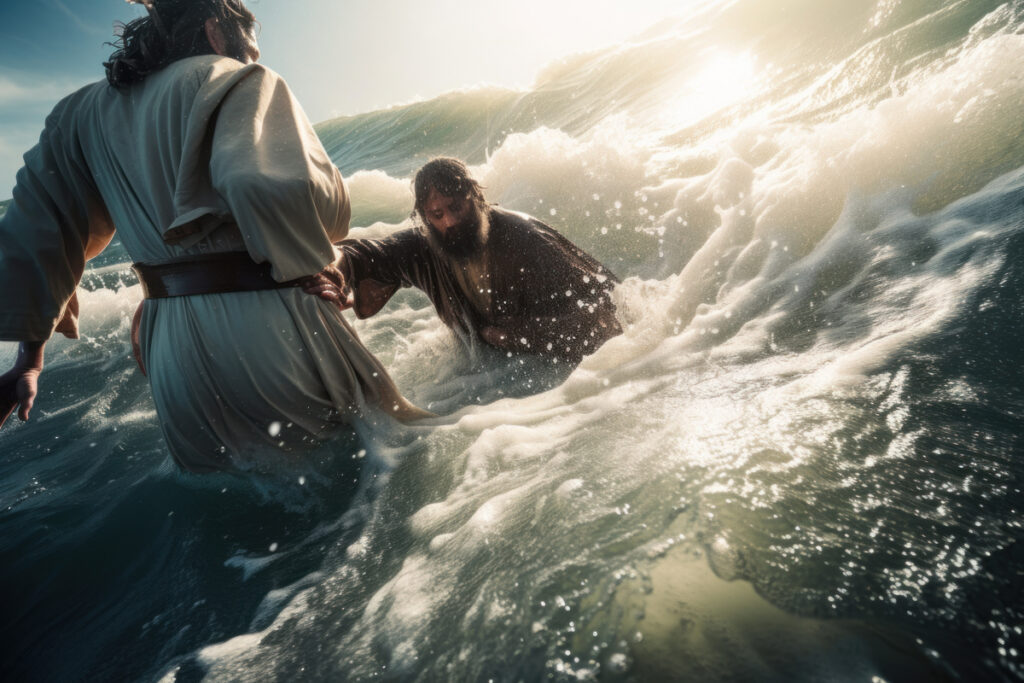
- When he calmed the storm, it wasn’t just about wind and waves. It was about his all-encompassing authority, reminding us that everything on Earth, in the universe, and in heaven must obey his voice (Mark 4:35–41).
- When he healed the sick, it wasn’t just about restoring bodies. It was about restoring our spirits, about compassion, about revealing a God who steps into suffering and offers wholeness (physically and spiritually) for all eternity (Luke 5:12–16).
Every miracle in Scripture pointed to something greater. They weren’t just about what happened but about who made it happen. Miracles were teaching moments about God’s plans, purposes, and priorities. They were intended to motivate people to repent of their sins, receive God’s offer of salvation, and submit to God’s authority and direction over their lives. Miracles were tangible moments when heaven touched Earth, and God’s kingdom broke into human reality.

Miracles: Then and Now
What about today? Have miracles ceased? Are they just relics of a distant past? Just stories of burning bushes, parted seas, and the blind receiving sight?
Some believe miracles belonged to a different time, a biblical era when God made himself known in undeniable ways. But if the God of Scripture never changes, if he’s the same yesterday, today, and forever, then why would his power be any different now than it was then?
The God who split the Red Sea, healed the sick, and raised the dead has not stopped moving.
Miracles still happen.
They may not always come in the form of fire from heaven or a voice from a cloud, but that doesn’t make them any less real. Miracles are not just events; they’re expressions of God’s heart. They tell us he is near when we feel forgotten. And they remind us he is powerful when we feel weak and that he’s ready to assist. They assure us he is faithful when we’re filled with doubt.
And while some miracles are dramatic (seas parting, the blind seeing, the dead rising) many unfold in ways so gentle we might miss them if we’re not paying attention.
- The burden lifts when you pray, even when circumstances haven’t changed.
- The opportunity arises just when you’ve nearly given up hope.
- It’s the hardened heart that softens, the prodigal who returns home; the soul once lost in despair that finds peace.
Through the lens of faith, today’s miracles may look different, but they carry the same message. God is near and working. He’s still making the impossible possible.

What Are Miracles?
Miracles are divine interventions that defy the ordinary course of events and natural laws of the universe.
We live in a world of patterns and predictability.
The sun rises. The tide rolls in. Seasons change.
The laws of nature keep everything moving in perfect rhythm.
But now and then, something happens that doesn’t fit the pattern. Something unexplainable. Something that makes us stop and wonder: Was that more than just chance?
That’s the realm of miracles.
A miracle isn’t just a rare event or an incredible coincidence. It’s more than a feel-good moment or an unexpected turn of luck. A miracle is when God steps in and does what only he can do. It’s something that defies natural explanation and points directly back to him.
Some miracles are dramatic and impossible to miss:
- The withered hand is made completely whole and functional.
- The axehead floats.
- Water is turned into fine wine.
Others are quieter but no less powerful:
- The mother who prayed for her wayward son, only for him to come to faith in a way no one could have predicted.
- The provision that arrives at the exact moment of need, with no logical explanation.
- The peace that floods a broken heart amid tragedy, a comfort no human words could provide.
Miracles are not random or purposeless. They serve as signs, pointing us back to the One who holds everything together. They reveal his power, presence, and love at work.
Miracles vs. Coincidences
How do miracles differ from everyday coincidences or rare events?
The easiest way to tell the difference is by considering the effect.
Coincidences happen. Miracles change us.
A coincidence is an unexpected alignment of events—a surprise, an anomaly, a rare stroke of timing. You bump into an old friend in a city of millions or find a $20 bill in your coat pocket when you need it. You think of someone, and moments later, they call.
These moments feel special, even meaningful, but they don’t transform anything. They’re happy accidents, fleeting moments that come and go without leaving a lasting imprint.
Miracles, however, do more than surprise us—they change us. They don’t just defy the odds; they defy the natural order. A coincidence might make us pause, but a miracle makes us believe.
A coincidence might help you for a moment; a lucky break, a near miss, a perfect turn of events. But a miracle? A miracle alters the course of a life.
- A body riddled with disease is suddenly, inexplicably healed.
- A prodigal, lost in addiction for years, wakes up one day and never turns back.
- A door that should have been sealed shut swings open at just the right moment.
- A heart once filled with bitterness is softened by an unexplainable peace.
- A person bent on habitual evil practices suddenly stops, repairs the damage he’s caused, and consistently manifests Christlike character and love.
Coincidences are mere chances. Miracles are messages. They don’t just happen to us—they happen for us with purpose, meaning, and divine intention.
A coincidence fades with time. A miracle leaves a mark that never disappears.

Evidence of Divine Power
One of the clearest examples of a miracle in Scripture is Jesus raising Lazarus from the dead (John 11:1–44).
Lazarus wasn’t just sick, he had been dead for four days. His body had begun to decay. No doctor, medicine, or natural process could undo what had happened.
But then, Jesus arrived.
Despite the grief of Mary and Martha, the mourners who had gathered, and the weight of hopelessness in the air, Jesus was undeterred. He approached the tomb and commanded that the stone be rolled away.
Martha, ever practical, reminded him, “Lord, by this time there is a bad odor” (John 11:39).
But when has death ever gone too far for the Author of life?
Then, Jesus spoke.
“Lazarus, come out!”
And at the sound of his voice, everything changed.
- The blood that had stopped flowing began to course through his veins again.
- The organs that had shut down came back to life.
- The lungs that had collapsed drew in breath.
- The eyes that had been shut in darkness opened to the light.
A dead man took a breath. A buried man walked out of his tomb.
It wasn’t a coincidence or simply a rare event. It was a miracle.
No one standing there that day could claim otherwise. The mourners who had prepared his body, the family who had wept over his grave, the bystanders who had come to comfort, all of them witnessed the impossible happen right before their eyes. Even the chief priests could not deny the miracle and plotted to kill Lazarus to stem the number of Jews who were deserting them to follow Jesus (John 12:10). The only explanation? The One who holds power over life and death had spoken.
Miracles remind us that God is still in control. They’re his way of showing that he’s not distant or indifferent but is deeply involved in the details of our lives.
So when we see something that defies logic and human explanation and leaves us with only one conclusion, God did this. We stand in the presence of a miracle.
In the end, miracles are not just about what happens.
They are about who makes them happen.

A Scientific Perspective on Miracles
Science loves definitions.
It organizes, categorizes, and classifies. It seeks order in a world that usually follows predictable laws.
Suppose you were to look up the word miracle in a dictionary. You’d likely find something like “a surprising and welcome event that is not explicable by natural or scientific laws and is therefore considered to be the work of a divine agency.”
A simple definition. Neat and tidy.
But a dictionary entry hardly seems enough for something so extraordinary, so world-shaking.
Science deals with what can be measured, tested, and repeated. Miracles, by their nature, refuse to fit into that box.
How Science Interprets Miracles
When met with a miracle—say, a sudden, unexplained healing or a disaster-defying escape—science looks for patterns. Could there be a natural explanation? A biological reason? A statistical probability?
And sometimes, science finds an answer. Diseases go into remission, winds shift, and human resilience surprises us.
But then there are the moments that go beyond probability.
These are the moments that leave doctors utterly dumbfounded. These are moments when all logic says it shouldn’t have happened.
That’s where science meets its match.
- A body riddled with cancer one day, completely cancer-free the next? No explanation.
- A person clinically dead for minutes, even hours, and then suddenly breathing again? No explanation.
- A blind man who sees? A deaf girl who hears? No explanation.
Science, for all its remarkable insight, cannot define the supernatural. It can only be observed when the natural bends to something greater.

Three Types of Miracles—and How Science Views Them
Miracles don’t all look the same. Some come in flashes of divine power, rewriting the laws of nature in an instant. Others unfold slowly, transforming a life over time. Some don’t change circumstances but carry us when we thought we wouldn’t survive.
Science approaches these miracles cautiously, applying the fundamental sensibilities of patterns, probabilities, and natural explanations. It seeks cause and effect, measurable outcomes, and repeatable processes.
But what happens when even the most advanced scientific methods cannot account for what unfolds before us? When the numbers don’t add up, when logic fails, when the unexplainable refuses to fit the formula?
Let’s consider different types of miracles and how science tries to make sense of them.
1. Transcendent Miracles: When Heaven Breaks Through
Transcendent miracles leave no doubt. These are the ones that defy the laws of physics, biology, and time itself. Blind eyes open. The dead are raised.
Take the resurrection of Jesus—the most powerful transcendent miracle in history. The historical evidence is overwhelming:
- an empty tomb
- hundreds of eyewitnesses
- disciples who went from fearful to fearless, willing to die for their testimony
Yet, science struggles to engage with transcendent miracles because they cannot be repeated, tested, or measured.
Scientists might label them as legends, history distortions, or unknown phenomena.
But what science cannot explain, faith embraces. God is not bound by the laws of nature, because he is the One who created them.
If space and time had a beginning, and if science confirms that the universe was caused by something beyond time, space, and matter, then miracles are not just possible, they’re expected. Scientists have done that very thing (see, The Great Miracle below).
2. Transformative Miracles: When God Operates Within the Laws of Physics
Some miracles don’t violate the laws of physics but occur with such remarkable power, timing, and location as to leave no doubt that God was controlling the operation of the natural laws. Some examples include:
- The ten plagues that struck all the Egyptians but none of the Jews (Exodus 7–11).
- The parting of the Red Sea that permitted the passage of the Jews and their livestock but drowned the Egyptian army (Exodus 14).
- King Jehoshaphat’s tiny army that defeated three powerful armies simply by singing, “Give thanks to the Lord, for his faithful love endures forever” (2 Chronicles 20).
3. Transformative Miracles: When God Changes a Life
Some miracles don’t rewrite the laws of nature; instead, they rewrite the human heart.
- An addict walks away from addiction and never turns back.
- A hardened criminal surrenders his life to Christ.
- A marriage on the verge of collapse is restored beyond what seemed possible.
Scientists call these psychological shifts the result of willpower, therapy, or social influence. Psychologists study behavioral change, emotional healing, and the brain’s ability to rewire itself. While those explanations have merit, they fall short when transformation happens suddenly, permanently, and against all human odds.
- Why do some people with an addiction recover after years of failed attempts?
- Why do some people, known for their rage, become gentle overnight?
- Why do some conversions come with no external influence, only an unshakable encounter with God?
Science can describe what happens inside the brain but cannot explain who changes the heart.
Only God can take a broken soul and breathe new life into it. That’s a miracle.
4. Sustaining Miracles: When God Holds Everything Together
In Colossians 1, the apostle Paul explains that Jesus Christ is the creator of all things, that he is before all things and in him all things hold together.
Scientists have discovered the miracle of everything holding together through their research on fine-tuning. For example, they note that without the ratio of the electromagnetic force to the gravitational force and the ratio of the proton mass to the electron mass both being exquisitely and continually fine-tuned there would be no molecules in the universe and, consequently, no life. Similarly, both the strength and the distance ranges over which the strong and weak nuclear forces operate must be exquisitely fine-tuned for atoms to exist in the universe.
In his debate with Eliphaz, Bildad, and Zophar, Job declared that if God were to withdraw his spirit, every living thing would breathe its last breath (Job 34:14).
5. Sustaining Miracles: When God Carries Us Through
Sometimes, the miracle isn’t expressed as the removal of suffering but the strength to endure it.
- A mother who loses a child but still wakes up each morning with peace she cannot explain.
- A man battling cancer, filled with joy instead of fear.
- A woman facing financial ruin yet trusting God like never before.
Science might point to resilience, coping mechanisms, or neurological conditioning, but how do you explain peace where there should be despair? Joy where there should be fear? Strength where there should be nothing left?
The apostle Paul prayed three times for God to remove his “thorn,” but instead, God gave him the grace to endure it (2 Corinthians 12:9).
This is a sustaining miracle. It may not part seas, but it (meaning, God) holds people up when the waves crash down. God may not remove the fire, but he walks with you through the flames.
Science may not be able to explain it, but millions of Christians can testify that when life should’ve broken them, God held them together.

Scientific View: Do Miracles Happen?
Science is a gift, an incredible tool that allows us to explore the depths of the oceans, map the intricacies of the human genome, and glimpse the edges of the universe.
Does science observe miracles? Absolutely.
What it doesn’t do (at least, not within its framework) is label them as such. Where faith sees divine intervention, science sees an event that doesn’t fit the expected model. It acknowledges the pattern break but stops short of calling it a miracle, not out of dismissal, but because a miracle implies divine agency—and science, by its nature, works within the realm of the observable and testable and often excludes the possibility of the supernatural.
Will the residue of the supernatural fit in a lab report? Some say no.
Can the fingerprints of the divine be detected under a microscope? Maybe not with a microscope, but certainly with other scientific instruments such as the James Webb Space Telescope’s exploration of the first billion years of cosmic history giving us more evidence for the biblically predicted big bang creation model and the Initiator and Designer of the universe.
Where it can be unmistakably detected is in the extraordinarily exquisite fine-tuning at every cosmic size scale to make possible the existence of life (human beings in particular) and in the redemption of billions of humans on one planet from their sin and evil. Even more impressive is how much of this multi-faceted fine-tuning simultaneously occurs only during the narrow time window of possible human existence.
So, science has its own words. The term phenomena is a useful one. Science recognizes that, at times, things happen that cannot yet be explained. A disease disappears. A storm changes course at just the right moment. A patient declared beyond hope recovers with no medical explanation.
These cases are documented, studied, and analyzed. But because—with rare exception—they do not lend themselves to repeatability, they remain categorized as extraordinary but unclassified events. One exception is when Christians who believe in the power of prayer pray for the healing and rapid recovery of hospitalized patients they do not know—people recovering from surgery, injury, or disease—without the patients ever knowing.
But for all its brilliance, science has its limits.
Science does not disprove miracles. It simply approaches them from a different lens.
Science can tell us when something is statistically impossible but can’t explain why it happened. It can observe the laws of physics, but can’t account for the moments when they appear to bend
Yet even science points to something beyond itself in its search for truth. Behind the forces of gravity, behind the finely tuned laws of the universe, behind the order and complexity of creation, there is a Lawgiver.
The Great Miracle: The Birth of Space and Time
If we’re looking for the most profound, undeniable miracle, we need only look to the universe’s beginning.
Before the first star flickered, before time had a first second, before space had a place to exist—God was.
And then, in a moment beyond human comprehension, he spoke. And everything began.
Science confirms what Christianity knows: The universe had a beginning. The space-time theorems of general relativity prove that the cosmic time and space dimensions we can observe had a beginning, that the universe we can observe came from that which we cannot observe (Hebrews 11:3).
But that raises the question: who or what created the space, time, matter, and energy that we observe?
The cause of all this must be an Entity beyond the time, space, matter, and energy that we observe; something uncaused, something eternal.
That “something” is a “Someone.”
And if the entire universe (the very fabric of existence) is built on a miracle, why should we doubt that any lesser miracles are possible?
More Miracles: The Origin of Life
Miracles didn’t stop with the stars. Life appeared. Some scientists assert that life arose naturally from nonlife on the early Earth. Yet despite decades of effort, no one has been able to replicate this process in the lab. While experiments have successfully simulated some of the basic chemical steps involved in the origin of life, these results were achieved only under tightly controlled conditions—using pure, preselected chemicals, regulated temperature and humidity, ideal pH levels, and the elimination of all contaminants and competing reactions.
Such conditions bear little resemblance to the chaotic, uncontrolled environment of the early Earth. Ironically, these very experiments demonstrate that the emergence of life requires far more knowledge, precision, and power than even the most skilled, well-funded scientists can provide—pointing instead to the work of an intelligent Creator.
That emergence includes not just physical life, but soulish and spiritual life.
Science can describe the biological complexity of a cell, map the human genome, and explain neural pathways, but it cannot explain why humans are different.
- Why do we have a moral compass?
- Why do we seek meaning and purpose beyond survival?
- Why do we long for eternity?
We are not just flesh and bone or only have electrical signals firing in the brain. We are soulish and spiritual beings, handcrafted by a Creator who placed eternity in our hearts.
Science can explain how life functions but cannot explain why we know there is more to life than existence.
Within the scientific community, some moments refuse to be explained, instances that challenge what is known and stretch the limits of understanding.
Spontaneous healings are among these mysteries. Researchers have documented cases where diseases vanish, wounds heal overnight, and medical scans show conditions that no longer exist despite no medical intervention that can account for the change.
Near-death experiences also defy explanation. Patients who have been clinically dead—some for minutes, others for longer—later describe encounters beyond this world or details of their surroundings beyond what their physical bodies or physical organs can detect. For example, a patient under anesthesia on the operating table describing upon recovery surgery tools that were beyond the line of sight of her body.
Scientists have spent years researching these accounts and have found compelling evidence that consciousness continues after brain activity ceases. While difficult to measure in a lab, these reports consistently suggest there’s more to human existence than the physical body.
Similarly, visions of recently passed loved ones have been widely reported, particularly in end-of-life care. Studies published by PubMed Central (PMC) suggest that as many as 50% of hospice patients experience brief, 5- to 6-second visions of deceased loved ones, offering reassurance that they are at peace in the afterlife.
For scientists who hold a strictly naturalistic view that assumes only what is measurable is real, these accounts are often dismissed as anomalies, coincidences, or the result of psychological and physiological factors.
Spontaneous healing can be attributed to unknown biological mechanisms or misdiagnoses.
At the same time, near-death experiences are sometimes explained as the brain’s response to extreme stress, a surge of neural activity, or even hallucinations brought on by oxygen deprivation.
Similarly, visions of deceased loved ones can be interpreted as the product of memory recall, subconscious processing, or the brain’s way of easing the transition from life to death.
Yet, despite these rationalizations, such experiences persist across cultures, eras, and belief systems, defying simple explanations. Many scientists who initially dismissed them as unscientific have been drawn into more profound research, compelled by the consistency of these reports and their profound impact on those who experience them.
Studies in quantum physics, consciousness, and neurobiology have begun to challenge the notion that reality is purely physical, raising new questions about the nature of existence, perception, and the limits of empirical observation.
While the scientific method relies on measurable, repeatable phenomena, some moments transcend those boundaries, leaving even the most skeptical minds with lingering questions.
For some, whether these mysteries represent the limits of current scientific understanding or point to something beyond the physical realm remains debatable. However, one thing is clear: Human experience doesn’t always fit neatly into what can be seen, tested, and quantified.
For those willing to consider the supernatural, these moments point to a reality far greater than what science alone can uncover.

The Skeptic’s View: Why Some People Doubt Miracles
Not everyone accepts the idea of miracles.
Some struggle because they’ve never witnessed one, and others find it hard to believe in something that cannot be tested or reproduced.
Psychologists often argue that hope, cultural background, or perception may influence some miraculous claims. They say the mind is powerful, and people may interpret events as supernatural in moments of deep emotion or trauma.
Yes, the human mind is powerful. Faith can bring strength in suffering. Hope can change our outlook. But faith apart from God cannot cure cancer. Hope apart from God cannot bring the dead back to life.
There are times when something happens that goes beyond human psychology and reasoning. And when that happens, we must ask: Who is behind it?
To acknowledge miracles is to recognize a Miracle-Maker. It is to admit there is something—or Someone—more significant than us. And for some, that’s a difficult concept to accept. To embrace miracles is to surrender to the reality that we are not the ones writing the story.
Some resist the idea, not because miracles lack evidence but because miracles point to a God who is sovereign, in control, and not bound by our limitations.
And if that’s true, then it raises the question of what that means for us.
Faith and Science: Complementary, Not Contradictory
This is where faith and science meet, not as rivals but as partners in the search for truth.
If miracles are real, faith and science can help us understand them. The two are not enemies; at their best, they are allies.
- Science explains how things work. Miracles remind us who is at work.
- Science studies creation. Miracles reveal the Creator.
- Science seeks knowledge. Miracles whisper of a deeper truth.
Skeptics may demand more proof, and scientists may wrestle with what cannot be measured. But in the end, miracles are not so much about data but revelation.
They are God’s fingerprints left on the world he created.
They are the impossible made possible by the One who has never been bound by impossibility.
And maybe, just maybe, they are invitations to believe, to trust, to open our eyes to a world far greater than the one we can see.
But miracles—whether in the birth of the universe, the origin of life, the formation of the soul, the resurrection of Jesus, or the healing of the broken- continue to whisper a truth. The truth that there is more to this world than what we can see.
The question is are we willing to look beyond what we can measure and step into what we must believe?

Miracles vs. Magic: The Power Behind the Impossible
Miracles and magic often get tangled together in a world captivated by the extraordinary.
Both speak of things unseen and break from the expected. Both stretch the limits of human understanding.
But look closer, and you’ll see they are not the same, not even close.
Magic is an illusion, a crafted spectacle designed to deceive the senses, while miracles are interventions that transcend what naturally happens under the operation of the laws of physics and chemistry. It seeks to impress, drawing attention to the performer’s skill, whereas miracles seek to reveal something greater, pointing beyond human capability.
Magic is about manipulating perception to create wonder, but miracles are about surrender, inviting trust in something beyond explanation.
One is a performance. The other is a proclamation.
The Difference Between Miracles and Magic
Magic is about illusion, manipulation, and control. It attempts to bend reality to human will, whether through sleight of hand, deception, or the pursuit of hidden forces. Magic whispers, “Look what I can do. Look at my power.”
A miracle, however, is not man’s attempt to gain power; it’s God’s revelation of his power. It’s not an illusion or an act of deception but truth breaking through.
| Magic | Miracles |
| seeks to entertain or impress | seek to reveal and redeem |
| is about technique, formulas, and secret | are about relationship—God’s hand |
| knowledge | moving on behalf of his people |
When Jesus performed miracles, he never did them for spectacle.
He didn’t turn stones into bread to satisfy his hunger or summon angels to rescue him from the cross. His miracles were meant to heal, restore, and proclaim God’s kingdom’s presence.
When the blind received sight, it was about restoring vision and revealing the Light of the World.
When the storm was calmed, it wasn’t just about silencing the waves. It was about revealing the One whom even the winds and seas obey.
When the dead were raised, it wasn’t just about bringing life back to a body. It was about pointing to the resurrection power of the Savior who would conquer death itself.
Magic tricks the eye. Miracles transform the heart.
Is Magic Real?
The Bible is clear on this topic. There is a supernatural realm and forces beyond human understanding. But not all supernatural power comes from God.
Scripture warns against sorcery, divination, and attempts to seek power outside God (Deuteronomy 18:10–12; Acts 8:9–24). Why? Because magic is about self-exaltation. It’s about seeking power apart from the Creator.
Consider Pharaoh’s magicians in Exodus. They mimicked some of Moses’s miracles—turning staffs into serpents and water into blood. But they couldn’t undo what God had done, and they couldn’t match his power. Ultimately, they were defeated, unable to stand before the one true God.
There is no competition between magic and miracles. One is a counterfeit. The other is the real thing.
The Bible acknowledges that angels, both the righteous angels and the evil angels, can perform miracles to a limited degree. Consequently, John, in his first epistle exhorts us, “Do not believe every spirit, but test the spirits to see whether they are from God” (1 John 4:1).
The Significance for Christians
Why does this matter? Because where we seek our power determines where we place our faith.
The world is drawn to magic because it promises control. Miracles remind us that God is in control.
Magic says that if you learn the secret, say the right words, and tap into the right force, you can shape your destiny.
Miracles say, “Be still and know that I am God.”
The faithful don’t chase after illusions, after hidden forces, after shadows pretending to be light. We follow the One who created light itself.
Miracles are not about what we can do. They are about what God has already done and is still doing.
Because absolute and eternal power doesn’t come from spells, formulas, or human effort. It comes from the One who spoke the universe into existence, the One who conquered the grave, the One whose name makes demons tremble and hearts come alive.
And that’s no illusion. That’s true. That’s Jesus.

The Miracle Worker: The Evidence of a Living God
Miracles are more than just moments that make us wonder. They are signposts pointing to the One who holds all things together. They whisper through the impossible, echo through the unexplainable, and remind us that we are not alone.
Because behind every miracle—every healing, every divine provision, every heart that beats again—is a living, present, all-powerful God.
God: The Source of All Miracles
From the first breath of creation to the resurrection of Christ, every miracle in history has one common denominator: God himself.
The Red Sea didn’t part because of Moses’s greatness. The blind didn’t see because of their strength. The dead didn’t rise by accident. These things happened because the Creator of the universe stepped in and did what only he can do.
Miracles are not random events. They are evidence. Evidence of God’s power and his love. Proof that he is not distant or detached but deeply involved in the lives of his children.
Science may explain the mechanics of the world, but miracles reveal the heart of the One who made it. They remind us that we’re more than atoms and molecules—that eternity is real, that hope is not in vain, and that the impossible is possible when placed in God’s hands.
1: God Works Through His People
Although miracles originate from God, he often works through people to accomplish his purposes.
He used Moses to call down plagues and part the sea, Elijah to bring fire from heaven, Peter to heal the sick, and Paul to raise the dead.
And he still uses his people today.
- The doctor who prays before surgery and watches a tumor disappear.
- The missionary who lays hands on the sick and witnesses their healing.
- The Christian who speaks a word of truth that turns a hardened heart toward Christ.
Miracles aren’t locked in the pages of history. They still unfold in the lives of those who trust him, step out in faith, and believe that the same God who worked wonders then is still working today.
2: All God’s People Can Experience Miracles
The apostle Peter exhorts Christians to always be ready to give good reasons for their faith and hope in Jesus Christ, and to do so with gentleness, respect, and a clear conscience (1 Peter 3:15–16). When Christians undergo such preparation, God will perform miracles to bring them into contact with non-Christians who will respond to the good reasons and Christian demeanor by committing to become followers of Jesus Christ. Examples of such miracles are documented in the book of Acts. They also occur in the lives of many Christians today as documented in the book, Always Be Ready
Are Miracles Real? Signs of a God Who Still Moves
Miracles surround us. Some are grand, and some are quiet. But they all speak the same truth that God is near.
The greatest miracle isn’t just what God has done. It’s what he is still doing. In hearts, in lives, in moments we may never fully understand.
One day, we will experience the crowning miracle of God’s story. The moment we step into eternity, where every tear is wiped away, death is no more, and God’s presence is not just felt but seen.
Until then, we walk by faith.
We trust. We believe. And we give thanks to the God of miracles.
Frequently Asked Questions About Miracles
Miracles spark wonder, stir faith, and make us lean in and ask the big questions. Here are a few quick answers to some of the most common ones.
1. What Is the True Meaning of a Miracle?
At its core, a miracle is a sign—a glimpse of God’s power, a whisper of his presence, a reminder that he is near.
A miracle isn’t just an unlikely event or a happy coincidence. It occurs when God steps in and does what only he can do. It’s when the natural world bows to the supernatural, the impossible becomes possible, and heaven touches Earth.
2. Why Don’t We Hear More About Miracles?
Miracles happen more often than we realize. The problem isn’t that God isn’t working; the problem is that we aren’t always seeing.
Sometimes, we expect miracles to look like lightning from heaven, but more often, they unfold unexpectedly. A prodigal child returning home. A cancer scan that comes back clear. A moment of peace in the middle of the storm.
Miracles happen all around the world, but we often dismiss them. Missionaries report healings and doctors see recoveries they can’t explain. God is still moving. The question is do we have eyes to see them?
3. Can Miracles Still Happen Today?
Absolutely.
The same God who parted the Red Sea, raised Lazarus, and fed 5,000 with a few loaves and fish has not changed. His power is not confined to the past.
Miracles still happen in hospital rooms, church pews, and the faithful’s quiet prayers. People are healed, hearts are restored, and prodigals come home.
And the greatest miracle of all? A life transformed by Jesus.
Some miracles unfold instantly, and others take time. But God is still at work. He still hears, moves, and does the impossible.
4. Why Are Some Prayers Miraculously Answered While Others Are Not?
This is a tricky question. If we’re honest, we’ve all struggled with it.
If God can do anything, why does he sometimes seem silent?
Here’s the truth: Every prayer is heard. Every prayer is answered.
But not always in the way we expect.
- Sometimes, God says yes.
- The healing comes. The provision arrives. The door swings wide open.
- Sometimes, God says wait.
- Because something is happening behind the scenes—something we can’t yet see.
- Sometimes, God says no.
- Not because he doesn’t care but because he sees what we cannot. Because what we want isn’t always what we need. Because his plan is always bigger, always better, and always filled with wisdom beyond our understanding.
Even when the miracle doesn’t happen as we hoped, God is still good. His love is still sure, and his presence is still near.
And one day, when we stand in his presence and see the whole picture, every seemingly unanswered prayer will make sense.
Until then, we trust.
We believe.
We hold onto the God who still works miracles.