

The miracles of Jesus Christ aren’t just ancient wonders; they’re glimpses into his heart—a heart overflowing with power, compassion, and a relentless love for a world that needs redemption.
As John 21:25 reflects, “Jesus did many other things as well. If every one of them were written down, I suppose that even the whole world would not have room for the books that would be written.”
Let’s step into these stories, marveling at the One who walks on water, restores the broken, and reminds us that no need is beyond his reach—especially reconciliation for our sins.
Miracles of Jesus in Order
The miracles of Jesus demonstrate his identity as the Messiah. Organized chronologically, Jesus’s miracles reveal his power over nature, sickness, and death and underscore his mission to restore and redeem humanity. Recognizing that the four Gospels overlap and sometimes repeat material, this article provides a reasonable chronology of Jesus’s healings. Taken cumulatively, it testifies to Jesus’s compassion and love for people who suffer.

1. Turning Water into Wine: John 2:1–11
At a wedding in Cana, joy turned to panic as the wine ran out. Mary told Jesus, “They have no more wine.” He instructed the servants, “Fill the jars with water,” and when they obeyed, the water turned into “the best wine,” astonishing the banquet master and saving the celebration.
This first miracle wasn’t about spectacle; it was about compassion. Jesus transformed potential shame into overflowing joy.
By choosing a wedding for his debut, he revealed that God delights in our celebrations and turns the ordinary into the extraordinary. “I have come that they may have life and have it to the full.”
2. Healing the Official’s Son: John 4:46–54
A royal official from Capernaum traveled over 20 miles to plead with Jesus: “Sir, come down before my child dies.”
Instead of going with him, Jesus declared, “Go, your son will live.” The man believed Jesus’s word and began his journey home. On the way, his servants met him with joyous news: his son had recovered at the exact moment Jesus had spoken.
This miracle was about faith. The official had no evidence, only Jesus’s word, and that was enough. His trust transformed not only his son’s fate but also the hearts of his entire household.
3. Driving Out a Demon: Mark 1:21–27; Luke 4:31–37
As Jesus taught in Capernaum, a man possessed by an unclean spirit cried out, “What have you to do with us, Jesus of Nazareth? Have you come to destroy us? I know who you are—the Holy One of God!”
Jesus rebuked him: “Be silent, and come out of him!” At his command, the spirit fled, leaving everyone astonished at his authority.
His words brought light into the darkest of struggles. In times of oppression or fear, we can trust in his unmatched power to deliver and restore, knowing no force of darkness can withstand his command.
4. Healing Peter’s Mother-in-Law: Mark 1:29–31; Luke 4:38–39
In Capernaum, Jesus entered Peter’s home and found his mother-in-law bedridden with a fever. He approached her, touched her hand, and the fever left her. “She got up and began to serve Him.”
In a moment, weakness turned to strength, and isolation gave way to purpose. Jesus’s touch brought wholeness, showing his compassion reaches into our deepest needs.
His healing isn’t just about the body and restoring life, purpose, and belonging. With Jesus, what feels broken can be made whole, and even small acts of service become sacred.
5. Healing Many Sick: Mark 1:32–34; Luke 4:40–41
As the sun set on the Sabbath, “all who had various kinds of sickness, and laying his hands on each one, healed them.” He also cast out demons, rebuking them and would not allow them to speak, asserting his authority over the spiritual realm.
This moment displays the Savior’s boundless mercy and sovereignty. Jesus healed with tenderness, confronted darkness with strength, and chose the timing of his revelation.

6. The Miraculous Catch of Fish: Luke 5:1–11
At dawn on the Sea of Galilee, Simon Peter’s empty nets told a story of effort without reward. Then Jesus stepped into his boat—and into his life.
With a simple command, the nets overflowed with abundance. Overwhelmed by the miracle, Peter fell to his knees, confessing his unworthiness.
But Jesus, full of compassion, lifted him. “Don’t be afraid; from now on, you will fish for people,” he said, offering Simon, James, and John a new purpose. They left everything—their boats, nets, and old lives—and followed him.
Jesus meets us in our empty boats when our efforts fall short. He calls us to trust him, step out in obedience, and experience his overflowing provision.
Just as he transformed Simon’s vocation, he calls us to a higher purpose—to share his love and grace with a world in need.
7. Healing a Leper: Mark 1:40–45; Matthew 8:2–4; Luke 5:12–16
A man burdened by leprosy—an affliction that isolated him from family and community—approached Jesus with trembling faith.
Falling to his knees, he whispered a plea filled with hope and humility: “Lord, if you are willing, you can make me clean.”
Moved, Jesus did the unthinkable. He reached out and touched him.
“I am willing,” he said. “Be clean!”
At that moment, leprosy vanished, and the man was restored physically, emotionally, and socially.
By touching the untouchable, Jesus shattered societal barriers, showing that his love knows no limits. It’s a powerful reminder that Jesus Christ welcomes all who come to him in faith, ready to cleanse, restore, and make us whole.
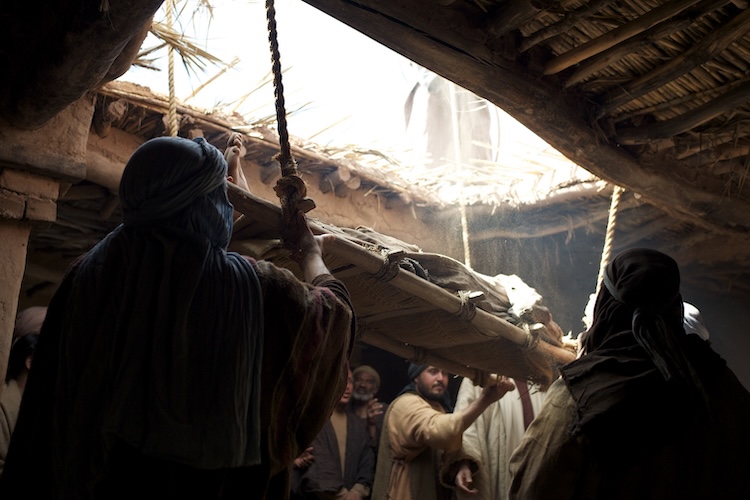
8. Healing a Paralytic: Mark 2:1–12; Matthew 9:1–8; Luke 5:17–26
As Jesus returned home, many eager listeners gathered at his house to hear his message. Undeterred by the crowd, four friends clambered onto the roof, dismantled it, and lowered their disabled companion before Jesus.
Moved by their faith, Jesus declared, “Son, your sins are forgiven.” Perceiving doubts by the scribes, Jesus challenged, “Which is easier: to say, ‘Your sins are forgiven,’ or ‘Get up and walk’?” He commanded the person with paralysis, “Rise, take your mat, and go home.” Immediately, the man stood, gathered his mat, and walked out.
This miracle reveals Jesus’s authority to forgive sins and heal, meeting spiritual and physical needs. It’s a testament to the power of faith and the lengths true friends will go to bring someone to the Savior who restores completely.
9. Healing a Man with a Withered Hand: Mark 3:1–6; Matthew 12:9–14; Luke 6:6–11
On a Sabbath morning, Jesus healed a man with a withered hand, challenging the Pharisees’ hardened hearts and questioning their legalism: “Is it lawful to do good or harm on the Sabbath?” Restoring the man’s hand, Jesus’s act of mercy intensified opposition as the Pharisees conspired with the Herodians against him.
This moment was a declaration of God’s priorities. Jesus showed that mercy, not legalism, fulfills the Sabbath’s purpose.
In restoring the man, he revealed a God who values compassion over rules and wholeness over ritual, reminding us that love is always the highest law.
10. Healing a Centurion’s Servant: Matthew 8:5–13; Luke 7:1–10
In Capernaum, a centurion’s servant lay gravely ill. Feeling unworthy, he sent others to Jesus with a powerful message: “Just say the word, and my servant will be healed.”
Jesus declared, “I tell you, not even in Israel have I found such faith.” Upon returning to the house, the messengers found the servant wholly healed.
In this act of trust, the centurion moved God’s heart, and his servant was healed. Jesus’s love transcends divisions, and faith in his authority can bring miraculous change.
11. Raising a Widow’s Son: Luke 7:11–17
In the village of Nain, a widow led a funeral procession for her only son, her grief compounded by the loss of her sole provider. As they approached the town gate, Jesus arrived with his disciples and a large crowd.
He told her, “Don’t cry.” Touching the bier, he commanded, “Young man, I say to you, get up!” The dead man sat up and began speaking, and Jesus returned him to his mother.
It wasn’t just power on display; it was his deep compassion, his heart breaking alongside those who mourned.
In this moment, Jesus revealed that God isn’t distant from our suffering—he steps into it, bringing light to the darkest places. It’s a promise that even in the face of death, his love is stronger, his presence unwavering, and his hope eternal.
12. Calming the Storm: Mark 4:35–41; Matthew 8:23–27; Luke 8:22–25
One evening on the Sea of Galilee, a fierce storm threatened to sink the disciples’ boat as Jesus slept peacefully. Terrified, they woke him, crying, “Do you not care we are perishing?”
“Peace! Be still!” Jesus said, calming the storm. Awestruck, they marveled, “Who is this, that even the wind and sea obey Him?”
Just as Jesus calmed the raging sea, he offers peace amid life’s tempests, reminding us that his presence brings comfort and assurance, even when circumstances seem overwhelming.
13. Casting Out a Legion of Demons: Mark 5:1–20; Matthew 8:28–34; Luke 8:26–39
In the region of the Gerasenes, a man tormented by demons lived among the tombs, isolated and broken. Then Jesus commanded, “Come out of this man, you impure spirit!”
The demons fled into a herd of pigs, which plunged into the lake. The man, now clothed and in his right mind, sat at Jesus’s feet, restored.
The townspeople, amazed yet fearful, begged Jesus to leave, unable to embrace the transformation before them.
This story reminds us how often we resist change, even when wrapped in God’s grace. Yet Jesus Christ calls us to trust his power, knowing that his transformation brings freedom, light, and the life we were created to live.
14. Healing a Woman with a Blood Issue: Mark 5:25–34; Matthew 9:20–22; Luke 8:43–48
In a crowded throng, a woman who had suffered twelve years of bleeding reached out in desperation to touch Jesus’s garment. “If I just touch His clothes, I will be healed,” she thought. Instantly, her bleeding stopped.
Jesus asked, “Who touched me?” Trembling, she confessed, and he replied with compassion, “Daughter, your faith has healed you. Go in peace and be freed from your suffering.”
Jesus’s touch went beyond her illness—it restored her health, dignity, and connection to God. This is the Savior we meet: One who sees, heals, and shows that even trembling faith can lead to a life fully renewed.

15. Raising Jairus’s Daughter: Mark 5:22–24, 35–43; Matthew 9:18–19, 23–26; Luke 8:41–42, 49–56
In Capernaum, a desperate father fell at Jesus’s feet, his heart breaking for his dying daughter. Jairus’s plea was met with compassion, but before they could reach her, news came that it was too late.
Yet, Jesus’s words cut through the despair:
Don’t be afraid; just believe.
At the house, surrounded by mourners, Jesus saw beyond the grief. “She is not dead but asleep,” he said. Taking her hand, he spoke life into the silence: “Little girl, get up.” And she rose, her life restored.
This miracle calls us to trust him beyond our deepest fears, reminding us that with him, even the darkest moments hold the promise of hope and life.
16. Healing Two Blind Men: Matthew 9:27–30
One day, as Jesus departed, two blind men followed, their voices cutting through the crowd: “Have mercy on us, Son of David!” Their cry wasn’t just desperation—it was a declaration of faith, proclaiming Jesus as the Messiah.
When he asked, “Do you believe I can do this?” Their answer was simple yet profound: “Yes, Lord.”
With a touch, Jesus responded, “According to your faith, let it be done.” Instantly, their world transformed as sight was restored and darkness fled.
Their belief unlocked the miracle they longed for, showing that trusting Jesus isn’t just transformative—it’s the key to seeing him for who he truly is.
17. Healing a Man Who Was Mute: Matthew 12:22–23
A demon-possessed man, blind and mute, was brought to Jesus. With authority, Jesus healed him, and the man could see and speak. The crowd, witnessing this transformation, marveled, asking, “Could this be the Son of David?”
The man’s blindness and silence symbolized the enemy’s grip, which dimmed vision and silenced hope. But Jesus brought light where there was darkness and words where there were none.
With one act, Jesus revealed his power to restore, offering hope to every heart longing to be set free.
18. Healing an Invalid at the Pool of Bethesda: John 5:1–16
At the Pool of Bethesda, hope mingled with despair as a paralyzed man waited, bound by his condition for 38 long years. Jesus saw him—truly saw him—and asked, “Do you want to be healed?”
The man’s story was one of missed opportunities and unmet dreams. But Jesus, full of compassion and authority, didn’t focus on the past.
He spoke life into the moment: “Get up, take your mat, and walk.” Instantly, strength replaced weakness, and the man rose, carrying his mat as a testament to his transformation.
Jesus sees us in our waiting, hears our struggles, and calls us to rise into the wholeness only he can provide.

19. Feeding the 5,000: Mark 6:30–44; Matthew 14:13–21; Luke 9:10–17; John 6:5–14
Five thousand gathered to hear Jesus teach and see him heal. As evening fell, he told his disciples, “You give them something to eat.” With five loaves and two fish, Jesus gave thanks, broke the bread, and fed everyone. Miraculously, thousands were satisfied, and twelve baskets of leftovers remained.
His compassion turned scarcity into abundance, meeting both physical and spiritual needs. It wasn’t just provision—it was a revelation of his divine nature, showing that with him, there is always more than enough to satisfy every need.
20. Walking on Water: Mark 6:45–52; Matthew 14:22–33; John 6:15–21
After feeding the five thousand, Jesus prayed alone as his disciples struggled against the wind on the Sea of Galilee. Walking out to them on the water, he calmed their fears. Peter, faltering in faith, sank but Jesus rescued him.
The wind ceased, and the disciples worshipped, proclaiming, “Truly, you are the Son of God.”
Jesus shows his power over the forces of nature and his unwavering presence in life’s chaos. It’s a call to faith—a reminder that no matter how fierce the storm, we can trust the One who commands the winds and waves with just a word.
21. Jesus Heals Many Sick in Gennesaret: Matthew 14:34–36; Mark 6:53–56
In Gennesaret, news of Jesus spread quickly. People brought their sick, laying them in marketplaces, hoping to touch even the fringe of his garment.
Their faith was rewarded, as Scripture declares, “And as many as touched it were made well.” Lives were transformed through simple belief.
This moment shows the limitless reach of Jesus’s compassion, stretching across humanity’s brokenness.
Lives were restored with every touch and every act of belief. This reminds us that faith, no matter how simple, can unlock healing and transformation in the hands of the Savior.
22. Healing a Gentile Woman’s Daughter: Matthew 15:21–28; Mark 7:24–30
A Canaanite woman pleaded with Jesus to heal her demon-oppressed daughter. As a Gentile, she faced resistance, but her faith overcame the barriers.
Jesus proclaimed, “Great is your faith! Be it done as you desire,” and her daughter was healed instantly.
Here, we see his love knows no borders, and his grace [TK: Cheryl: this links to a post that was accidentally archived] has no limits. Through faith, he welcomes all who seek him, proving that God’s heart is open to everyone, regardless of culture or background.
23. Healing a Deaf and Mute Man: Mark 7:31–37
Journeying through the Decapolis region, Jesus encountered a deaf man with a speech impediment. Kindly, he took the man aside, placed his fingers into his ears, and touched his tongue.
Looking up to heaven, Jesus sighed and commanded, “Ephphatha,” meaning “Be opened.”
Immediately, the man’s ears opened, his tongue loosened, and he began to speak plainly.
Jesus’s tender heart meets brokenness with empathy and power. He restored hearing and speech, showing his unmatched authority to heal and his deep care for every individual’s needs.
24. Feeding the 4,000: Mark 8:1–10; Matthew 15:32–39
A crowd stayed with Jesus for three days, hungry for his words but without food.
Jesus said, “I have compassion for these people; they have already been with me three days and have nothing to eat.”
Taking seven loaves and a few fish, he gave thanks, broke them, and multiplied them into abundance. Thousands ate and were satisfied, and seven baskets of leftovers remained.
This was more than a meal—it was a feeding in faith and trust. Jesus showed that even the smallest offering becomes more than enough in his hands. The overflowing leftovers remind all that God’s provision doesn’t just meet needs—it exceeds them.
25. Healing a Blind Man at Bethsaida: Mark 8:22–26
In Bethsaida, people brought a blind man to Jesus, pleading for healing. Taking him by the hand, Jesus led him outside the village, spat on his eyes, and laid hands on him. “Do you see anything?” he asked. The man replied, “I see people; they look like trees walking around.”
With a second touch, his sight was fully restored, and he saw everything clearly.
Here, Jesus demonstrates patience and personal care. He didn’t rush the process but met the man where he was, restoring his vision in stages. This isn’t just about seeing the world clearly—it’s about seeing Jesus for who he is: the One who gently leads us into the fullness of life.
26. Healing a Man Born Blind: John 9:1–41
When Jesus met a man blind from birth, he rejected the idea that his condition was punishment for sin, declaring instead that it was an opportunity to reveal God’s works.
Mixing mud with saliva, he applied it to the man’s eyes and told him to wash in the Pool of Siloam. The man obeyed and returned healed, proclaiming, “I was blind, but now I see!”
Through healing, the man recognized Jesus as the Savior and boldly testified, even in the face of opposition. This shows us that God’s purpose can shine through any circumstance.
27. Healing a Boy with an Unclean Spirit: Mark 9:14–29
Descending from the Mount of Transfiguration, Jesus stepped into the chaos of a desperate father pleading for his possessed son. The disciples had tried to help but failed. The father cried, “If you can do anything, take pity on us and help us.”
Jesus replied, “‘If you can’? Everything is possible for one who believes.” The father responded with raw honesty, “I believe; help me overcome my unbelief!”
With divine authority, Jesus rebuked the spirit and restored the boy. Later, he explained, “This kind can come out only by prayer.”
Even fragile faith can lead to miracles. Jesus didn’t just heal the boy—he lifted an entire family from despair, reminding us that spiritual battles are won through reliance on God.
28. Temple Tax Paid with a Coin from a Fish’s Mouth: Matthew 17:24–27
In Capernaum, tax collectors asked Peter, “Does your teacher not pay the temple tax?”
Jesus explained that as God’s Son, he was exempt. Still, he chose to pay to avoid offense.
He instructed Peter, “Go to the lake and throw out your line. Take the first fish you catch; open its mouth, and you will find a four-drachma coin. Take it and give it to them for my tax and yours.”
This event reveals the value of peace over rights, his authority over creation, and God’s surprising yet always sufficient provision.
29. Healing a Blind and Mute Demoniac: Matthew 12:22–32
Jesus stepped into the chaos of a man’s torment, restoring his sight and speech where darkness had ruled. With mercy and authority, he revealed his power to heal both the seen and unseen, showing that no part of us is beyond the reach of his grace.
While the crowd marveled, the Pharisees accused him of working by demonic power.
Jesus silenced them with truth:
Every kingdom divided against itself will be ruined. . . . But if it is by the Spirit of God that I drive out demons, then the kingdom of God has come upon you.
This was a glimpse of heaven touching earth. With Jesus, light always overcomes darkness, and God’s kingdom stands unshakable.
30. Healing a Woman Crippled for 18 Years: Luke 13:10–17
While teaching on the Sabbath, Jesus noticed a woman crippled for eighteen years, bent under her affliction. Kindly, he called her forward and said, “Woman, you are set free from your infirmity.” Laying his hands on her, he healed her, and she immediately stood straight, praising God.
When the synagogue leaders objected, Jesus exposed their hypocrisy: “Doesn’t each of you untie your ox or donkey on the Sabbath to give it water? Then shouldn’t this daughter of Abraham, whom Satan has kept bound for eighteen long years, be set free on the Sabbath?”
His words silenced his critics and filled the crowd with joy. This miracle speaks to all who feel weighed down, reminding us that Jesus sees, heals, and sets us free to stand tall in his love.
31. Healing a Man with Dropsy on the Sabbath: Luke 14:1–6
On the Sabbath, while dining at a Pharisee’s house, Jesus noticed a man suffering from dropsy (abnormal swelling) and asked, “Is it lawful to heal on the Sabbath, or not?”
When no one answered, he healed the man and sent him away.
Addressing hypocrisy, Jesus asked, “If one of you has a child or an ox that falls into a well on the Sabbath day, will you not immediately pull it out?” His words left them speechless and exposed their hardened hearts.
Jesus’s actions revealed that compassion outweighs legalism. In a room filled with silence and judgment, he taught that God’s law is fulfilled through love and mercy. He calls us to extend the same compassion he so freely offers.
32. Cleansing Ten Lepers: Luke 17:11–19
On his way to Jerusalem, Jesus encountered ten lepers who cried out, “Jesus, Master, have mercy on us!” He instructed them, “Go and show yourselves to the priests.” As they obeyed, they were healed.
But only one, a Samaritan, turned back. With a loud voice, he praised God and fell at Jesus’s feet in gratitude. Jesus asked, “Were not ten cleansed? Where are the nine? Was no one found to return and praise God except this foreigner?”
To the Samaritan, Jesus said, “Rise and go; your faith has made you well.”
Here, we are called to respond to God’s blessings with faith, gratitude, and worship. And we are shown that true healing transforms the heart.

33. Raising Lazarus from the Dead: John 11:1–44
Lazarus, the beloved brother of Mary and Martha, was gravely ill. When they sent word to Jesus, he assured them, “This sickness will not end in death; it is for God’s glory.” Yet by the time he arrived in Bethany, Lazarus had been in the tomb for four days.
Meeting Martha, Jesus declared, “I am the resurrection and the life. The one who believes in me will live.” Overcome by Mary’s grief, “Jesus wept.” At the tomb, he prayed and then commanded, “Lazarus, come out!” And Lazarus emerged alive.
This miracle wasn’t just about restoring life—it was a glimpse of eternity. With Jesus, death never has the final word.
34. Restoring Sight to Bartimaeus: Mark 10:46–52
As Jesus passed through Jericho, blind Bartimaeus cried out, “Son of David, have mercy on me!” The crowd rebuked him, but Bartimaeus persisted.
Jesus stopped and called him forward. Casting aside his cloak, Bartimaeus leaped toward the Savior with a bold request: “I want to see.”
Jesus replied, “Your faith has healed you.” And his sight was restored. From then on, Bartimaeus followed him, joyfully walking in the light.
Faith, even in the face of obstacles, catches Jesus’s attention. Like Bartimaeus, when we trust him, he brings healing, hope, and a life forever changed by his love.
35. Withering a Fig Tree: Mark 11:12–14; Matthew 21:18–22
While traveling from Bethany, Jesus cursed a barren fig tree, and by the next day, it had withered. Seeing the disciples’ amazement, he taught them, “If you believe and do not doubt . . . even mountains can be moved.”
The fig tree, full of leaves but fruitless, symbolized empty appearances without substance. Jesus used its withering to illustrate that true faith isn’t for show—it’s a trust that bears results.
This moment calls us to live with bold belief, anchored in God.
Faith in the One who makes the impossible possible can move mountains. Lives can change in ways beyond what we imagine.
36. Healing Malchus’s Severed Ear: Luke 22:50–51
In the chaos of Gethsemane, as soldiers came to arrest Jesus, Peter impulsively struck Malchus, severing his ear. But Jesus intervened, commanding, “No more of this!”
With divine grace, he touched Malchus’s ear and healed him.
In his darkest hour, Jesus chose mercy over retaliation, restoring his enemy and revealing a kingdom built on love, not violence.
His compassion knows no bounds—even in the face of betrayal. In Gethsemane, Jesus showed that true strength is found in grace, and his mission was not to harm but to heal and redeem.
37. Second Miraculous Catch of Fish: John 21:1–14
After his resurrection, Jesus appeared by the Sea of Tiberias. Following a fruitless night of fishing, he called out to his disciples, “Throw your net on the right side of the boat, and you will find some.” Obeying, they caught 153 fish. Realizing Jesus had called out, Peter plunged into the water, eager to reach him.
On the shore, Jesus welcomed them to a fire with bread and fish, saying, “Come and have breakfast.” Peter’s leap revealed a heart longing for restoration after failure.
In this tender moment, Jesus showed that his grace restores, his provision satisfies, and his presence transforms even the ordinary into the sacred and eternal.
Understanding Jesus’s Miracles in the Gospels
The miracles of Jesus are the exclamation points of the Gospels, each one shouting his heart, his mission, and his identity as Savior.
These weren’t random acts to dazzle crowds—they were intentional moments, revealing the nearness of God’s kingdom and the depth of his love.
Every healing, every act of provision, every command over nature was a living parable, showing us who Jesus is and what he came to do.
They invite us to look closer—not just at what he did, but why—and discover their meaning for our lives today.
Types of Miracles Performed by Jesus
The miracles Jesus performed leave us in awe of his limitless power and tender compassion. Scholars often categorize the types of miracles performed by Jesus into these key areas:
- Healing
- Casting out demons
- Feeding
- Resurrection/raising people from the dead
- Power over nature
Who Did Jesus Heal?
Jesus didn’t heal the high and mighty; he healed the overlooked and the outcast. He touched the blind, the lepers, the paralytics, and the children.
He crossed social and cultural boundaries. His healings show us that his love is for everyone—no one is too far, too forgotten, or too unworthy of his grace.
What Do Jesus’s Miracles Teach Us?
Every miracle carries a lesson, an invitation to see life through the lens of faith. Jesus’s miracles teach us that God is compassionate and powerful, sees our pain, and can redeem it.
They remind us to trust in his timing, believe in his promises, and know his kingdom has broken into our world.
Why Did Jesus Perform Miracles?
Jesus’s miracles revealed him as the Son of God and the promised Messiah.
He turned scarcity into abundance, mourning into joy, and impossibility into reality. His miracles weren’t just about meeting needs—they were about making heaven touch the earth, showing that in him, the broken are made whole, and the hopeless find their way home.
God Is With Us
Emmanuel—God with us—is the heart of Jesus’s story. The word became flesh as the Creator humbly entered his creation to walk among his people.
Through healing, calming storms, and extending grace, Jesus revealed a God deeply involved in human struggles. His ultimate act—bearing sin on the cross and conquering death—secured eternal life.
In trials and triumphs, we cling to this truth: God is with us, bringing light, hope, and infinite love to a broken world.