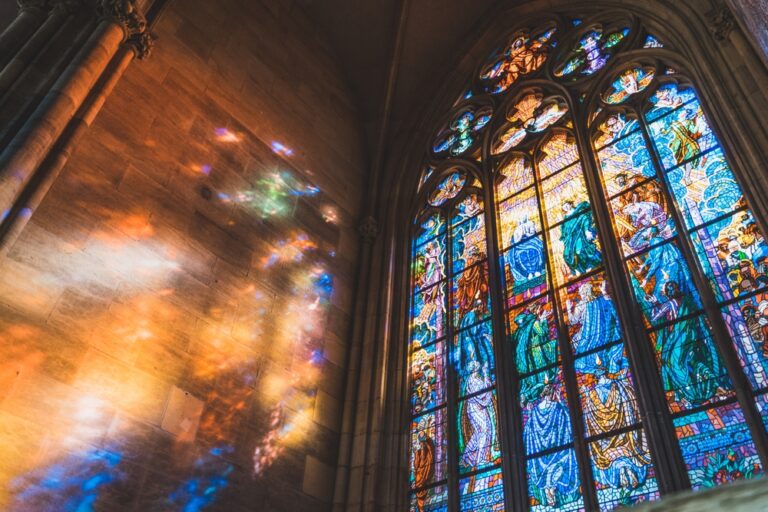

From the very beginning, the church has stood—not by human strength but by God’s steady, sovereign hand. It’s not a monument to what we’ve done but a masterpiece of what he’s done.
Whether faith is new or seasoned over the years, knowing the story behind it helps us see where we stand. Christian history isn’t just about the past—it’s about the path that brought us here.
It reminds us that the church is more than a building, more than a weekly gathering.
It’s faith. Forged in trials, anchored in truth, and carried by Christ.
When we belong to the church, we belong to something far greater than ourselves. Our hope rests on the unshakable foundation of God’s Word and moves forward by the power of his Spirit.
As we walk through the pages of history, we find his fingerprints everywhere. In the courage of apostles, the fire of reformers, the sacrifice of martyrs, and the passion of missionaries—his truth has never wavered.
Empires have fallen. Leaders have changed. But the church? It’s still standing, still moving, still his.
Christian history tells a story of God’s faithfulness. A living testimony to the words of Jesus: “I will build my church, and the gates of Hades will not overcome it” (Matthew 16:18).
The History of Christianity: Timeline
The history of Christianity is more than a list of dates and events. It’s the unfolding of God’s great plan—sovereign, steady, and full of grace.
It is the story of redemption. Not written with ink, but written with the blood of Christ.
It began with Jesus walking dusty roads and healing broken hearts. Then came the fire of Pentecost that gave the church legs. From there, the gospel spread through Roman cities, across continents, and into cathedrals and cottages alike.
The establishment of the Nicene Creed during the First Council of Nicaea in AD 325 unified Christian beliefs and addressed theological disputes.
Nations were stirred. Hearts were called. The Great Awakenings lit fires that still burn today.
This faith is not tied to one land or one people. It moves, breathes, and lives wherever hearts are willing.
It’s the story of ordinary people trusting an extraordinary God.
Origin of Christianity
It all started with Jesus.
He was not a king in a palace or a warrior on a throne. The founder of Christianity was an itinerant preacher who traveled and taught in the Galilee region, a servant King who walked old roads with calloused hands and a heart full of mercy.
He healed the sick. He dined with sinners. His kingdom was not made of stone or sword, and he spoke of grace, love, and second chances.
His message was radical—sinners could be forgiven, the outcast could be welcomed, and God’s grace was a gift, not a wage.
The founding of Christianity dates back to AD 30–33, and it is marked by a hill called Golgotha, an empty tomb, and a room filled with wind and fire.
It began not with a law but with a resurrection. In the hearts of fishermen, tax collectors, and broken souls who met Jesus—and were never the same.
When Jesus Christ walked among us, he calmed storms with a whisper, cast out demons with a word, and healed the untouchable with a single touch.
Crowds followed him. Leaders feared him.
But still, they didn’t understand him.
They expected a rebel to rise against Rome. Instead, he came to conquer something deeper—sin, shame, and death itself.
And he did.
He was betrayed. Condemned. Crucified.
The sky went dark. The earth shook. Hope was buried in a borrowed tomb. But on the third day, that tomb stood empty.
Jesus Christ had risen. Just as he said he would.
And everything changed.
The followers who had once scattered in fear now stood firm in faith. They had seen him, touched him, heard his voice again. And they couldn’t keep silent.
That was the beginning. That was the spark.
And from that moment, nothing could stop the fire from spreading.
Early Christians
One might think the King of Kings would start with palaces and choose his followers from thrones and temples.
Surely, the polished ranks of the religious elite, those with long prayers and spotless robes, would make ideal disciples.
That would make sense. That would be expected.
But that wouldn’t be Jesus. Early Christian leaders, primarily educated converts, played a significant role in establishing the church’s institutional structures.
Who Were the First Christians?
The first Christians weren’t scholars. They weren’t rulers or people of influence. And they had no cathedrals, no councils, no seminaries.
They had a Savior who had conquered the grave, and that was enough.
The first Christians were ordinary people who had encountered the risen Christ and been transformed.
There was Peter, the fisherman who once trembled before a servant girl. He came to stand before thousands, proclaiming:
This Jesus, whom you crucified, is both Lord and Messiah” (Acts 2:36).
The same man who had denied Jesus three times risked everything to declare his name.
There was Mary Magdalene, once bound by darkness, now the first to witness the Light of the world breaking from the tomb.
She was not just the first to see him—she was the first sent to tell others of his resurrection (John 20:17), and she did.
There was Thomas, the doubter and skeptic. He needed proof.
What did Jesus do? He offered his scars. He let Thomas touch the wounds, see the marks, and feel the evidence. “My Lord and my God!” Thomas declared, and he no longer doubted but believed.
And then there was Paul, who made it his mission to destroy the church.
He hunted Christians, dragged them from their homes, and approved their executions. But with one encounter on the road to Damascus, he was changed. The persecutor became the preacher. The one who had tried to silence the gospel became its loudest voice.
The twelve apostles played a foundational role in the development and spread of Christian teachings, particularly during key events like the confession of Peter and Pentecost. But there were many more. The poor, the wealthy, the enslaved, the free, the Jew, the Gentile.
A Roman centurion. A businesswoman named Lydia. A runaway slave named Onesimus. Men and women from every walk of life drawn together by one name—Jesus Christ.
The Spread of Christianity
The spread of Christianity started in Jerusalem after the city crucified Jesus.
But the gospel wouldn’t stay there. It couldn’t.
Jesus had given his followers a mission—a commission that stretched beyond city walls, borders, and anything they had imagined: “Go and make disciples of all nations” (Matthew 28:19).
And they did. The significance of missionary work in the rapid expansion and spread of early Christianity cannot be overstated, particularly the efforts of apostles like St. Paul.
At first, they stayed close, preaching in the temple courts, healing the sick, and adding to their numbers daily.
But then came opposition.
Stephen was stoned, James was executed, and the believers were scattered. Yet what seemed like an attempt to crush the faith only became the means of its expansion.
Wherever they fled, they carried the message of Christ.
Philip went to Samaria and preached the good news. He crossed barriers of race and culture, and the gospel took root in unexpected soil.
Peter stepped into the home of a Roman centurion, a place he never thought he’d enter. And there, he watched as the Holy Spirit fell—not just on the Jews, but on the Gentiles too. Grace knew no borders.
And then there was Paul. Once a man who hunted down Christians, now a man who couldn’t stop talking about Christ. He journeyed across Asia Minor, through Greece, to Rome—planting churches, writing letters, and speaking the name of Jesus Christ in cities that had never heard it before.

What Is the History of Christianity?
The history of Christianity is the story of faith that began with a handful of followers and grew to stretch across continents. It’s a faith that endures persecution, shapes civilizations, and changes the course of history.
It’s a story of bold love, unrelenting grace, and a message too powerful to be silenced. During the early centuries, the early Christian community faced numerous challenges, including persecution—but the Holy Spirit was always alive and active, working for the glory of God.
Early Church History
They had no cathedrals. No budgets. No programs or platforms. Just hearts on fire. They met in homes, prayed in whispers, and worshiped with everything they had.
They shared what little they owned, cared for widows and orphans, and healed the sick—not for applause but because love told them to.
And they lived differently. So, the world pushed back.
Religious leaders tried to silence them. Rome tried to crush them. But the harder they were pressed, the more their faith spread.
Their courage caught attention.
Joy in the middle of suffering didn’t make sense, and their forgiveness in the face of cruelty left a mark more profound than any wound.
Early church history reminds us—God doesn’t need crowds or crowns to move. He uses ordinary people, filled with his Spirit, to do extraordinary things.
The gospel spread through persecution and trials, carried not by swords or wealth but faith and love.
The Beginning of the Christian Church
The church was born in fire and faith, in a room filled with ordinary men and women waiting on an extraordinary promise.
Fifty days had passed since the resurrection. Jerusalem was alive with travelers, and the city swelled with people from every nation who gathered for the festival of Pentecost.
In an upstairs room, a smaller gathering waited—not for the festival, but for a promise.
Jesus had told them to wait, to pray, to prepare.
But for what, exactly? They didn’t know.
And then, heaven broke through.
“A sound like the blowing of a violent wind came from heaven and filled the whole house where they were sitting. They saw what seemed to be tongues of fire that separated and came to rest on each of them” (Acts 2:2–4). The Holy Spirit had come.
They spilled into the streets, declaring God’s wonders to the crowds below. People stopped, listened, and wondered.
And then Peter—Peter, who had once denied even knowing Jesus—stood tall.
His voice, no longer timid, rang out with truth: Christ was crucified, and Christ is risen.
And that day, three thousand believed. The church had taken its first breath, and that was the beginning of the church.
Yet, the age of the apostles would not be easy. Persecution came swiftly, and religious leaders resisted.
Stephen became the first to die for his faith. Paul, once the church’s fiercest enemy, became its greatest missionary. The disciples stood before kings and endured beatings, prison cells, and threats of death.
But they would not be silenced.
They had seen the risen Christ, touched his scars, and shared meals with him. And he had promised them: “You will be my witnesses . . . to the ends of the earth” (Acts 1:8).
And so, the gospel spread. It leaped beyond Jerusalem and Judea, beyond borders no one thought it could cross. Some went willingly, others were scattered by persecution, but all went purposefully.
Christianity in the Roman Empire
The Roman Empire was a place of power, conquest, and glory.
It was a kingdom of iron, stretching from the windswept shores of Britain to the sands of Egypt. The Roman emperor ruled. Legions marched. Nations bowed.
And through it all, a small group of men and women carried a message so powerful and world-altering that even the greatest empire on earth couldn’t contain it.
Ancient Roman Church
Christianity arrived in Rome through conviction. It didn’t storm the city with swords; it entered through the testimony of ordinary believers who Jesus had changed.
It took root in the streets, markets, and homes of merchants and enslaved people. The gospel spread through whispered conversations in dark alleys, prayers spoken in underground rooms, and letters carried on the backs of weary travelers.
And before long, the faith of the crucified Christ had reached the capital of the world’s greatest empire.
At first, Rome dismissed it as just another strange belief, a passing moment among the lower class. The Roman state, however, soon saw the growing Christian movement as a threat to its unity and stability, leading to political pressures and persecution.
But when Christianity didn’t fade, when its followers didn’t bow to Caesar, when they chose death over denial—Rome took notice.
Christian Persecution
Faced with the power of the Christian faith, the Roman Empire struck back.
It started with threats, with warnings to stay silent. But the Christians wouldn’t be silenced.
So Rome escalated.
The warnings turned into whips. Christians were arrested, beaten, and stoned. Some were crucified. Others were thrown to lions for sport. Some lit the night sky—burned alive in Nero’s gardens.
And still, they would not deny their Lord.
They were given a choice: deny Christ and live . . . or affirm him as Lord and die.
They chose Jesus. Every time. Many Christians held diverse beliefs and practices, and these variations have shaped the faith over time.
The world had never seen anything like it. Kings and warriors fought for power. But these men and women—they died for love.
They forgave their executioners. They met death with joy because they knew something Rome could never understand—Jesus had already conquered death.
The gospel spread not in spite of persecution but because of it.
As Tertullian, an early church father, wrote: “The blood of the martyrs is the seed of the church” (Apologeticus, chapter 50).
Roman Emperor Constantine and the Edict of Milan
Then came Constantine. The Roman emperor looked out at a world in motion, a world he could feel shifting beneath his feet.
History tells us that before a great battle, he saw a vision—a cross in the sky, glowing with the words, “In this sign, you will conquer.” So he marched forward, not with pagan symbols, but under the banner of Christ. And he won.
In AD 313, he issued the Edict of Milan. With it came a sweeping change: religious tolerance for Christians.
Not long after, Constantine called the Council of Nicaea in AD 325 to address theological disputes and establish key doctrines, including the Nicene Creed.
The persecution stopped. The executions ended. The fear began to fade.
Christianity was no longer outlawed. No longer hunted.
The Roman Empire—the very force that once tried to crush the church—was now welcoming it.
And just like that, the faith that had grown quietly in catacombs and whispered through prison walls stepped into the light.
The Roman Catholic Church
As Christianity gained acceptance, it also gained structure.
The days of secret meetings in homes gave way to gatherings in grand basilicas. The faith that had once been outlawed now found itself welcomed in halls of power.
By AD 380, under Emperor Theodosius, Christianity became the official religion of the Roman Empire. The church, once hunted and hated, was now honored and protected.
But with favor came new challenges.
Power brought politics. Acceptance invited compromise.
What began with fishermen and tax collectors now mingled with emperors and laws. Some traditions strengthened the church, while others dragged it away from its simple beginnings.
The purity of the gospel sometimes became tangled in the complexities of religion.
And yet—God was not finished.
Through every debate, every struggle, every growing pain, his gospel endured.
His truth held fast.
And his kingdom kept moving forward, one heart at a time.
The Spread of Christianity Beyond the Roman Empire
But the gospel was never meant to stay in Rome. Jesus had said, “Go into all the world.” And so, that’s precisely where it went.
This message wasn’t anchored to a city or wrapped in a single culture. It was meant for every tribe, tongue, and nation under heaven.
Missionaries crossed deserts and sailed seas, carrying the hope of Christ to Africa, Persia, India, and beyond. Early Muslim conquests impacted Christian communities in North Africa, but Christianity continued to spread in Europe and Asia despite these challenges.
Merchants told the story of Jesus as they traveled dusty trade routes, planting seeds of faith in foreign soil.
Even those exiled or imprisoned—those who had lost everything—found themselves in new places, with new people, holding onto a message that refused to be silenced. What felt like the end became the beginning of something greater.
And so, the gospel continued to move. It leaped across continents, stretched through generations, and weathered empires, revolutions, reformations, and awakenings.
It outlived Rome and outlasted persecution. And it outlives us.
Medieval Christianity: Light in the Darkness
The Middle Ages—often called the Dark Ages—was a time of kings and castles, knights in armor, and battles. Empires rose and fell like waves on a restless sea. The world was uncertain, fragile, and often cruel.
But through the shifting shadows of war and power, one light refused to go out—the church. Muslim conquests affected Christian communities in the Middle East during various significant periods of Christianity’s development.
In a time when most couldn’t read and many lived in fear, the church became more than a building. It became the heartbeat of the community.
When storms came, it stood as shelter. And when bodies broke, it brought healing. When minds were hungry, it offered truth. When hope was hard to find, it became a sanctuary.
In the church, babies were baptized. The sick were anointed. The grieving were comforted. The poor were fed. The weary were welcomed.
It wasn’t perfect. But it was present.
And through its quiet presence, the gospel kept moving. Shaping hearts, homes and history.
But even in this place of light, shadows crept in.
Kings reached for control. Popes sometimes looked more like emperors than shepherds. Politics tangled with piety. Power blurred the purpose. The unity that once defined the church began to crack. Division spread like a slow leak—silent, steady, and hard to stop.
Monasticism: Seeking God in Silence
Not all of the church’s influence came from cathedrals with high ceilings or courts filled with kings.
Some came from quiet places—stone halls, candlelit libraries, and whispered prayers in the stillness of monasteries.
Monasticism, the practice of withdrawing from the public world to worship, took root.
Men and women stepped away from the noise of the world to live lives of prayer, study, and service. They chose simplicity over comfort. Discipline over ease. Devotion over distraction.
They copied Scripture by hand, one page at a time, preserving God’s Word in an age when books were rare and few could read. They taught the uneducated. Cared for the poor. Healed the sick.
Their hands worked. Their hearts prayed. Day after day. Year after year.
While kings waged war and kingdoms rose and fell, these quiet servants of Christ kept the flame of faith alive.
Hidden from the spotlight, but never forgotten by God.
Feudalism and the Church: A Complex Relationship
The Middle Ages were ruled by feudalism, a system in which kings granted land to nobles, who then ruled over knights and peasants. It was a world of castles and oaths, of duty and hierarchy.
And in the middle of it all? You guessed it—the church.
At times, the church was a spiritual guide, calling leaders to righteousness and reminding them of their duty before God. Other times, it was a political player, influencing kings, settling disputes, and even crowning emperors.
Some leaders sought to honor God in their rule. Others used the church for their gain. Corruption crept in. The line between spiritual authority and earthly power blurred.
Yet, even in the middle of politics and power struggles, the church remained a place where faith thrived, the poor found hope, and the gospel was still proclaimed.
The Role of the Church in Establishing Schools and Universities
Imagine a world with few books, where most people never learned to read, and knowledge was kept behind stone walls tucked away in monasteries and royal courts.
That was medieval Europe.
And then came the church.
Monks became more than scribes. They became teachers. They didn’t just copy Scripture in quiet monasteries—they taught it.
Cathedrals became classrooms, and churches opened doors to young minds, teaching philosophy, law, and theology.
Universities were born. Oxford. Cambridge. Paris. Some of the greatest learning centers began as places to study God’s truth.
For the church, knowledge was more than information—it was a revelation.
God had created the world in order, which meant it could be studied.
Science, philosophy, and theology weren’t in conflict—they were windows into the Creator’s wisdom.
The church didn’t just shape hearts. It shaped minds and raised up leaders, scholars, and reformers who would one day change the world.
The Crusades: Faith and War Collide
The Crusades were a complicated and often heartbreaking chapter in the history of Christianity.
They arose from what many saw as noble intentions—the desire to defend Christian pilgrims and sacred places in the Holy Land.
But along the way, something shifted.
The First Crusade marched toward Jerusalem with passion and purpose. Many knights believed they were fighting for God. And yet, in their zeal, they did things that broke his heart.
As the years passed, the focus faded. Later, the Crusades were less about faith and more about power. Kings saw opportunity, rulers chased wealth, and innocent lives were caught in the crossfire.
Some went sincerely, hoping to honor Christ and defend what they held sacred.
Others, sadly, missed the heart of the gospel in their pursuit of war.
The Crusades remind us of a deep truth: there’s a tension between serving God and chasing power. A battle between what is holy and what is human.
And they leave us with a sobering lesson—not every act done in the name of Christ reflects the love of Christ.
The Great Schism: A Church Divided
The church had been one body, faith, mission, and people under Christ for a thousand years.
But in 1054, the great divide came.
It didn’t happen in a day. The fault lines had been forming for centuries—language, culture, and theology differences widened the gap between East and West.
The church in Rome, led by the Pope, saw itself as the central authority. The church in Constantinople, guided by its patriarchs, held to a more decentralized leadership. They wrestled over doctrine—the nature of the Holy Spirit, the authority of the Bishop of Rome, and even the use of unleavened bread in communion.
Tension turned to conflict. Conflict turned to separation.
And then, the final blow: excommunications were exchanged, doors closed, and a unity once held was broken.
The Western Church became known as the Roman Catholic Church, and the Eastern Church became the Eastern Orthodox Church. The East–West Schism in 1054 marked the formal separation of Eastern Orthodoxy from the Western Catholic Church, significantly impacting the development of Christian theology and practices.
One church became two.
But did the faith disappear? No. Did the gospel stop moving? Never.
The Reformation: A Cry for Truth, A Call to Grace
The church had weathered storms before. The Great Schism had split East from West, dividing one church into two.
But another storm began to stir in the following centuries—this time from within.
The Roman Catholic Church stood as the dominant force in the West, holding both spiritual and political power. But with power came pride. And with pride came corruption.
The gospel of grace—once so clear—began to fade beneath layers of tradition, decrees, and indulgences.
Forgiveness, once offered freely by Christ, was sold for a price. Hearts ached for truth. And in God’s perfect timing, voices rose to call the church back to him.
In 1517, a German monk named Martin Luther walked to the door of Wittenberg Castle Church and nailed up a list—Ninety-Five Theses, words meant to spark a conversation.
What he didn’t know was that this simple act would light a fire that would change Christian history.
At the heart of the Reformation was a bold, beautiful truth: salvation is not earned. It’s a gift.
Through Scripture, Luther rediscovered that righteousness comes by grace alone, through faith alone, in Christ alone. Not by works or penance. Not by the decree of any man.
And Luther wasn’t alone. Ulrich Zwingli challenged practices that had no place in Scripture.
In Geneva, John Calvin shaped the theology of the movement, pointing to the sovereignty of God and the authority of his Word.
In England, William Tyndale labored to bring the Bible into the language of the people—because a gospel that’s kept behind closed doors is no gospel at all.
These men, and many more, risked everything so that God’s Word could be heard again.
At its core, the Reformation stood on five truths—the Five Solas:
- Sola Scriptura – Scripture alone is our authority.
- Sola Fide – Faith alone makes us right with God.
- Sola Gratia – Grace alone saves us.
- Solus Christus – Christ alone is our mediator.
- Soli Deo Gloria – All glory belongs to God alone.
The Protestant Reformation was a pivotal event in Christianity, significantly shaping its doctrines and practices. The Reformation placed the Bible into the hands of ordinary people. It reshaped worship, shifting the focus from ritual to relationship. It broke the church’s political grip and gave rise to new denominations—Lutheran, Reformed, Anglican, and others.
And it spread like wildfire—fueled by the printing press, and by people hungry for truth.
But not everyone welcomed the change.
The Catholic Church fought back with the Counter-Reformation. Reformers were exiled. Imprisoned. Martyred. William Tyndale was burned at the stake for giving the Bible to the people. John Huss died a century earlier for daring to say that Christ, not the pope, was the head of the church.
The cost was high. But the Word of God could not be silenced.
Did the church fall? No.
Did the gospel fade? Never.
Because the truth is not fragile. And grace cannot be chained.
The Reformation wasn’t the end. It was a new beginning. And through every trial, every council, every split and scar—Christ remained at the center.
Faithful to his promise: “The grass withers and the flowers fall, but the word of our God endures forever” (Isaiah 40:8).
The Great Awakening: When Hearts Caught Fire
There are moments in history when God moves so powerfully, the world can’t help but notice.
Hearts are stirred. Lives are changed. Nations feel the tremble of his presence. The Great Awakening was one of those moments.
From the 1730s to the 1740s, a wave of revival swept across the American colonies and parts of Europe. Churches that had grown cold came alive. Faith that had gone quiet found its voice again.
God used bold, passionate preachers to spark the flame.
Jonathan Edwards stood in New England pulpits with sermons that pierced the soul. His sermons, like ”Sinners in the Hands of an Angry God,” called people to repentance—not with guilt, but with grace.
George Whitefield, with a voice that could reach thousands in open fields, preached the new birth in Christ. Rich or poor, educated or uneducated—it didn’t matter. People came. They listened. They wept.
John Wesley, founder of Methodism, brought structure to the fire. He taught holiness. He preached grace. And he helped create change that would stretch far beyond his time.
These men weren’t just preaching—they were shaking the foundations. They challenged lifeless religion. They broke through denominational lines. And they reminded the church that salvation doesn’t come through ritual, but through faith in Jesus alone.
The effects reached far beyond Sunday mornings.
The Great Awakening sparked social reform. It stirred hearts to care for the poor, educate the unlearned, reach into prisons, and to speak out against slavery.
Leaders began to say what others were afraid to say: every soul matters to God.
Methodists, Baptists, Quakers—they became voices for the voiceless. The gospel’s call for justice took root in hearts, and the dignity of the ordinary person was upheld.
The revival also planted the seeds of freedom.
People began to see faith as something deeply personal—not something handed down by the government or confined to official churches. This awakening helped shape the belief that religion and state should be separate and that faith should be chosen, not forced.
This idea would one day help shape the First Amendment of the US Constitution.
The Great Awakening didn’t just revive the church. It helped shape a nation.
It helped lay the groundwork for democracy, liberty, and a faith that comes from the heart—not from a law.
Because when God moves, he doesn’t just wake up churches. He wakes up the world.
The Modern Church: A Light in a Changing World
The church has never been tied to one place, one people, or one moment in time. Christianity emerged as an independent religion, evolving from the teachings of Jesus of Nazareth and distinguishing itself from ancient Judaism and other cultural influences of the time.
It’s always been on the move—growing, stretching, reaching into new lands and new hearts.
And today, more than ever, the body of Christ stands at a crossroads. A world that’s shifting. A gospel that has not.
The mission remains the same: make disciples of all nations, be Jesus’s hands and feet, and shine light in the darkness.
One of the most remarkable changes in recent years has been the rise of evangelical Christianity. What started as a revival movement has become a global force.
With a deep love for Scripture, a focus on personal faith, and a passion for sharing the good news, evangelicals have filled churches with worship, pulpits with preaching, and the world with mission work.
Yes, churches are still thriving in places like North America and Europe. But they’re also bursting with life in areas that once seemed far from faith.
The center of Christianity is shifting. While some churches in the West face decline, others in the Global South—Africa, Asia, and Latin America—are growing.
In-house churches and open-air stadiums, in cities and villages, in whispered prayers and joyful songs—the gospel is alive.
In Asia, new believers are coming to faith despite persecution. And in Africa, entire communities are turning to Christ. In Latin America, faith is reshaping culture.
Jesus said, “This gospel of the kingdom will be preached in the whole world as a testimony to all nations” (Matthew 24:14). And it is.
But even as the church grows, it also faces new challenges.
Secularism has taken hold in many parts of the Western world. Some say faith has no place in public life. Some see the church as outdated, unnecessary, and even oppressive.
Culture shifts, voices grow louder, and some churches feel the pull to water down what they believe.
But even in the storm, Christ’s promise still stands: “On this rock I will build my church, and the gates of Hades will not overcome it” (Matthew 16:18).
Through it all, God is calling his church to something greater—unity.
For too long, divisions have weakened the body of Christ. Lines have been drawn. Debates have turned into battles. But the gospel is clear: One Lord. One faith. One baptism (Ephesians 4:5).
Across the globe, believers are setting aside differences to pray, to worship, to serve together.
Calls for unity are growing. Churches from all backgrounds are joining hands to proclaim Christ, feed the hungry, fight injustice, and bring hope to the hurting.
Because, in the end, it’s not about the name on the church door. It’s about the name above all names—Jesus Christ.
And when the church walks in unity, the world takes notice. Walls fall. Healing begins. The gospel moves with greater power. We reflect the heart of Christ not in uniformity but in love. Different voices, one song. Different paths, one purpose. One body, one Savior—forever faithful, always enough.
The modern church is not perfect. But it is alive. And it still belongs to him.
Through trials, revivals, shifting cultures, and new frontiers, his kingdom keeps advancing. The church is still in his hands. It’s still the body of Christ. It’s still his light in a world that needs him now more than ever.

The Significance of Christian History for Us Today
The history of Christianity isn’t just a record of what it once was. It’s the story of what still is—a living, breathing testimony to the faithfulness of God through every age, in every place.
It didn’t end with the apostles or stop with the reformers. And it didn’t fade after the revivals. The story continues—and we’re a part of it.
Every moment of persecution, every spark of revival, every quiet act of obedience is woven into a faith that cannot be silenced. A faith that stretches across generations and borders.
The same Spirit who filled the upper room, who gave courage to the martyrs, who ignited Great Awakenings—is alive in us today.
Christian history reminds us of something beautiful: no empire has crushed the gospel. No opposition has silenced it. No cultural shift has outpaced it.
When Rome tried to break the church, it only grew stronger. Corruption crept in, but reform rose up. And when hearts grew cold, revival caught fire.
The world changes, but God does not. He’s still faithful. Still working and calling. And because of that, we don’t live in fear—we live in hope.
We’re not here by accident. There is purpose—to carry the gospel forward, love boldly, and stand firm in truth.
We may never stand before kings, but we can be faithful in our homes. We may not preach to thousands, but we can tell one person about Jesus.
And one day, when future generations look back, may they see in us what we see in those who came before—a church that would not be silenced, would not compromise, and would not stop shining the light of Christ.
Ready to go deeper? Explore more of the story.
Check out our resources to learn how the history of Christianity still speaks to our faith today. Every chapter whispers his name, and every turning point draws us closer to him.
If we let it, Christian history can stir the soul, strengthen faith, and remind us that our chapter matters too.
We can start exploring now. The journey is far from over—it’s just getting good.