
When it comes to controversial figures in religious texts, few can match the notoriety and intrigue surrounding Satan. But who is Satan? Is he a literal entity or merely a symbol of evil? And how does our understanding of Satan intersect with modern scientific knowledge?
In this article, we’ll dive into the biblical accounts of Satan, explore the range of names and titles attributed to him, and examine how our understanding of this figure has evolved over time, creating a comprehensive understanding of who Satan is in the Bible and how it relates to our modern world.
Satan, as revealed in Scripture, is not an abstract idea but a real and malicious being—the enemy of God and the deceiver of humanity. His aim is to alienate people from their Creator, corrupt the truth, and incite division, hatred, and destruction in human relationships. Far from a symbolic figure, he operates with intent and power, seeking to blind minds and harden hearts against God.
The character of Satan challenges our understanding of free will, divine power and justice, and the origins of human temptation.
Different religious traditions interpret this figure through unique cultural and historical lenses, ranging from a literal fallen angel to a metaphorical representation of humanity’s inherent capacity for moral transgression. By examining these diverse perspectives, we can gain deeper insights into how different belief systems conceptualize the nature of evil, personal responsibility, and the complex dynamics of spiritual warfare.

Satan in the Bible: The Ultimate Antagonist
What Does Satan Mean?
Before we delve into the various aspects of Satan’s identity, let’s start with a fundamental question: What does Satan mean? The name “Satan” is a translation of the Hebrew word שָׂטָן (satan), which literally means “adversary” or “opponent.”
This etymology gives our first clue about Satan’s role in biblical narratives—he is the ultimate antagonist, the one who stands in opposition to God and his plans.
In the Bible, Satan is portrayed as a real being and not just a representation of evil. He appears in both the Old and New Testaments, playing a significant role in several key stories. Let’s explore some of the most important biblical accounts that shape our understanding of who Satan is.
The Garden of Eden: Satan’s Debut
Many people are surprised to learn that Satan isn’t explicitly named in the Genesis account of Adam and Eve’s temptation. Instead, we read about a serpent who deceives Eve into eating the forbidden fruit. However, later biblical texts and Christian tradition have referred to this serpent as Satan.
This interpretation adds an intriguing layer to the story. If Satan is indeed the serpent, it means he’s been causing trouble since the very beginning of human history.
Job’s Trials: Satan as the Accuser
One of the most vivid portrayals of Satan in the Old Testament comes from the book of Job. Here, we see how Satan played a role that aligns closely with his Hebrew name—as an accuser or adversary. In this story, Satan challenges God’s assessment of Job’s faithfulness, essentially saying, “Job only loves you because you’ve blessed him. Take away his blessings, and he’ll turn away from you.”
This story gives us a glimpse into Satan’s character. He’s not just randomly evil; he’s strategic, manipulative, and looks to have a grudge against humanity’s relationship with God.
Is Satan Real or Symbolic?
In our modern, scientifically minded world, the idea of a literal Satan can seem far-fetched. Some scholars and theologians argue that Satan is best understood as a symbol of evil or human nature’s darker impulses rather than a real entity and a literal fallen angel.
The Bible, however, consistently portrays Satan as a real being. He speaks, acts, and interacts with both God and humans. Jesus himself spoke of Satan as a spiritual, personal being, not just a metaphor.
So, how do we reconcile this with our scientific understanding of the world? It’s worth noting that the existence of Satan isn’t something that science can prove or disprove. Science deals with the natural, observable world, while Satan would be part of a spiritual realm beyond our current ability to measure or observe.
Where Did Satan Come From?
One of the most intriguing questions about Satan is his origin story. Where did he come from? The Bible doesn’t give us a straightforward account of Satan’s creation or fall, but it does provide some clues.
Some interpretations understand Satan to be a fallen angel, originally created by God as a magnificent celestial being who subsequently rebelled against divine authority.
Some biblical scholars point to passages in Ezekiel and Isaiah that are traditionally interpreted as allegorical descriptions of Satan’s pride and downfall, suggesting that he was once a high-ranking angel named Lucifer, distinguished by extraordinary beauty and intelligence.
These texts describe a being who became consumed by pride, aiming to elevate himself to the status of God, which ultimately led to his catastrophic expulsion from heaven. Understanding Satan’s origin is theologically significant because it addresses how evil could emerge from God’s perfect creation, providing insight into the nature of free will, moral choice, the reality of evil’s presence within God’s created order and its impact on human experience.
Was Satan An Angel?
According to Christian tradition and interpretation of various biblical passages, Satan is believed to have been originally created as an angel—and not just any angel, but one of the highest-ranking ones.
Two passages in the Old Testament are often interpreted as referring to Satan’s fall from heaven: Isaiah 14:12–15 and Ezekiel 28:12–19. These texts describe the fall of a magnificent celestial being due to pride and rebellion against God. While these passages are directly addressing earthly kings (the king of Babylon in Isaiah and the king of Tyre in Ezekiel), many theologians see them as also describing Satan’s origin and fall.
The passage in Isaiah is particularly interesting because it uses the term “Lucifer,” which means “light-bearer” in Latin. This is where we get the idea that Lucifer was Satan’s original name before his fall, but it’s important to note that this interpretation is not universally accepted among biblical scholars.
What Was Satan’s Role in Heaven?
If Satan was indeed a high-ranking angel before his fall, what was his job description? The Bible doesn’t give us a clear answer, but based on the descriptions in Isaiah and Ezekiel, many theologians speculate that Satan held a position of great authority and beauty in heaven.
The Great Rebellion: Lucifer’s Fall
So, why did Satan rebel against God? Again, the Bible doesn’t give us a detailed answer, but the general understanding is that Satan’s fall was due to pride and a desire to usurp God’s position and God’s throne.
The passage in Isaiah 14 paints a vivid picture: “You said in your heart, ‘I will ascend to the heavens; I will raise my throne above the stars of God; I will sit enthroned on the mount of assembly, on the utmost heights of Mount Zaphon. I will ascend above the tops of the clouds; I will make myself like the Most High'” (Isaiah 14:13–14).
This rebellion didn’t just affect Satan. Revelation 12:4 suggests that he managed to convince a third of all the angels to join his rebellion. That’s some serious charisma and leadership skills, even if they were used for nefarious purposes.
Where Is Satan Now?
After his fall from heaven, where did Satan end up? Contrary to popular belief, Satan is not currently in hell. The Bible portrays Satan as having a surprising amount of freedom to move about and cause trouble.
Is Satan Roaming the Earth?
According to the Bible, Satan is indeed roaming the earth. In the book of Job, when God asks Satan where he’s been, Satan replies, “From roaming throughout the earth, going back and forth on it” (Job 1:7).
The apostle Peter also warns believers to “Be alert and of sober mind. Your enemy the devil prowls around like a roaring lion looking for someone to devour” (1 Peter 5:8).
This imagery of Satan actively moving about the earth, seeking to cause harm, is a far cry from the popular notion of Satan lounging on a throne in hell. It’s more like he’s on the run and causing as much chaos as he can before his final judgment.
Is Satan in Hell?
While Satan is often associated with hell in pop culture, the Bible teaches that Satan’s eternal punishment in hell is a future event, not a current reality. Revelation 20:10 describes Satan being thrown into the lake of fire on the final day of judgment.
So if you’ve ever imagined Satan as some kind of infernal prison warden, overseeing the torments of hell, you might need to revise that mental image. According to the Bible, Satan is more like a condemned criminal awaiting his final sentence, desperately trying to drag as many others down with him as he can.
Is Lucifer the Devil?
We mentioned earlier that “Lucifer” is often considered to be Satan’s original name before his fall. The name Lucifer comes from the Latin translation of Isaiah 14:12, where the Hebrew phrase “helel ben shachar” (meaning “shining one, son of the dawn”) was translated as “Lucifer” in the Latin Vulgate.
It’s worth noting that the direct connection between Lucifer and Satan is not explicitly made in the Bible itself. This association developed over time from early Christian writers and Christian tradition. Some modern Bible translations, like the NIV, translate this phrase as “morning star” instead of using the name Lucifer.
Regardless of whether Lucifer was actually Satan’s original name, the contrast between “light-bearer” and Satan’s current role as the prince of darkness is striking. It’s a powerful reminder of how far pride can cause someone to fall.

What Does the Bible Say About Satan’s Purpose & Influence?
Now that we’ve explored who Satan is and where he came from, let’s consider what the Bible says about his purpose and how he influences the world.
What Is Satan’s Purpose?
Based on biblical accounts, Satan’s primary purpose seems to be opposing God’s plans and trying to disrupt the relationship between God and humanity. He’s always looking for ways to throw a wrench in the works of God’s creation.
In the Garden of Eden, we see Satan working to drive a wedge between humans and God. In Job, he challenges God’s assessment of Job’s faithfulness. In the Gospels, he tries to derail Jesus’s mission through temptation. And in Revelation, we see him waging all-out war against God and his people.
It’s important to note that despite Satan’s efforts, the Bible consistently portrays him as a defeated foe. His rebellion against God is ultimately futile, and his final defeat is assured. As C. S. Lewis famously put it in The Screwtape Letters, Satan is like a strong man bound by an even stronger one—he can cause trouble, but he’s ultimately powerless against God’s sovereign will.
How Does Satan Influence the World?
The Bible describes several ways in which Satan exerts influence in the world:
- Temptation: As we saw in the Garden of Eden and Jesus’s wilderness temptation, Satan works to entice people into sin.
- Deception: Jesus calls Satan the “father of lies,” suggesting that spreading falsehood is one of his primary tactics.
- Accusation: As “the accuser of our brothers and sisters” (Revelation 12:10), Satan works to make believers feel guilty and unworthy.
- Opposition: The Bible describes Satan as actively working against the spread of the gospel and the work of the church.
- Possession: In some cases, the Bible describes Satan or his demons taking control of individuals, although this is relatively rare.
It’s worth noting that while the Bible attributes significant influence to Satan, it doesn’t give him ultimate power. Humans still have free will and are responsible for their own choices. Satan can tempt and deceive, but he can’t force anyone to sin.
Characteristics of Satan: Know Your Enemy
Understanding the characteristics of Satan can help us recognize his influence and resist his tactics. Here are some key traits the Bible attributes to Satan:
Intelligence
Satan is portrayed as highly intelligent and cunning. His ability to craft clever temptations and manipulate situations suggests a keen intellect. He is the being who thought he could outsmart God himself.
Deceitful
As the “father of lies,” Satan uses deception as his stock in trade. He’s a master of half-truths and subtle distortions, often twisting good things to serve evil purposes.
Seductive
Satan doesn’t usually present evil in its raw form, instead, he’s adept at making sinful choices seem attractive and reasonable. Think of how he tempted Eve in the Garden—he didn’t just say “disobey God,” he made the forbidden fruit sound desirable and beneficial.
Hostile
The Bible portrays Satan as having intense hatred for God and his creation, especially humans. His actions are driven by a desire to destroy and corrupt what God loves.
Invisible
As a spiritual being, Satan operates in ways we can’t directly observe. This invisibility makes his influence subtle and often hard to recognize.
Limited
Despite his power, Satan is not omnipotent, omniscient, or omnipresent like God. He has significant limitations and can only be in one place at a time.
Understanding these characteristics can help us be more discerning about Satan’s tactics and influence in our lives and the world around us.
Does Satan Have Limitations?
While Satan is portrayed as a powerful adversary in the Bible, it’s crucial to understand that he is not all-powerful. God’s sovereignty always trumps Satan’s schemes. Here are some key limitations of Satan’s power:
- He’s not omnipresent: Unlike God, Satan can’t be everywhere at once. When Job 1:7 describes Satan as roaming the earth, it implies he has to move from place to place.
- He’s not omniscient: Satan doesn’t know everything. He can’t read minds or predict the future with certainty.
- He’s not omnipotent: Satan’s power is limited. He can only do what God allows, as we see in the book of Job where Satan had to ask permission to afflict Job.
- He can’t force people to sin: While Satan can tempt and deceive, he can’t override human free will. The choice to sin always remains with the individual.
- He can’t separate believers from God: Romans 8:38–39 assures us that nothing, including Satan, can separate us from God’s love.
- His fate is sealed: Revelation 20:10 describes Satan’s ultimate defeat and eternal punishment. He’s fighting a losing battle, and he knows it.
Understanding these limitations is important because it prevents us from giving Satan more credit (or blame) than he’s due. While we should be aware of his schemes, we don’t need to live in fear of his power.
Other Names for Satan in the Bible
The Bible uses several other names and titles for Satan, each highlighting a different aspect of his character or role:
- The Devil: This title comes from the Greek word “diabolos,” which means “slanderer” or “accuser.” It emphasizes Satan’s role in bringing accusations against God’s people, as we saw in the book of Job.
- The Evil One: This title, used by Jesus in the Lord’s Prayer, emphasizes Satan’s inherently wicked nature.
- The Tempter: Used in Matthew 4:3, this title highlights Satan’s role in enticing people to sin.
- The Prince of this World: Jesus uses this title in John 12:31, suggesting that Satan has a degree of authority over the current world system.
- The Father of Lies: In John 8:44, Jesus calls Satan “a liar and the father of lies,” emphasizing his role in spreading deception.
- Beelzebub: This name, which means “lord of the flies” or “lord of dung,” was used by the pharisees as a derogatory term for Satan.
- The Ancient Serpent: In Revelation 12:9, Satan is identified as “that ancient serpent,” linking him back to the Garden of Eden story.
Each of these names provides a different facet of Satan’s character and role, building a complex picture of this adversarial being.
What Does the Devil Look Like?
Now, here’s a question that’s sparked countless artistic interpretations over the centuries: what does the devil look like? You’ve probably seen depictions ranging from a red-skinned, horned creature with a pitchfork to a suave, well-dressed gentleman.
The truth is, the Bible doesn’t give us a physical description of Satan. As a spiritual being, he doesn’t have a fixed physical form. The images we often associate with the devil—the horns, the tail, the pitchfork—are largely products of medieval art and literature, not biblical descriptions.
2 Corinthians 11:14 tells us that “Satan himself masquerades as an angel of light.” This suggests that if Satan were to appear visibly, he might choose an attractive or benign form rather than a frightening one.
The lack of a physical description in the Bible is probably intentional. It encourages us to focus on recognizing Satan by his actions and influence rather than by some specific appearance.

Jesus vs. Satan: The Ultimate Showdown
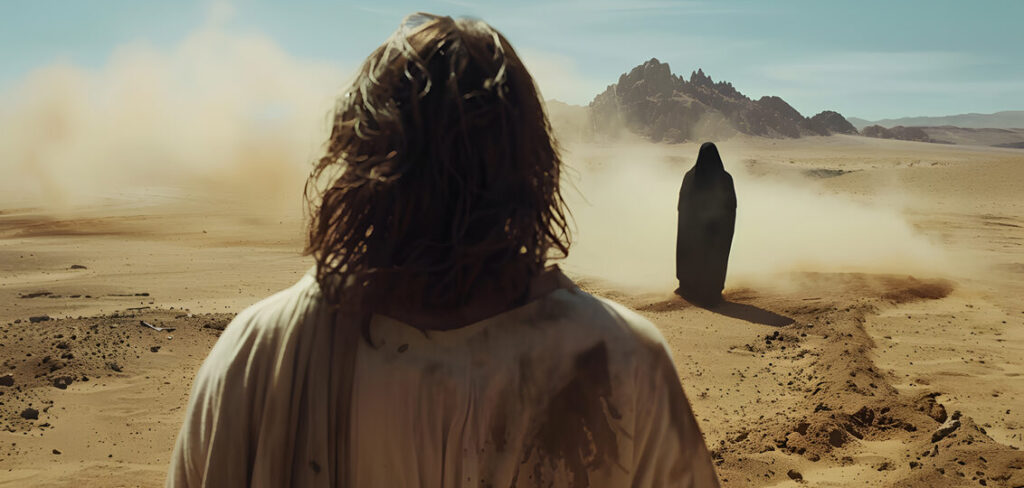
In the New Testament, we see Satan taking center stage as Jesus’s primary antagonist. The Gospels recount a confrontation between Jesus and Satan, where he tempts Jesus three times, with Satan trying to outmaneuver Jesus at every turn.
What’s fascinating about this account is how it portrays Satan’s tactics. He doesn’t go for brute force or obvious evil. He instead uses subtle manipulation and even quotes Scripture. It’s a reminder that Satan is a cunning adversary who knows how to package temptation in appealing ways.
The conflict between Jesus and Satan is a central theme in the New Testament. Let’s look at how this played out in three key areas: Jesus’s life, death, and resurrection.
Victorious in Life
One of the most dramatic confrontations between Jesus and Satan occurs at the beginning of Jesus’s ministry. After fasting for 40 days in the wilderness, Jesus faces three temptations from Satan.
What’s fascinating about this encounter is how it mirrors the temptation in the Garden of Eden, but with a different outcome. Where Adam and Eve fell to temptation, Jesus stood firm, countering each of Satan’s offers with Scripture and constant faith in God’s plan. When tempted to turn stones to bread, throw himself from the temple, or worship Satan for worldly power, Jesus consistently responded with divine truth rather than yielding to deception.
This victory sets the tone for Jesus’s entire ministry. Throughout the Gospels, we see Jesus consistently opposing Satan’s work by casting out demons, forgiving sins, and proclaiming the coming of God’s kingdom.
Victorious in Death
Jesus’s crucifixion might seem like a victory for Satan after he managed to turn religious leaders against Jesus and have him executed. But this apparent defeat was actually part of God’s plan all along.
Through his death on the cross, Jesus defeated sin and broke Satan’s power over humanity. As Hebrews 2:14–15 puts it, “By his death he might break the power of him who holds the power of death—that is, the devil—and free those who all their lives were held in slavery by their fear of death.”
Victorious in Resurrection
The resurrection of Jesus is the ultimate demonstration of his decisive defeat of Satan and his power. By rising from the dead, Jesus demonstrated his power over death itself—the very thing Satan had used to hold humanity in fear.
The resurrection proves that Jesus’s victory over Satan is complete and final. It assures believers that Satan’s defeat is certain, even if we still struggle with his influence in the present.
Conclusion: The Enduring Relevance of Satan
As we’ve seen, the question “Who is Satan?” doesn’t have a simple answer. The Bible portrays Satan as a complex figure—a fallen angel turned cosmic adversary, a tempter and deceiver whose influence touches every aspect of human existence.
Understanding Satan’s nature is essential for grasping fundamental Christian truths. His existence explains how evil entered God’s perfect creation. His role as tempter reveals the spiritual dimension of moral choice. His ultimate defeat through Christ demonstrates the assured victory of good over evil, offering hope that suffering is temporary. His limited authority under God’s sovereignty shows that evil cannot ultimately prevent divine purposes.
At the same time, the biblical narrative reminds us that Satan is a defeated foe. Through Jesus’s life, death, and resurrection, the power of evil has been broken, even if we still grapple with its influence in our daily lives.
As we navigate the complexities of our modern world, the story of Satan serves as a reminder to be vigilant against the subtle influences that can lead us astray, to recognize the profound consequences of our moral choices, and to hold onto hope in the face of evil and suffering. Understanding Satan as a real spiritual enemy shows us that our moral struggles have a spiritual side, and that while evil is truly dangerous, it cannot win against God’s power.
By choosing good over evil in our daily lives, we participate in Christ’s victory and demonstrate that Satan’s power has already been broken through the cross and resurrection.