
Exploring the Age of the Universe
Was your pastor right when he answered the question, “How old is the universe?” by saying that it’s just 6,000 years old? According to the estimates of many astronomers, the universe is 13.8 billion years old. The next natural question is: How can estimates for the age of the universe be that far apart?
For years, scientists believed the universe was 13.7 billion years old. But, according to the latest estimates, many astronomers now believe the universe is 13.8 billion years old. This might seem like a minor adjustment in the grand scheme of things, but it represents a huge leap in our understanding of the cosmos. How did scientists arrive at this number, and what does it mean for us today?
In Christian circles, the age of the universe has long been a topic of debate, reaching back to some of the early church fathers. Even today, scientists continue to debate the accuracy of the commonly cited age of 13.8 billion years.
Perhaps you’ve never researched any of this for yourself. So, let’s separate truth from fiction as we look into the origins of the universe, scientific advancements, and interpretations of the Bible.
We’ll explore time and space alongside the Word of God. If it’s true that “the heavens declare the glory of God” (Psalm 19), then how can we reconcile biblical faith with this apparent discrepancy of ages?
Tools and Methods for Measuring the Age of the Universe

Over time, scientists have found better ways to study the world around us. Early astronomers used basic tools and calculations, but today’s technology allows us to explore space and time like never before. Consider the advances in our understanding of the cosmos from using tools like the ancient astrolabe (used like a star chart, see figure) to the $10-billion, state-of-the-art James Webb Space Telescope, which is stationed at a stable point more than four times farther from Earth than the Moon.

The twentieth century marked a giant leap forward in our exploration of earth and space. Just 60 to 80 years ago, scientists were debating the origin of the universe. According to the big bang theory, the universe has been expanding for billions of years after all matter, energy, and even space and time began to exist (this explosive starting point is what scientists call a singularity). In contrast, the steady state theory described a universe that, though expanding, always looked the same—it has no beginning or end.
In 1964, radio astronomers Arno Penzias and Robert Wilson accidentally discovered the cosmic microwave background radiation (CMBR)—the faint radiation left over from the cosmic creation event—which provided strong support for the big bang theory. Big bang models say the universe started from a very hot, very dense state and has been expanding ever since. In 2001, NASA launched the Wilkinson Microwave Anisotropy Probe (WMAP) to study the CMBR—that ancient cosmic radiation — in greater detail. WMAP revolutionized our understanding of cosmology by providing precise measurements of the universe’s age, composition, and evolution. The Planck telescope, a successor to WMAP, advanced our understanding even more. It’s been said that the WMAP and Planck provide baby pictures of the universe.

How Did the Universe Begin?
To understand the age of the universe, we must explore how it began. Did the creation event that set reality as we know it into motion happen some 6,000 years ago or 13.8 billion years ago? The big bang theory is the prevailing scientific theory that proposes how the universe began and rapidly expanded into the cosmos we witness today. Many scientists and, ironically, some Christians, think that big bang cosmology says that no supernatural power played a part.
Christianity, on the other hand, holds that the eternal God in his infinite power created the universe. Many Christians see the big bang as evidence for when God spoke the universe into existence for the Bible thousands of years ago correctly predicting several features of the universe. The Bible’s opening words, “In the beginning, God created the heavens and the earth” (Genesis 1:1), integrate well with the idea of a definite starting point for the universe.
Even within the big bang framework, a question remains: what preceded the singularity? What caused our universe to begin? For Christians, this query points to the necessity of a Creator who exists outside of time and space, and who initiated the universe with purpose and precision. As Hebrews 11:3 declares, “We understand that the universe was created by the word of God, so that what is seen was not made out of things that are visible.”

Observing the Cosmic Cooling

The big bang theory predicts certain observations that help explain and date the origin of the cosmos. For example, the CMBR provides clues about the age of the universe similar to how you can observe a kitchen with an oven that has been baking at 500 degrees. When you turn off the oven and open the door, heat from the oven begins to dissipate into the kitchen and adjacent rooms. With the right equipment, you can detect the heat in various areas and at various times and calculate when the oven door was opened. Astronomers have measured the temperature of the CMBR at distances ranging over 12 billion light years. As scientific knowledge and technologies advance, learning more about the universe’s beginning and its many properties becomes more detailed and accurate.
Using the CMBR maps and many other measurements, scientists have been able to specify a date for the beginning of space and time—13.8 billion years ago. Several methods contribute to this estimate.
By measuring the cosmic expansion rate, scientists can run the clock backward to calculate when the universe began. Baryon acoustic oscillations — ripple patterns in the early universe that act like a cosmic ruler — provide another independent measure. Analyzing first-generation stars also helps: since they can’t be older than the universe itself, their ages give scientists a baseline.
And by tracking the CMBR temperature cooling curve — how the radiation has gradually cooled as the universe expanded, like an ember slowly losing heat — and determining how long stars have been shining, scientists are able to cross-check and confirm their findings.
Redshift
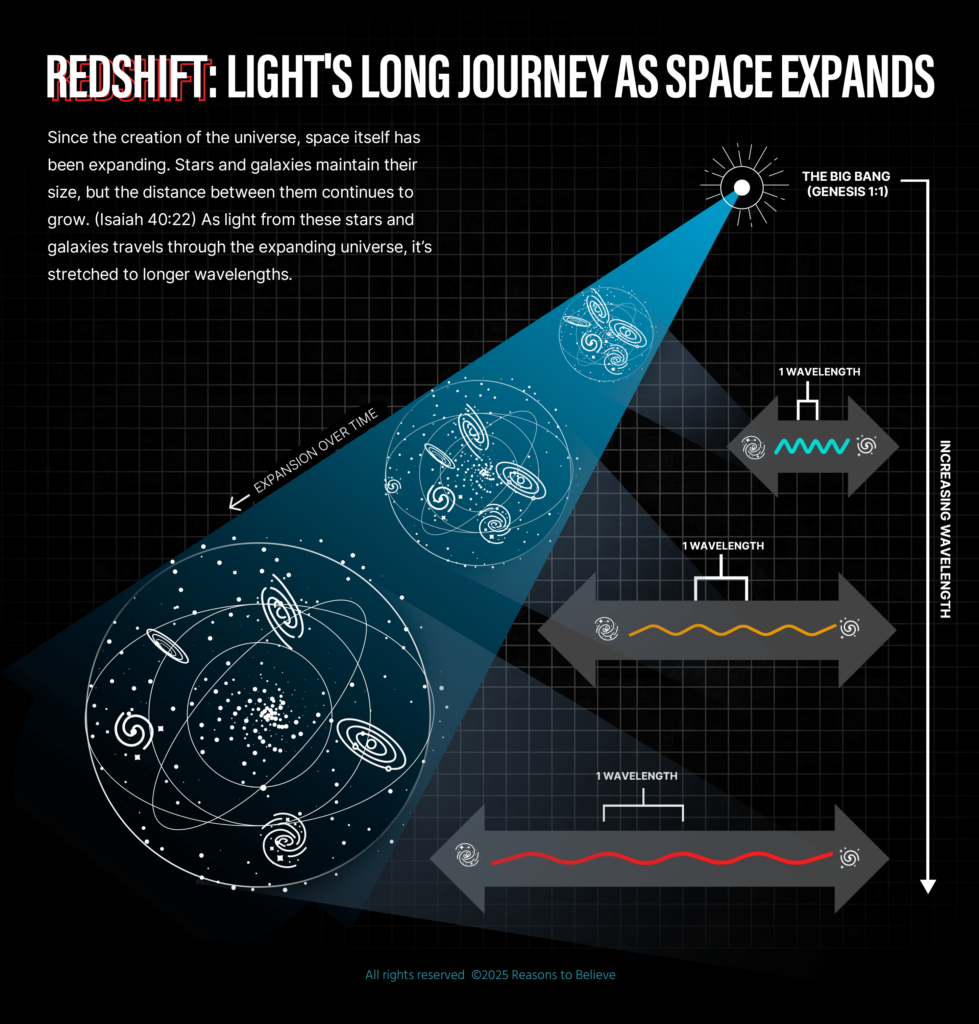
One of the most powerful tools scientists have to measure the expansion of the universe and consequently the age of the universe is redshift. Astronomers use the Hubble Constant to define the cosmic expansion rate. The Hubble Constant is a measure of how fast galaxies move away from us based on their distances.
To understand how redshift works, it’s important to know that light comes in different colors, and each color is actually the same type of wave but with a specific wavelength. Blue light has shorter wavelengths and red light has longer wavelengths. When light comes from a galaxy far away and, hence, moving rapidly away from us as a result of the expansion of the universe, the galaxy’s velocity relative to us stretches out the wavelengths, shifting all the galaxy’s wavelengths toward the red part of the color spectrum. This concept is known as redshift.
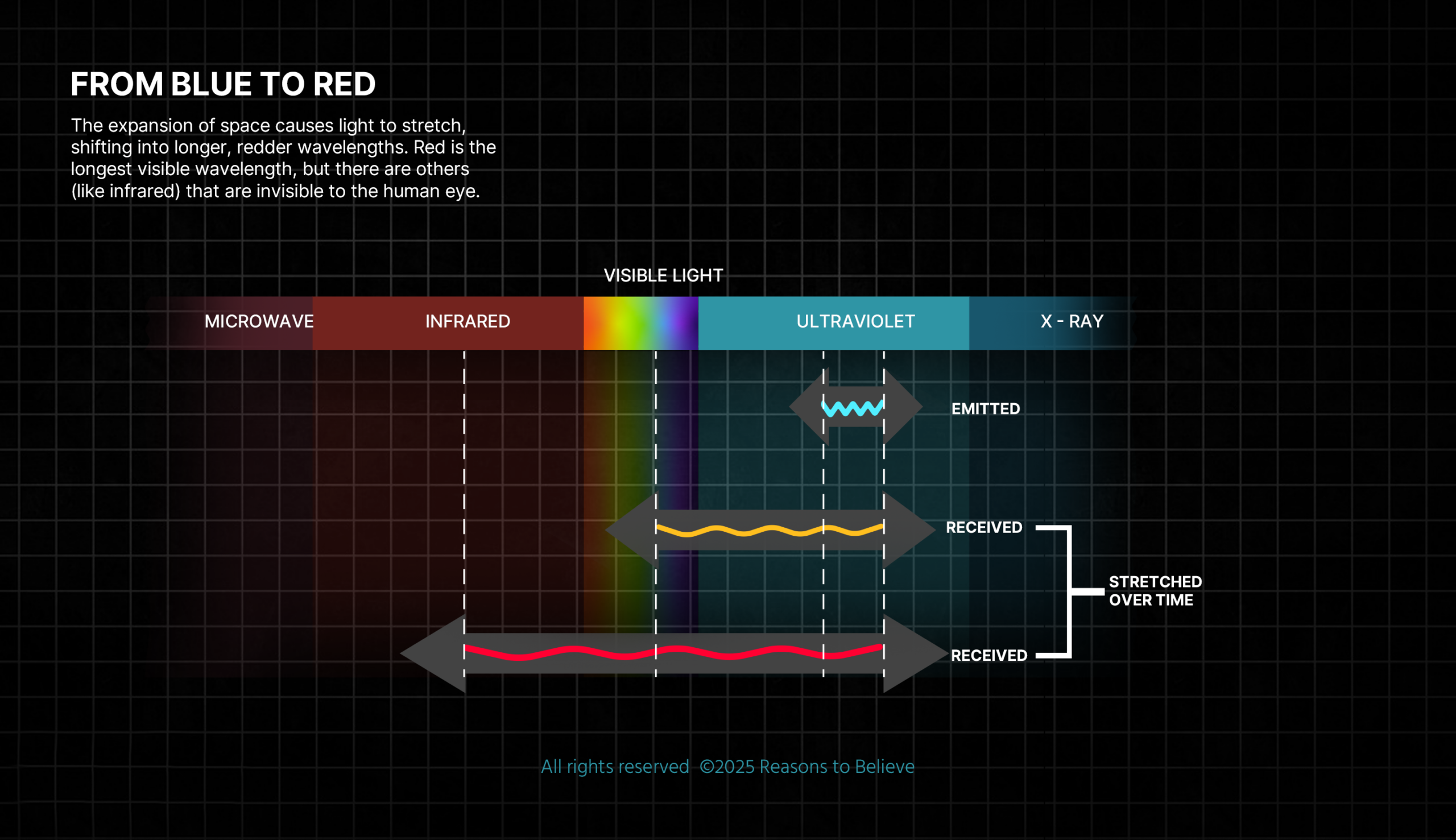
Astronomers recognize that when light is redshifted, it means those galaxies are moving away from us at velocities proportional to the redshifts. This understanding has helped scientists realize they could use the redshifted light evident in the spectra of galaxies to measure the cosmic expansion rate and therefore the universe’s age.
An example to help visualize this expansion is a balloon. Color a few dots on the surface of the balloon before inflating it, and then blow it up. You’ll see that all the dots move away from each other at rates proportional to the distances between the dots. Similarly, galaxies continue to move apart from each other in proportion to the distances separating them as the universe expands. This movement allows scientists to calculate the universe’s expansion rate by measuring the distances of galaxies and how fast they’re moving away from each other. And, if everything is moving away from everything else, then you can run the clock backward to discover when they all came together at the beginning of the universe.
Einstein’s theory of special relativity gives us yet another way to check the universe’s age. It tells us that the faster something moves away from us, the slower time passes for it relative to us — a phenomenon called time dilation. Think of it like a clock on a rocket ship: the faster the ship travels, the slower the clock ticks compared to one on Earth. Astronomers can observe this effect in distant stellar explosions called supernovae — the farther away they are, the longer they appear to last. This stretching of time across vast distances gives scientists another independent measurement indicating a universe 13.8 billion years old.
What Does the Bible Say About the Age of the Universe?
While it doesn’t provide a specific age for the universe, Scripture emphasizes the Creator’s power and purpose in bringing the cosmos into existence and gradually fashioning it and the earth into a suitable home for life and human beings in particular. Concerning Earth, it states that its mountains and rivers are ancient (Judges 5:21, Habakkuk 3:6, 2 Peter 3:5).
Christians disagree about how to interpret the creation days in Genesis 1. Some read them as consecutive 24-hour periods. Others point out that the seventh creation day in Genesis 1 is never closed with the phrase ‘evening was, morning was’ that ends each of the other days — suggesting that God’s seventh day is still ongoing. Both Psalm 95 and Hebrews 4 affirm that we are still in God’s seventh day. Genesis 2 also describes a long sequence of events between God creating Adam and Eve — events that suggest the passage of several months, not a few minutes at the end of a 24-hour day. For these reasons, many Christians interpret the Genesis 1 creation days as long time periods and find harmony between the scientific record and the Bible on the ages of the universe and Earth.
Biblical Narratives: The Origin of the Universe
The Bible contains several passages that describe the creation of the universe. Genesis 1:1 opens with the foundational statement: “In the beginning, God created the heavens and the earth.” Biblical Hebrew has no word for the universe. Instead, the phrase translated “the heavens and the earth” refers to all matter, energy, space, and time, that is, the universe. This verse establishes God as the ultimate source of all that exists. Beyond Genesis, other Bible verses talk about creation:
- Psalm 19:1: “The heavens declare the glory of God; the skies proclaim the work of his hands.”
- Job 38–41: God’s dialogue with Job highlights his sovereignty and wisdom beyond man’s in creating and sustaining the universe.
- Psalm 104: A poetic celebration of God’s provision and care for his creation.
- Hebrews 11:3: States that the universe that we can see and detect did not come from what we can see and detect.
- Revelation 21–22: A vision of the new heavens and new earth, pointing to God’s ultimate plan for his creation.
These passages remind us that the universe is not a random accident but the purposeful act of a loving Creator.
How Old Is Our Universe According to the Bible?
Christians often wonder how the Bible’s creation account compares to what we scientifically observe in the universe. If God is the author of both Scripture and creation, then the two should ultimately align. However, the Bible does not explicitly state how old the universe is. Instead, it leaves room for us to explore the universe’s age through science alongside Scripture.
The Creationism Perspective: Bridging Beliefs and Evidence
For Christians, the Bible and the natural world are both revelations of God to us. While the Bible primarily reveals God’s character and purpose and how we humans should live our lives and respond to God’s offer of salvation from our sin, the natural world primarily reflects his creativity, wisdom, power, love, and appreciation of beauty, elegance, and order. Together, they provide a collective picture of who God is, how his nature impacts his work, and his plans for humanity.
Let’s look at the three main views Christians hold about creationism and the age of the universe, recognizing that each view addresses related issues differently. Keep in mind, while these are general summaries highlighting the most common positions, individual views may vary.

Three Creationism Views
| YOUNG-EARTH CREATIONISM | OLD-EARTH CREATIONISM | EVOLUTIONARY CREATIONISM | |
|---|---|---|---|
| AGE OF THE UNIVERSE | 6,000–10,000 years | 13.8 billion years | 13.8 billion years |
| AGE OF THE EARTH | 6,000–10,000 years | 4.6 billion years | 4.6 billion years |
| GENESIS CREATION DAYS | Literal 24-hour “yom” days | Literal long “yom” days | Typically not literal, but allegorical/symbolic |
| ADAM & EVE | Real historical people Lived 6,000–10,000 years ago | Real historical people Lived 50,000–200,000 years ago | Typically not literal people, but allegorical/symbolic |
| GOD’S ACTIVITY | God did not use macroevolution God created quickly The fossil record formed rapidly from Noah’s flood | God did not use macroevolution God created over time The fossil record formed slowly through purposeful acts of creation and extinction | God used macroevolution God’s involvement was through the laws of physics with little to no intervention |
Young-Earth Creationism
Young-earth creationism holds that the earth and universe are 6,000 to 10,000 years old. The two primary reasons for this position come from a simple, particular literal reading of Genesis 1 and the interpretation of the Hebrew word yom to mean that the creation days in Genesis 1 are consecutive 24-hour periods.
Young-earth creationists (YECs) also see the various genealogies in Scripture as complete records of direct descendants, with no gaps, which they use to calculate a young age for the earth. YECs believe in a real, specially created Adam and Eve who lived 6,000 to 10,000 years ago from whom all humans are descended. Some YECs believe the universe and Earth are young but God created them with the appearance of age to account for scientific observations.
Old-Earth Creationism
Old-earth creationism accepts the scientific evidence that Earth is 4.6 billion years old and the universe is 13.8 billion years old. It views the fossil record as an accurate picture of God’s creation works and God-directed extinction events throughout history as part of his intimate intervention and ingenuity. While old-earth creationism affirms an ancient earth, it does not accept macroevolution. When looking at the creation days in Genesis, old-earth creationists (OECs) note that the Hebrew word yom has multiple, yet literal, meanings for “day,” just like many words in English do. One of those literal definitions is a long, finite period of time. OECs also believe in a historical Adam and Eve as the first two humans from whom all humans are descended, specially created by God 50,000 to 200,000 years ago.
Evolutionary Creationism
Evolutionary creationism (sometimes called theistic evolution) is the view that God created and designed the universe for life and humans in particular, but that God created life through the process of natural evolution — both macroevolution and microevolution. People who hold this view believe the universe is 13.8 billion years old and Earth is 4.6 billion years old. They affirm the theory of biological evolution, believing that God used it to bring about all the different life-forms we see today and all Earth’s past life evident in the fossil record. In this view, there’s a range of beliefs about how directly God was involved — some think he intervened at certain points, while others think he let natural processes unfold entirely on their own. Most evolutionary creationists see the early chapters of Genesis as symbolic or allegorical rather than literal or historical, and do not believe in a historical Adam and Eve. While evolutionary creationists and theistic evolutionists agree on much, evolutionary creationists are more emphatic that God actively directed and designed the universe and Earth for life, and they remain open to the possibility that God was directly responsible for the origin of life.
Which Creation View Is Correct?
So, for the age of the universe, the key difference between the three creation views is the time between the origin of the universe and the origin of humanity. Both old-earth creationism and evolutionary creationism argue the days of Genesis 1 are much longer than 24 hours. Therefore, a lot of time transpired from when God created the universe to when he created humans. For a young-earth creationist, the origin of humanity and the universe are separated by a few 24-hour days at most.
Without exception all the scientific evidence establishes that the universe is 13.8 billion years old, which is consistent with the old-earth and evolutionary creationist views. Young-earth creationists rest on their interpretation of Genesis to date the universe’s and Earth’s origins at 6,000 to 10,000 years ago. They then try to find ways to account for scientific evidence that indicates a much older age. Some young-earth creationists argue that the speed of light has slowed down to explain how astronomers see objects so far away. Others argue that light might move toward us with an infinite velocity. However, the light travel time from distant galaxies remains an impossible problem for young-earth creationists to solve.
The Universe’s Age and Our Understanding
Our exploration into how old the universe is reveals how scientific advancements, from redshift measurements to the cosmic microwave background, are used to show that the universe is 13.8 billion years old. We’ve also highlighted how the Bible’s creation account can harmonize with these findings, and we’ve considered different perspectives of young-earth, old-earth, and evolutionary creationism.
Regardless of what you’ve been taught, it’s OK to ask questions and explore—even challenge—what you believe. As Christians, we can be confident that science and faith go perfectly together — God’s world and God’s Word each revealing his glory.
May the exploration of both science and Scripture deepen your wonder at our Creator’s wisdom and power — and confirm that in him, faith and knowledge unite perfectly.
Explore our library of resources where Scripture and science meet. Download our free Genesis 1 ebook, written by Dr. Hugh Ross. Two books, The Creator and the Cosmos, 4th edition; A Matter of Days, 2nd edition provide a deep dive into the age of the universe.