

When it comes to the topic of dinosaurs and the Bible, there’s no shortage of questions. As humans, we’re fascinated by these incredible creatures. And while the understanding of dinosaurs in the Bible may not make a difference for our salvation, we can grow in our knowledge of God when we study and learn about all that he created.
With that in mind, we’ll tackle these eight questions in light of Scripture and the scientific evidence:
- What does the Bible say about dinosaurs?
- Did God create dinosaurs?
- Where are dinosaurs mentioned in the Bible?
- Did dinosaurs live with humans?
- Why did God create dinosaurs?Why would God kill the dinosaurs?
- Does this mean there was animal death before Adam and Eve’s fall?
- What killed the dinosaurs, according to the Bible?
Before We Talk Dinosaurs: Our Biblical Framework
At Reasons to Believe, we approach these questions from an old-earth creationist (OEC) perspective. Before we talk about dinosaurs, it helps to understand this view.
Old-earth creationism begins with a high regard for Scripture. We believe Genesis is a true historical account of creation and should be interpreted carefully in light of its original language and context.
We understand the six days of creation as real, ordered acts of God, but not necessarily limited to 24-hour days. This understanding is derived from the biblical text itself.
In the original Hebrew, the word translated “day” (yom) is used throughout Scripture to describe different lengths of time depending on context. Genesis gives clear boundaries to each creation day, but it does not require them to be equal in length or tied to Earth’s rotation.
In short, the old-earth view doesn’t reinterpret Scripture to fit science. It seeks to take both God’s Word and God’s world seriously.
It’s also important to clarify what this view does not affirm. While we hold that the earth is approximately 4.5 billion years old, we do not accept macroevolutionary theory. We believe God created humans—Adam and Eve—uniquely and directly in his image.
With that groundwork laid, let’s get to the fun!
What Does the Bible Say About Dinosaurs?
Like we mentioned, Genesis 1 is a historical account of God’s creative work. Yet, Genesis 1 is not an exhaustive description of creation. Instead, it offers snapshots of the creation story.
While the Bible describes many historical accounts, it doesn’t provide all-inclusive summaries of every historical event. God in his goodness gave every generation his inspired Word with precisely what we need to know for our salvation. Nothing less and nothing more.
With that in mind, you won’t find direct mention of dinosaurs in the Bible.
The Bible is ultimately about God’s redemptive plan for humanity. Since dinosaurs are not part of the salvation story, we shouldn’t worry about their absence from Scripture.
Nevertheless, these fascinating creatures are well worth exploring and learning about. As we discover more about all that God created, including the dinosaurs, we can learn more about who God is.

Did God Create Dinosaurs?
Even though you won’t find dinosaurs mentioned in the Bible, that doesn’t mean God didn’t create these magnificent creatures. It simply means dinosaurs didn’t make the highlight reel of Scripture. (And, yes, we’ll get to the mention of the Behemoth and Leviathan in the book of Job later!)
The scientific record tells us dinosaurs lived roughly 260 million years to 65 million years ago. For Christians, this could mean God created dinosaurs at the end of his fifth creation day or at the beginning of the sixth day before God created mankind.
Let’s review the Genesis 1 text on the days of creation, specifically when animal life began.
In Genesis 1:21–23 we read:
So God created the great creatures of the sea and every living thing with which the water teems and that moves about in it, according to their kinds, and every winged bird according to its kind. And God saw that it was good. God blessed them and said, “Be fruitful and increase in number and fill the water in the seas, and let the birds increase on the earth.” And there was evening, and there was morning—the fifth day.
This passage can be understood to mean that if there were dinosaurs who lived in water, God created these dinosaurs on the fifth day.
In Genesis 1:24–25, we learn that God created land animals (as well as mankind) on the sixth day of creation:
And God said, “Let the land produce living creatures according to their kinds: the livestock, the creatures that move along the ground, and the wild animals, each according to its kind.” And it was so. God made the wild animals according to their kinds, the livestock according to their kinds, and all the creatures that move along the ground according to their kinds. And God saw that it was good.
Scientifically we know there were three generations (or epochs) of dinosaurs. Let’s break these generations down in chronological order:
- Triassic
Appeared around 260–200 million years ago
Lived for 60 million years until they were wiped out during the Triassic-Jurassic extinction event - Jurassic
Appeared around 200–145 million years ago
Lived for 55 million years until they were wiped out during the Jurassic-Cretaceous extinction event - Cretaceous
Appeared around 145–66 million years ago
Lived for 80 million years until they were wiped out during the Cretaceous-Tertiary extinction event

Some people assume that spans of millions of years point to evolutionary theory. But that’s not what happened. In the above timeline, if dinosaurs were wiped out, then repopulated quickly and diversely, it leaves no time for complex evolutionary processes.
Where Are Dinosaurs Mentioned in the Bible?
Again, we don’t believe you’ll find mention of dinosaurs in the Bible. But let’s take a look at some passages in Scripture that are often thought to be dinosaur descriptions.
Behemoth and Leviathan in the Book of Job
It has long been speculated that the book of Job mentions dinosaurs through its descriptions of the Behemoth and Leviathan in Job 40 and 41.
Let’s review the text, paying close attention to the poetic descriptions used.
In Job 40:15–19 the Lord says to Job:
Look at Behemoth, which I made along with you and which feeds on grass like an ox. What strength it has in its loins, what power in the muscles of its belly! Its tail sways like a cedar; the sinews of its thighs are close-knit. Its bones are tubes of bronze, its limbs like rods of iron. It ranks first among the works of God, yet its Maker can approach it with his sword.
In Job 41:1–2; 12–15; 19–21, the Lord continues with a long description of the Leviathan:
(1–2) Can you pull in Leviathan with a fishhook or tie down its tongue with a rope? Can you put a cord through its nose or pierce its jaw with a hook? (12–15) I will not fail to speak of Leviathan’s limbs, its strength and its graceful form. Who can strip off its outer coat? Who can penetrate its double coat of armor? Who dares open the doors of its mouth, ringed about with fearsome teeth? Its back has rows of shields tightly sealed together; (19–21) Flames stream from its mouth; sparks of fire shoot out. Smoke pours from its nostrils as from a boiling pot over burning reeds. Its breath sets coals ablaze, and flames dart from its mouth.
Before the nineteenth century, Christians who read this passage believed the Behemoth and Leviathan poetically described the hippopotamus and crocodile, respectively.

It wasn’t until dinosaur fossils were first described in 1677 by Robert Plot that some people began to refer to these descriptions as dinosaurs. Examples include the Triceratops (known to be a plant eater) or Tyrannosaurus (known to be the most fearsome of the dinosaurs).
The difficulty with this interpretation is that no creatures on Earth—alive or extinct—literally fit these descriptions. For example, there is no known fire-breathing animal that had body parts of actual bronze and iron. It’s important to remember that Job 40 isn’t a zoological field guide; it’s a poetic reflection on God’s creative power.
There’s also a possibility that these fearsome beasts are a part of the supernatural realm and not creatures that commonly roamed Earth.
So why would God take the time to describe these beasts in such detail?
Ultimately to explain his command over everything! While Job could not fathom taming such creatures, God explains that he is the only One who has made and can tame his creation.
It ranks first among the works of God, yet its Maker can approach it with his sword (Job 40:19).
What an incredible Creator we worship!

Did Dinosaurs Live with Humans?
Since we hold an old-earth creationist view, we maintain that the days of creation were long periods of time (epochs, eras, eons). However, we do not hold to an evolutionary theory. With that in mind, we believe God likely created dinosaurs on the sixth day, but they died off millions of years before he created Adam and Eve later in that same creation period.
Therefore, we do not believe dinosaurs and humans lived at the same time.
Our perspective differs from fellow Christians who hold a young-earth creationist (YEC) view. The YEC viewpoint says that the earth is closer to 6,000 years old, which means they do believe dinosaurs and early humans coexisted. They also believe there were dinosaurs on Noah’s ark.
Our RTB scholars approach both Scripture and the fossil record with confidence that they’re in harmony. We don’t need to dismiss or reinterpret the fossil record to make it fit the Bible. While God certainly could have created dinosaurs to live alongside humans, Scripture does not require that conclusion, nor does the scientific evidence support it.
Instead, the fossil record reveals that dinosaurs played a distinct and purposeful role in Earth’s history long before humans appeared—one that fits coherently within God’s broader plan for creation. When understood together, both Scripture and science point to a timeline that’s faithful to the biblical text and grounded in the physical evidence God has left for us to study.
Why Did God Create Dinosaurs?
On the surface, some people might see God’s creation of the dinosaurs as unnecessary if he created them just to be wiped out by mass extinction events.
If dinosaurs were not included in Scripture, then what was God’s purpose for creating these incredible creatures?
According to the fossil record, more species of life came into existence before humans were created (which, from an old-earth perspective, is during God’s fifth and sixth days of creation). The fossil record provides confirmation that there were sudden appearances of new life-forms on Earth, which points to God’s direct involvement in creating new life throughout the fifth and sixth days.
This means there is both biblical and scientific evidence for God’s creative activity of animal life on the fifth and six days in Genesis 1.
Christians can trust that God makes himself known to all humanity through his incredible work in creation. God’s creation of dinosaurs not only demonstrates the awesomeness and artistry of our Creator, but also reveals attributes of God’s character.
Romans 1:20 tells us this about God’s handiwork in relation to his character:
For since the creation of the world God’s invisible qualities—his eternal power and divine nature—have been clearly seen, being understood from what has been made, so that people are without excuse.
This passage gives us confidence that continued scientific exploration of the world around us leads to a deeper understanding of our Creator. God’s creation, along with the discoveries we make within it, continually points to him as the designer and sustainer of the universe.
So, even though the Bible doesn’t directly mention dinosaurs, we can trust that God made dinosaurs as an opportunity for us to discover the greatness of his handiwork and to worship him.
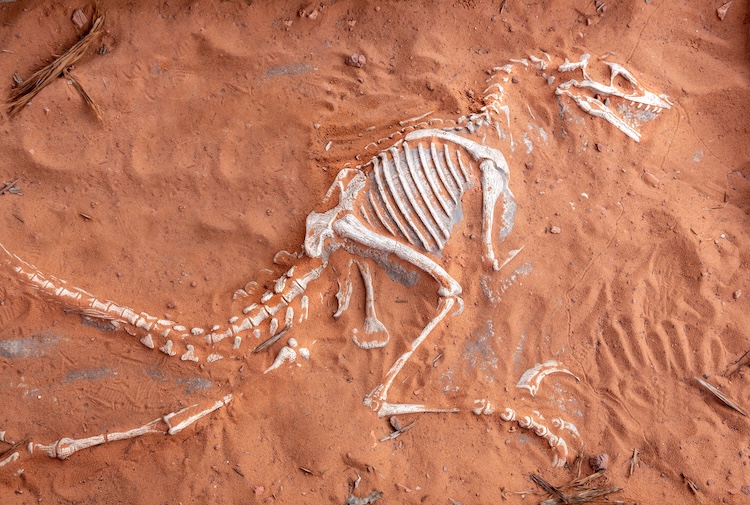
Why Would God Kill the Dinosaurs?
As Psalm 104:24–25 describes, God created animals in great quantity and with great diversity:
How many are your works, Lord! In wisdom you made them all; the earth is full of your creatures. There is the sea, vast and spacious, teeming with creatures beyond number—living things both large and small.
God filled the earth with the maximum quantity and diversity of life as the physical conditions on Earth permitted.
During the ages of the dinosaurs, shallow seas and tall trees on the continents permitted land animals as large as the dinosaurs. Today, Earth’s physical conditions do not allow a land animal any larger than an elephant to thrive.
It could also be that God’s creation and extinction of the dinosaurs was intended to keep Earth packed with the greatest possible biomass (organic matter used as fuel), biodiversity (the variety of life in an ecosystem), and biocomplexity (complex environments formed through many individual parts).
This endowment ensures that humans have all the biodeposits needed to launch and sustain a global high-tech civilization. It displays how God prepared the planet for humanity and provided for us even before the creation of Adam and Eve.
Reading further into Psalm 104:27–30, we find a general understanding of why God would create and then remove any life from Earth.
All creatures look to you to give them their food at the proper time. When you give it to them, they gather it up; when you open your hand, they are satisfied with good things. When you hide your face, they are terrified; when you take away their breath, they die and return to the dust. When you send your Spirit, they are created, and you renew the face of the ground.
From this passage, we find reason to praise God for his sovereignty over creation and for his provision for all life.
Genesis 1 also provides insight into why God would kill the dinosaurs. It describes the changing conditions in the universe and on Earth between God’s creative activity and today. The creation story agrees with scientific models that estimate it took almost 4.6 billion years for the earth to attain the environmental conditions that support life today.
This process could explain the extinction/creation cycles: life-forms became extinct due to a changing environment, and new life-forms adapted to the new conditions God created.
So then, how does the extinction of dinosaurs fit into God’s plan?
We know the purpose of all of Scripture is to tell the story of God’s redemption plan for human beings. The focus of Genesis 1 is the creation of humans—God’s image bearers and ultimate creation. Thus, the creation and death of such intermediate life-forms like dinosaurs may have been necessary to bring about habitable conditions for humans to live on Earth.
One example of this preparation that we see in nature is that scientists believe the extinction of dinosaurs resulted in petroleum: the lifeblood of today’s advanced society.
Going back to Psalm 104, if our interpretation is correct, then God’s inspired Word was once again ahead of humans’ scientific discovery in its description of our natural world. The harmony between the biblical accounts of creation and the fossil record gives us confidence that the Bible reveals truth about the natural realm.
Does This Mean There Was Animal Death Before the Fall of Adam and Eve?
If our biblical and scientific interpretations accurately portray an old earth (4.5 billion years old), then yes, there would have been animal death before Adam and Eve’s original sin in the garden.
The idea of animal death prior to the fall does concern YECs. From a young-earth view, the fall was the event that introduced death for all life-forms. In other words, prior to Adam and Eve’s sin, young-earth believers hold that there was no animal or human death.
At RTB we believe Scripture provides a clear explanation on the question of animal death before the fall. Here is one passage (of many) that provides an answer.
Romans 5:12–14:
Therefore, just as sin entered the world through one man, and death through sin, and in this way death came to all people, because all sinned—To be sure, sin was in the world before the law was given, but sin is not charged against anyone’s account where there is no law. Nevertheless, death reigned from the time of Adam to the time of Moses, even over those who did not sin by breaking a command, as did Adam, who is a pattern of the one to come.
Paul’s statement in Romans that death entered the world through Adam’s sin does not teach that death entered the nonhuman creation for the very first time after the fall. This becomes clear when interpreted in the context of the original Greek translation.
Romans 5 teaches us that the covenantal penalty of death, as the wages of human sin, began at the fall of Adam.
From this perspective, it makes it a bit easier to grasp why God would allow animals (even the dinosaurs) to die prior to the fall.
What Killed the Dinosaurs, According to the Bible?
If there’s no direct mention of dinosaur extinction in Scripture, we also don’t expect to find an explanation for the extinction of dinosaurs in the Bible.
We know scientifically that there were three generations of dinosaurs (Triassic, Jurassic, and Cretaceous) and each were wiped out by mass extinction events. While we can’t come to this conclusion through God’s inspired Word, we can learn about these extinction events through God’s record in nature.

God’s Sovereignty over Creation
As fun as it is to discuss the creation, purpose, and deaths of the dinosaurs, it’s even more amazing that no matter your conclusion, you can trust in God’s sovereignty.
If new discoveries of dinosaurs cropped up to prove either a young or old earth, our salvation as Christ-followers would remain unchanged.
If our OEC view is correct, then we should stand amazed at the foresight and creativity God exercises in his care for creation. We can especially marvel at his care for humans as he prepared and provided, millions of years in advance, a planet that was suitable for advanced human life.
We can praise God for the opportunity and curiosity that keeps us discovering more about him through our study of Scripture and his creation.
Looking for answers to other Old Testament questions? Check out our free ebook 10 Tough Questions from the Old Testament Answered.