
Easy Read
Microevolution vs. Macroevolution: Why the Difference Matters

Updated:
Published:
When it comes to the theory of evolution and understanding where plants, animals, and humans came from, some people picture a single-celled organism in Earth’s early ocean.
They imagine this cell changing form and function countless times over billions of years through microevolution and macroevolution. Eventually, it becomes an elephant roaming the plains of Africa or a towering redwood tree in the forests of California.
This is a bit jarring to think about. It implies humans—along with all other life-forms—came into existence without any special intervention by a Creator.
But is that what the scientific evidence tells us? Did all life on Earth come into being through a process of genetic mutation, with small changes leading to major transformations?
To answer these questions, you first need to understand the huge difference between microevolution vs. macroevolution.
So, let’s take a closer look and examine the evidence together. As we unpack this hotly debated topic, we’ll also explain why such radically different views on life’s origins exist.

What Is Evolution?
Before we dive into the differences between microevolution vs. macroevolution, it’s important to define our terms and cover some basics first.
What do people mean when they use the word “evolution”?
Well—it depends.
Evolution has become a blanket term used in many different contexts. In its most general definition, evolution simply means changes over time. There’s nothing controversial about that. From cars and technology to art and fashion, you can easily see many things evolving throughout history.
But in the world of science, evolution specifically refers to how natural things (not man-made or human directed) may have physically changed over time. It also includes the theory that evolution can explain the origin of entirely new species—complete with their own unique genetic blueprint that never existed before.
This is what brings us to the two main categories by which evolution is discussed: microevolution vs. macroevolution.
Let’s unpack each one.
What Is Microevolution?
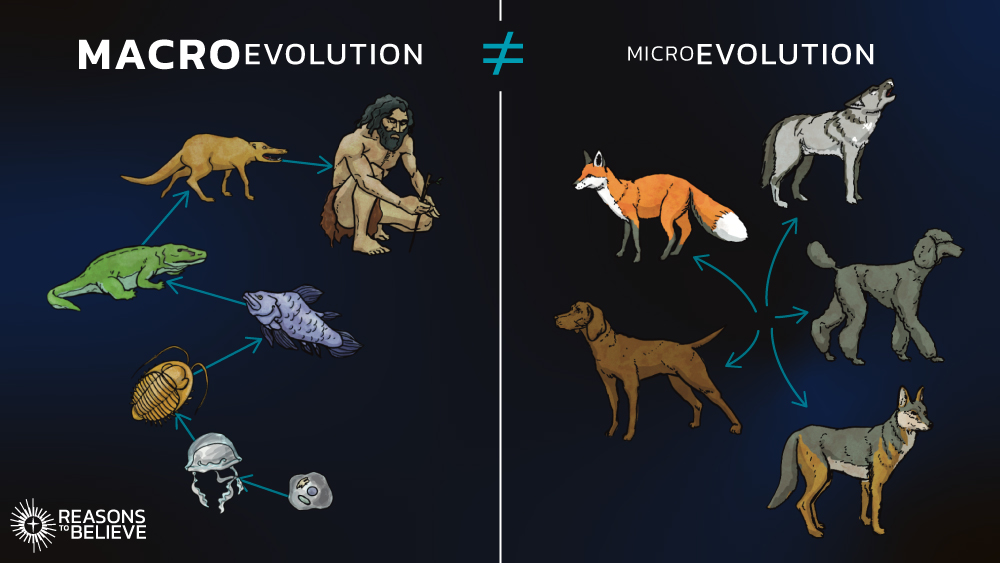
Microevolution definition: Small changes within a species or category.
Imagine walking into a garden filled with a hundred butterflies fluttering around. Some have hues of deep blue and black, while others have striking patterns in orange, white, red, purple, yellow, and everything in between.
You see some with sleek, streamlined wings shaped for speed and others with delicate, almost lace-like edges.
Then, you lean against a tree and notice something next to you moving slightly—it’s a gray-brown butterfly perfectly camouflage against the bark.
Each butterfly is like a tiny piece of art, illustrating the incredible diversity in color, shape, and size within their category of insects.


Each of these butterflies is a different species. That’s why their wing colors and patterns are so different. But if you closely examine butterflies from the same species, like monarch butterflies, they display small variations, too.
The differences you see in the monarch butterflies are evidence of microevolution on display. These small changes—often referred to as genetic variations or mutations—occur by changing the DNA or by combining existing genes in new ways within a species.
These changes can happen in a short period of time, such as a span of days with bacteria, or many years, depending on the species. Often, these small changes are observable within a human lifetime
This is what makes microevolution an undisputed fact, unlike macroevolution.
Is There Evidence of Microevolution?

Yes, researchers have made many direct and often repeatable observations of microevolutionary changes under many conditions in the wild and in labs.
An example of this change can be seen in lab studies on bacteria. Since bacteria can multiply very rapidly, scientists can observe their DNA changing to become more resistant to antibiotics. These microscopic organisms are the ultimate survival experts, constantly adapting to new challenges.
In the lab, scientists expose bacteria to antibiotics and watch their response. Initially, antibiotics may kill most bacteria, but a few hardy survivors carry traits that make them resistant. These traits are passed on and over time the entire population can become resistant, making antibiotics less effective. That’s microevolution in action, right there in the petri dish!
Keep in mind, this direct and repeatable observational evidence for microevolution does not exist in macroevolution. We’ll get to that in a bit.

How Does Microevolution Happen?
As a species goes through small changes—due to random mutations in their DNA, external changes in their environment, or natural selection—certain groups may eventually survive better than others.
For example, going back to our butterflies, if a certain wing pattern or color helps it blend in more easily with its surroundings, it’s less likely to be eaten by birds. So, the butterflies with helpful patterns or colors are more likely to survive and pass on their genes to the next generation.

What Is Macroevolution?
Macroevolution definition: Major changes over a long period of time that produce an entirely new species or category.
For the most part, when people talk about evolution in science, they’re typically referring to macroevolution—the change from one major group or category of living things into another over millions of years.
Macroevolution is the grand saga in the theory of evolution. It’s when an entirely new species pops up or many new species branch off from a common ancestor. It’s the assumption that, if microevolution is true and you give it enough time, those small changes will add up to major transformations.

Look familiar? You may recognize this from your high school biology class. It implies that you have a great-great-great-grand-apelike ancestor who, after millions of years, gave rise to a variety of species, including humans.
While this is a very popular illustration (which you’ve probably seen in one way or another), you need to know that there are several problems with the theory of macroevolution. Let’s examine the evidence together.
Is There Evidence of Macroevolution?
Unlike microevolution, macroevolution is not observable or conclusive.
Since there’s no direct evidence of one major group becoming a different major group, evolutionary scientists are making a hypothesis—a proposed explanation. Below are a few of their claims and the problems with each.

The Fossil Record
Claim: The fossil record shows a sequence of changes in species over millions of years, such as small, furry land mammals evolving into modern-day whales.
Problem: There are significant gaps in the fossil record. Transitional fossils, which should show the gradual evolution of one species into another, are extremely rare. For example, fossils like Tiktaalik that are often cited as transitional forms, are exceptions rather than the rule.
What we see most often in the fossil record is the sudden appearance of fully formed species without clear transitional forms. This contradicts the smooth, continuous process over millions of years suggested by macroevolution.

Genetic Studies
Claim: Genetic studies show similarities in DNA between different species, suggesting they share common ancestors (aka common descent).
Problem #1: The similarities we see in anatomy and genetics, which are often presented as evidence for common ancestors, can also be interpreted as evidence of common design. This means we have a common Designer (our Creator: God) who used similar structures and genetic codes across different forms of life.
Problem #2: Macroevolution would require extensive genetic changes to lead to new structures, functions, and entirely new species. This type of complex genetic reorganization, occurring purely through natural processes, has never been seen. Additionally, when you look at laboratory creatures—where humans are trying to force macro changes in DNA—it’s always catastrophic, leading to the creation of organisms that are badly deformed.
Microevolution to Macroevolution
Claim: Millions of years of microevolution will eventually lead to macroevolution.
Problem: This claim is an overreach. Since scientists don’t fully understand how an organism’s genetic makeup (genotype) influences its biological traits (phenotype), no one can claim to know how much time is required for supposed macroevolutionary changes. It’s like trying to predict how long it would take to build a mansion without a clear blueprint or knowing how all the materials work together.
In other words, the lack of evidence for the theory of macroevolution is too significant to dismiss. Without enough proof to build the case, we can’t accept that one major group becomes another major group as a natural process. That would require a huge leap of faith.
What’s the Difference Between Microevolution and Macroevolution?
The biggest and most obvious difference between micro and macroevolution is that microevolution results in variations within kinds of creatures, while macroevolution supposedly produces new kinds of creatures.
Here’s a breakdown of the differences:
| Microevolution | Macroevolution | |
|---|---|---|
| Definition | Small-scale changes within a species | Large-scale changes that supposedly result in the formation of new groups |
| Can we see it? | Yes, often directly observable in real-time or within a human lifetime | No |
| How long does it take? | Days, months, years, thousands of years | Supposedly millions of years |
| How does it happen? | Natural selection, genetic drift, gene flow, mutation | Supposedly through multiple microevolutionary changes in morphology, behavior, etc. |
| What evidence do we have? | Lab experiments, field studies, genetic analysis | No direct evidence. Assumptions from fossils, comparative anatomy, and molecular phylogenetics |
| Examples | Antibiotic resistance in bacteria, peppered moth color changes | No observable examples. Supposedly evolution of birds from theropod dinosaurs and diversification of mammals after the extinction of dinosaurs |
| What’s the final result? | Diversity within a species, adaptations to local environments, minor morphological changes | Supposedly the emergence of new groups |

Does Microevolution Lead to Macroevolution?
The assumption that microevolution leads to macroevolution requires physical evidence to prove that it’s true and possible.
As we mentioned above, macroevolution—the idea that evolutionary changes result in entirely new species—is not based on direct observation or repeatable experiments that demonstrate its validity.
Instead, it’s more like trying to complete a puzzle with only a few pieces. Imagine having a small section of a puzzle—just enough to form a partial picture. From those few pieces, you might guess what the full image is, but without all the pieces, you can’t be sure if your guess is accurate.
In the case of microevolution, scientists have the puzzle pieces and can clearly see how they fit together.
But with macroevolution, many critical pieces are missing. Despite this fact, some proponents of macroevolution take these few scattered pieces and try to force them into a narrative that excludes God, suggesting that life evolved without a Creator.
While the gaps in evidence may lead some to speculate how different species arose, we, as old-earth creationists, see a perfect alignment with Scripture. The sudden appearance of fully formed species without clear transitional forms is evidence of a masterful Designer creating.

God and Evolution: What Does the Bible Say?
It’s no surprise, but there’s a case to support microevolution vs. macroevolution in the Bible.
We find consistency with microevolution in the Scriptures when it mentions variations within “kinds” in Genesis 1:11–24, as well as the account of Jacob doing selective breeding to improve the number of his flock (Genesis 30:25–43).
Jacob basically created a “lab” field for the microevolution of his flock. The Bible is explicit on this as it describes microevolution!
However, macroevolution doesn’t appear in the Bible. There are no implications that the largest kinds of creatures evolved continuously into or from other large kinds of creatures.
What Scripture does state clearly is that God directly and supernaturally made each category of creature “after its own kind” (Genesis 1:11–24).
The Bible never describes a fish becoming an elephant, and monkeys certainly didn’t macroevolutionize to humans.
This is key because we ask these questions to ultimately answer our life’s origin.
And the natural reading of the Genesis account is that man is created de novo (anew, afresh, or fully formed). Genesis 2:7 implies God created us from inanimate matter (lifeless dust) rather than from an earlier animate creature (like the great apes).
There would be no need for a divine Creator to cause man’s existence if macroevolution is simply a natural and chance process of random mutation and natural selection, which ultimately would deny human exceptionalism.
At the end of the day, holding to macroevolution leaves no room for God.
Belonging to Him
There’s no doubt that creation reveals God’s love for us. And as we study microevolution, we see the intricacies that allow adaptations within kinds—without compromising the uniqueness of each creature’s category.
This view puts God in his rightful place as the infinitely creative mind behind our entire universe.
He has shown us his existence, character, and eternal power through creation, and it compels us to be in awe of his love for details, design, and beauty.
Ultimately, we’re accountable to him as we’re made uniquely in his image, set apart from all other creatures.
For a deeper discussion on evolution, check out our RTB books Who Was Adam? and Thinking About Evolution: 25 Questions Christians Want Answered.